
What is the Volts to Amps Calculator?
This calculator converts voltage (volts) into electric current (amperes) using one of two fundamental electrical relationships. If you know the power being consumed, it uses \(I = P / V\). If you know the circuit resistance, it applies Ohm's law, \(I = V / R\). It works for any DC circuit and for simple resistive AC loads at unity power factor.
How to use it
Pick a calculation method. To convert using power, enter the voltage in volts and the power in watts. To convert using resistance, enter the voltage in volts and the resistance in ohms. The calculator returns the current in amperes.
The formula explained
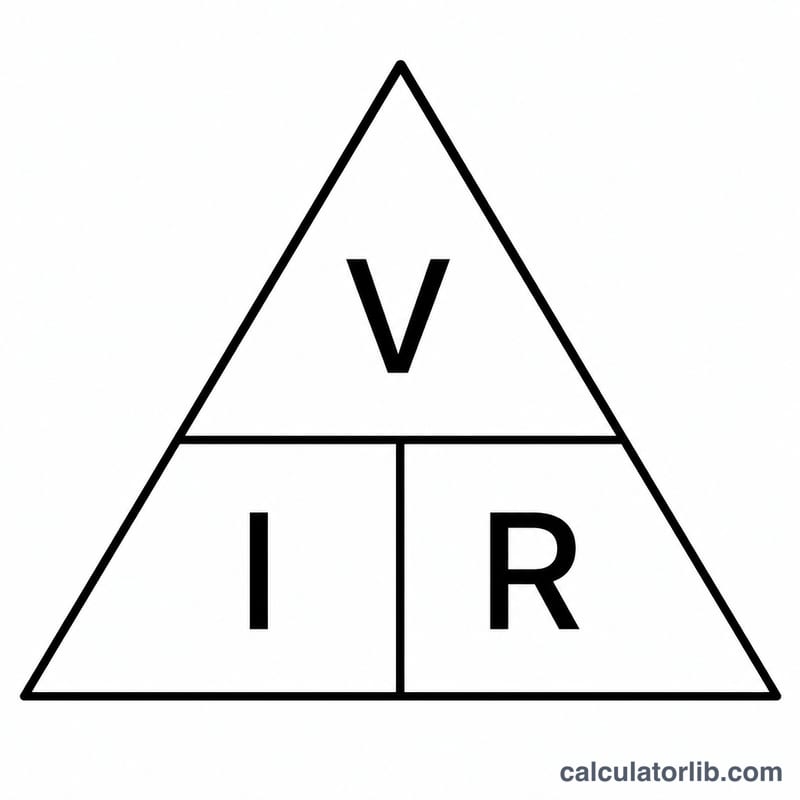
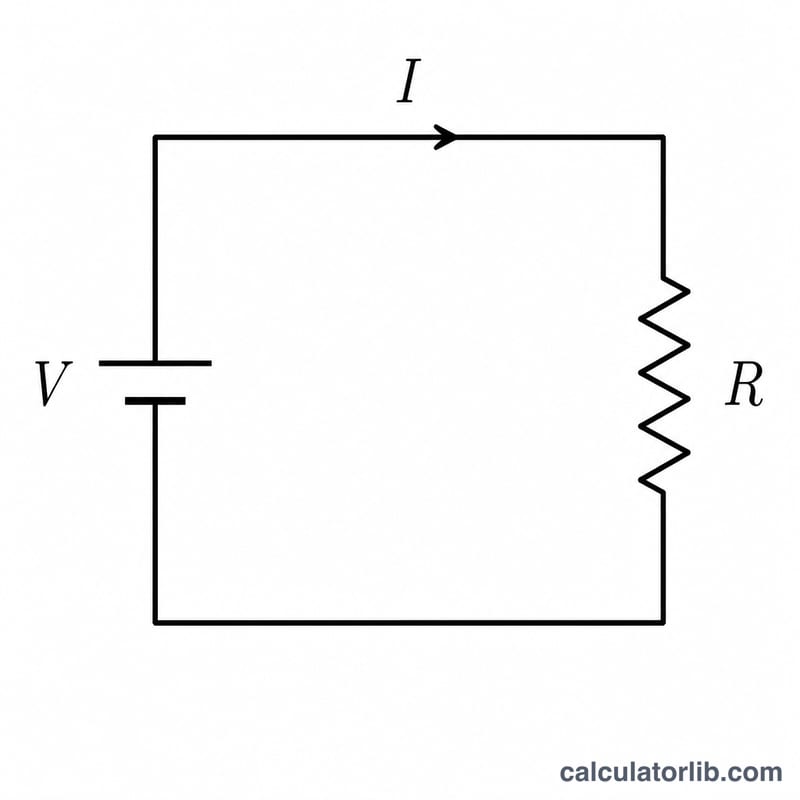
Electric current is the rate of charge flow. Power is the product of voltage and current (\(P = V \times I\)), so rearranging gives current as power divided by voltage: $$I = \frac{P}{V}$$ Ohm's law states that voltage across a resistor equals current times resistance (\(V = I \times R\)), which rearranges to $$I = \frac{V}{R}$$ Both express how many amperes flow for a given voltage.
Worked example
A 60-watt bulb runs on a 120-volt supply. Using $$I = \frac{P}{V} = \frac{60}{120} = 0.5\ \text{A}$$ Alternatively, a 12-volt source across a 4-ohm resistor draws $$I = \frac{V}{R} = \frac{12}{4} = 3\ \text{A}$$
FAQ
Can I convert volts to amps directly? No — voltage alone is not enough. You also need either the power (watts) or the resistance (ohms) of the circuit.
Does this work for AC? For resistive loads at unity power factor it is accurate. For inductive or capacitive loads you must include the power factor (\(I = P / (V \times PF)\)).
What if voltage is zero? Dividing by zero is undefined, so the calculator returns 0 — enter a real supply voltage for a meaningful result.