
What Is Equity Dilution?
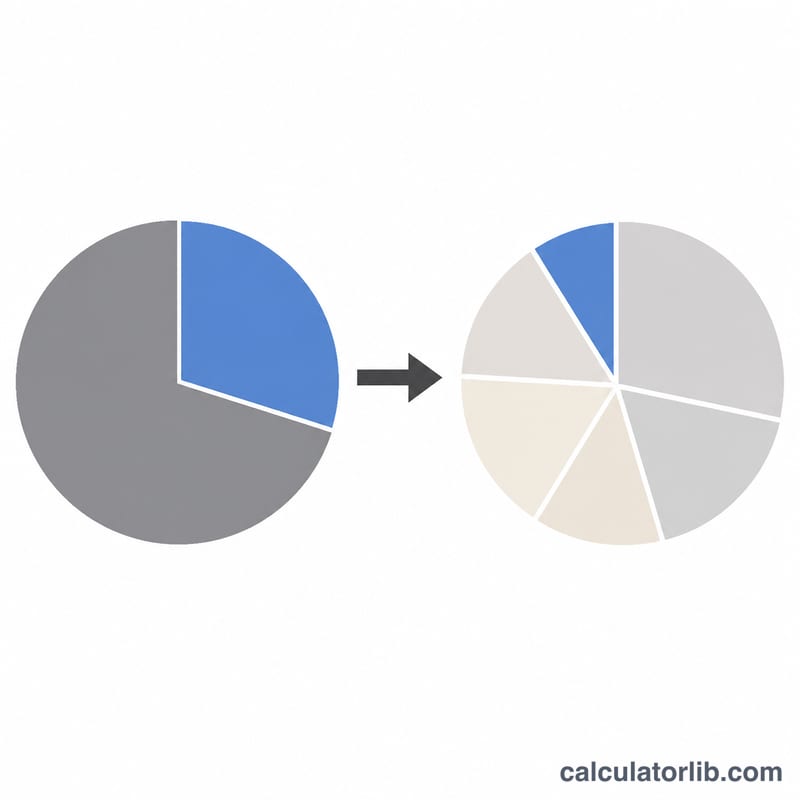
Equity dilution happens when a company issues new shares — typically in a funding round, an employee stock option pool expansion, or a convertible note conversion. Because the total number of shares grows but your share count stays the same, your percentage of ownership shrinks. This calculator shows exactly how much of the company you own before and after new shares are issued.
How to Use the Calculator
Enter three numbers: your current shares, the total shares outstanding before the new round, and the number of new shares the company plans to issue. The tool returns your new ownership percentage, the percentage points you lose, and your relative dilution.
The Formula Explained
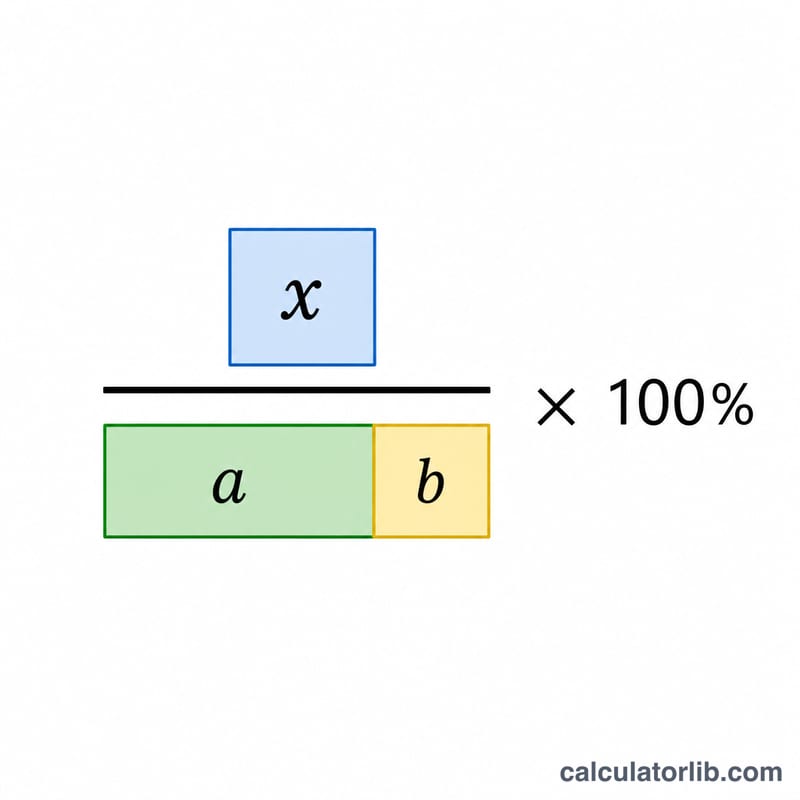
Ownership is always your shares divided by the total share count. Before the round your stake is Your Shares ÷ Total Shares. After the round the denominator grows by the new shares issued: Your Shares ÷ (Total Shares + New Shares Issued). The difference between the two is your dilution.
$$\text{New Ownership \%} = \frac{\text{Your Shares}}{\text{Total Shares} + \text{New Shares}} \times 100$$
$$\begin{gathered} \text{New \%} = \frac{\text{Your Shares}}{\text{Total Shares} + \text{New Shares}} \times 100 \\[1.5em] \text{where}\quad \left\{ \begin{aligned} \text{Old \%} &= \frac{\text{Your Shares}}{\text{Total Shares}} \times 100 \\ \text{Dilution \%} &= \frac{\text{Old \%} - \text{New \%}}{\text{Old \%}} \times 100 \end{aligned} \right. \end{gathered}$$
Worked Example
Suppose you hold 100,000 shares of a startup with 1,000,000 shares outstanding — a 10% stake. The company raises a round and issues 250,000 new shares, bringing the total to 1,250,000. Your ownership is now \(100{,}000 \div 1{,}250{,}000 = 8\%\). You were diluted by 2 percentage points, a 20% relative reduction in your stake.
FAQ
Does dilution reduce the value of my shares? Not necessarily. If the company raises capital at a higher valuation, a smaller percentage can still be worth more in dollar terms.
What is relative dilution? It is the percentage points lost divided by your original ownership — in the example above, \(2 / 10 = 20\%\). It tells you how big the hit is relative to where you started.
Should I include the option pool? Yes. If new options or a pool top-up are part of the round, count those shares in "New Shares Issued" to see your fully-diluted result.