
What Is a CPM Calculator?
CPM stands for "cost per mille" — the cost per 1,000 ad impressions (an impression is one display of your ad). It is one of the most common pricing and benchmarking metrics in digital and traditional advertising worldwide. This calculator takes two simple numbers — your total ad spend and the number of impressions you received — and returns your CPM, so you can compare campaigns, platforms or placements on a like-for-like basis.
How to Use It
You only need to fill in two fields:
- Ad Cost — the total amount you spent on the campaign or placement.
- Number of Impressions — how many times the ad was shown (a whole number).
The tool then displays your CPM along with a recap of the total spend and total impressions you entered, so you can sanity-check the inputs at a glance.
The Formula
The calculation is straightforward:
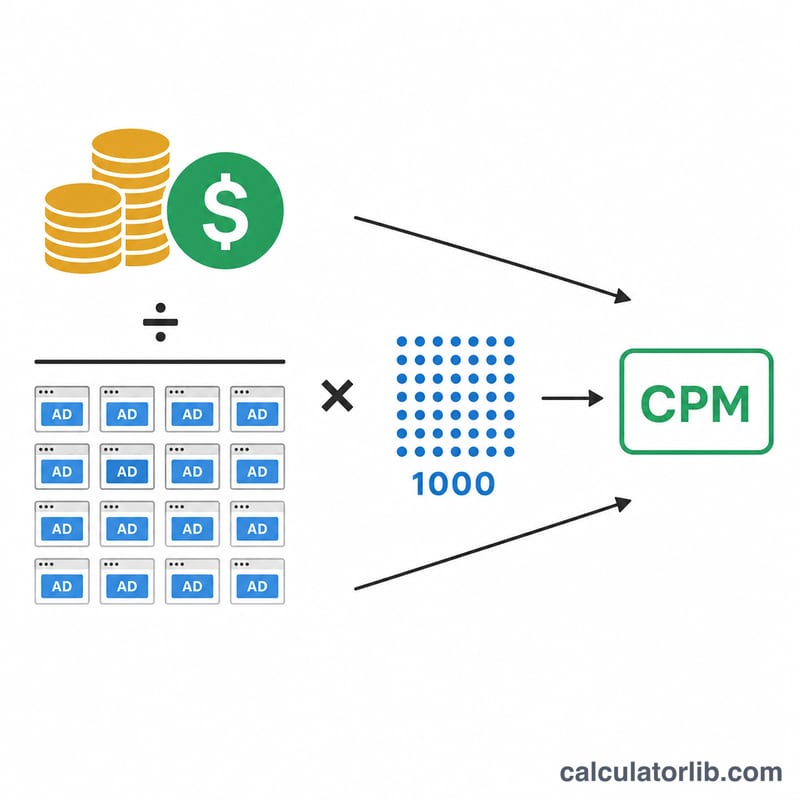
CPM = (Ad Cost ÷ Impressions) × 1,000
The calculator divides your cost by the number of impressions to get the cost of a single impression, then multiplies by 1,000 to express it per thousand. If impressions are zero (or blank), the result is simply shown as 0 to avoid dividing by nothing. The cost values are formatted in your local currency.
Worked Example
Suppose you spent $500 on a display campaign that earned 250,000 impressions:
- $500 ÷ 250,000 = $0.002 per impression
- $0.002 × 1,000 = $2.00 CPM
So you paid $2.00 for every thousand times your ad appeared. Lowering the cost or earning more impressions for the same spend would push the CPM down.
Frequently Asked Questions
Is a lower CPM always better? Generally a lower CPM means cheaper exposure, but cheap impressions are worthless if they reach the wrong audience. Always weigh CPM against engagement and conversions.
What's the difference between CPM and CPC? CPM charges per thousand impressions (views), while CPC charges per click. CPM suits awareness campaigns; CPC suits direct-response goals.
What counts as a good CPM? It varies enormously by platform, country, audience and season. Use this calculator to benchmark your own campaigns against each other rather than chasing a single "ideal" number.