What the eCPM Calculator Does
eCPM stands for effective cost per mille — your earnings for every 1,000 ad impressions served. This calculator takes two numbers you already have from your ad dashboard and turns them into a single, comparable benchmark. It is unit-agnostic, so it works equally well whether your revenue is in dollars, euros, pounds or any other currency; the result simply comes back in the same currency you entered.
It is especially useful for publishers, app developers and media buyers who run ads across multiple networks (Google AdSense, AdMob, programmatic exchanges, direct deals) and need a standard way to compare how much each one actually pays per thousand views.
How to Use It
There are only two input fields:
- Total Revenue — the total money earned from the ads over a chosen period.
- Number of Impressions — how many times the ads were displayed in that same period.
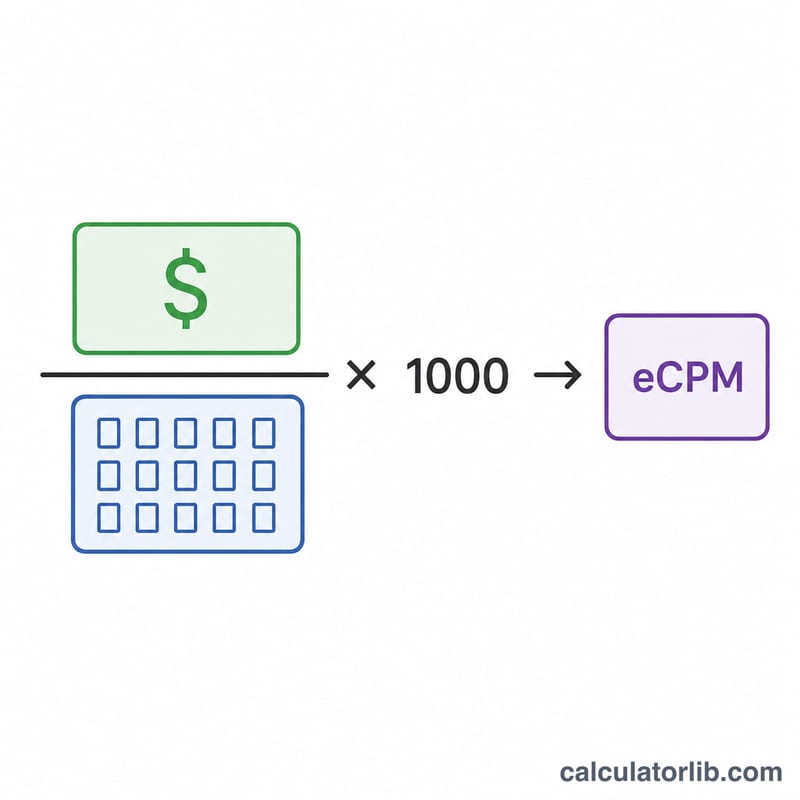
Enter both values for the same time window (a day, a week or a month) so the eCPM is meaningful. The calculator divides revenue by impressions and multiplies by 1,000. If you leave impressions at zero, the result stays at 0 to avoid dividing by zero.
The Formula Explained
The calculation is straightforward:
$$\text{eCPM} = \frac{\text{Total Revenue}}{\text{Impressions}} \times 1000$$Dividing revenue by impressions gives the value of a single impression; multiplying by 1,000 scales it to the industry-standard "per mille" (per thousand) unit, which makes small per-impression figures easier to read and compare.
Worked Example
Suppose a blog earned $450 in advertising revenue last month and served 180,000 impressions.
- Revenue per impression: \(450 \div 180{,}000 = 0.0025\)
- eCPM: \(0.0025 \times 1{,}000 = \mathbf{\$2.50}\)
So the site earns $2.50 for every 1,000 impressions. If another ad network reports an eCPM of $3.10 for the same content, it is paying more per view.
Interpreting Your eCPM Result
A higher eCPM means each 1,000 impressions generated more revenue; a lower eCPM means they generated less. It is a rate, not a total, so it lets you compare ad units, pages, campaigns or periods of different sizes. A change in eCPM does not by itself tell you why it changed.
Factors that commonly affect eCPM
- Ad format: video, native and large formats often earn different rates than small banners.
- Geography: advertisers typically pay more to reach audiences in some countries than in others.
- Niche: categories such as finance, software or B2B tend to attract different advertiser budgets than general entertainment.
- Seasonality: advertising demand usually rises in Q4 (holiday shopping) and often drops in early Q1.
- Viewability: ads that are actually seen are generally valued more by buyers.
- Fill rate: unfilled or low-value filled impressions can pull the average down.
- Device: desktop, mobile web and in-app inventory are often priced differently.
What eCPM blends together
eCPM combines revenue from different pricing models: CPM (paid per thousand impressions), CPC (paid per click) and CPA (paid per action). Click- or action-based revenue is converted into an equivalent per-1,000-impression figure, so a change in click-through or conversion rate can move eCPM even when CPM prices stay the same.
Cautions
- eCPM is based on impressions, not pageviews. A page with several ad slots can have many impressions per pageview.
- Compare eCPM over the same period and for the same ad format; mixing formats or comparing a holiday week with a quiet week can be misleading.
- Small impression counts produce volatile results; larger samples are more reliable.
This is general information about how the metric works, not advice for any specific situation.
Key Terms: CPM, eCPM, RPM, CPC and Impressions
- Impression
- One instance of an ad being displayed (served or rendered, depending on the platform's counting method).
- CPM (cost per mille)
- A pricing model where an advertiser pays a set amount per 1,000 impressions.
- eCPM (effective CPM)
- Total revenue divided by impressions, multiplied by 1,000. It expresses earnings from any pricing model as an equivalent per-1,000-impression rate.
- RPM (revenue per mille)
- Revenue per 1,000 pageviews or sessions (definitions vary by platform), covering all ad units on those pageviews or sessions.
- CPC (cost per click)
- A pricing model where the advertiser pays each time a user clicks the ad.
- CPA (cost per action)
- A pricing model where payment is triggered by a defined action, such as a purchase, sign-up or install.
- Fill rate
- The percentage of ad requests that return an ad: \(\text{Fill rate} = \frac{\text{Filled impressions}}{\text{Ad requests}} \times 100\%\).
eCPM vs. RPM
Both are scaled to 1,000, but the denominator differs. eCPM divides by ad impressions and describes how well ad inventory is monetized. RPM divides by pageviews or sessions and describes how much a page or visit earns overall. A page with three ad slots can have a modest eCPM but a high RPM because it shows more impressions per pageview.
Frequently Asked Questions
What's the difference between eCPM and CPM? CPM is the price an advertiser agrees to pay per 1,000 impressions, set in advance. eCPM is calculated after the fact from actual earnings, blending all revenue sources (CPM, CPC, CPA) into one effective rate.
What is a good eCPM? It varies widely by niche, format, geography and traffic quality — display ads often sit between $0.50 and $5, while video can be much higher. Use eCPM to compare your own channels rather than chasing a universal target.
How can I raise my eCPM? Improve ad placement and viewability, target higher-value audiences, test different ad formats, and reduce low-paying filler inventory so each impression earns more.