
What the tCPL Calculator Does
The tCPL (target cost per lead) Calculator helps marketers and business owners work out the maximum amount they can afford to pay for a single lead while still protecting their profit. Instead of guessing your lead budget, you enter four numbers and the tool returns your allowable cost per lead plus useful intermediate figures like profit per sale and total expected sales. This makes it easy to set realistic budgets for ad campaigns, lead-gen agencies, or sales funnels. The calculator is currency-neutral, so it works for any country—just use your own currency for revenue.
The Inputs You Enter
- Total Revenue: the revenue you expect from your campaign or sales period.
- Profit Margin (%): the share of revenue you keep as profit after costs.
- Close Rate (%): the percentage of leads that convert into paying customers.
- Number of Leads: the total leads generated or planned.
The Formula Explained
The calculator first works out the building blocks, then combines them:
$$\begin{gathered} \text{tCPL} = \frac{\text{Profit}}{\text{Sales}} \times \frac{\text{Close Rate}}{100} \\[1.5em] \text{where}\quad \left\{ \begin{aligned} \text{Profit} &= \text{Revenue} \times \frac{\text{Profit Margin}}{100} \\ \text{Sales} &= \text{Leads} \times \frac{\text{Close Rate}}{100} \end{aligned} \right. \end{gathered}$$- Profit = \(\text{Revenue} \times (\text{Profit Margin} \div 100)\)
- Sales = \(\text{Leads} \times (\text{Close Rate} \div 100)\)
- Profit per Sale = \(\text{Profit} \div \text{Sales}\)
- Target CPL = \(\text{Profit per Sale} \times (\text{Close Rate} \div 100)\)
In short, your allowable cost per lead is the profit each sale earns, scaled down by the close rate—because not every lead becomes a sale, each lead is "worth" only the profit per sale multiplied by the probability it converts.
Worked Example
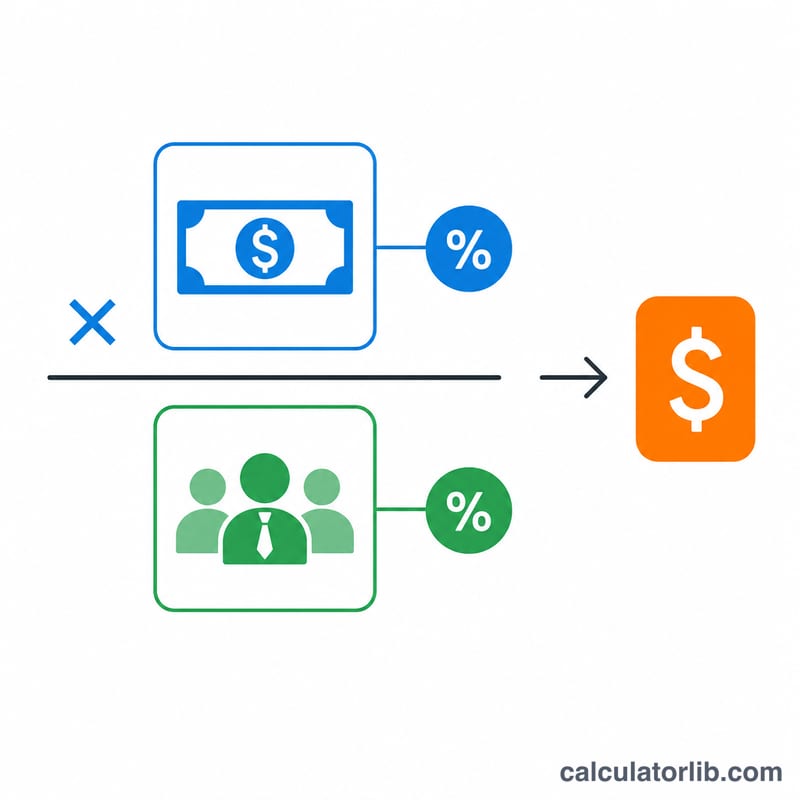
Suppose you generate $100,000 revenue, a 20% profit margin, a 10% close rate, and 500 leads.
- Profit = \(\$100{,}000 \times 0.20 = \$20{,}000\)
- Sales = \(500 \times 0.10 = 50\)
- Profit per Sale = \(\$20{,}000 \div 50 = \$400\)
- Target CPL = \(\$400 \times 0.10 = \$40\)
So you can afford to spend up to $40 per lead before that lead source stops being profitable.
Frequently Asked Questions
Why multiply by the close rate twice? The close rate is used once to count actual sales, and again to weight each lead's value—since only a fraction of leads convert, an individual lead is worth its converted profit times its conversion probability.
What if my actual CPL is higher than the target? Paying more than your tCPL means each lead costs more than it returns, eroding profit. Lower your cost, improve your close rate, or raise your margin.
Does the number of leads change the result? Yes—more leads spread the same total profit across more sales, lowering profit per sale and therefore the target CPL.