
What the CPA Calculator Does
The CPA Calculator works out your Cost Per Acquisition — the average amount you spend to win one customer, lead or conversion from a marketing campaign. It takes two numbers you already have in your ad dashboard and returns a single, clear figure you can use to judge whether a campaign is profitable. CPA is one of the core metrics in digital advertising on platforms like Google Ads, Meta Ads and TikTok, and it works the same way in any currency.
The Inputs You Enter
- Total Ad Spend: the full amount you paid for the campaign over the period you are measuring (for example, the monthly spend on a Google Ads campaign).
- Number of Acquisitions: how many conversions that spend produced — purchases, sign-ups, bookings or whatever you count as a win.
The Formula
The calculation is simply:
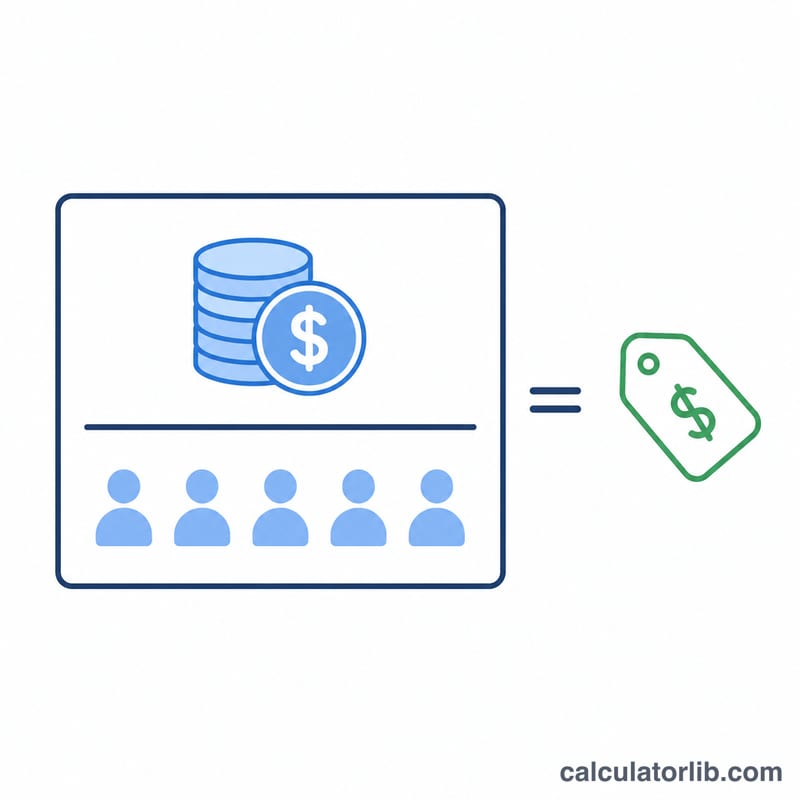
$$\text{CPA} = \frac{\text{Total Cost}}{\text{Conversions}}$$
Behind the scenes the tool reads your Total Ad Spend as a decimal and your Number of Acquisitions as a whole number, then divides one by the other. There is one important safeguard: if the number of acquisitions is zero (or blank), the calculator returns a CPA of 0 rather than dividing by zero. You must record at least one acquisition to get a meaningful result.
Worked Example
Suppose you spent 2,000 on a campaign and generated 50 sales:
- $$\text{CPA} = 2{,}000 \div 50 = 40 \text{ per acquisition.}$$
If you compare two campaigns — one at a CPA of 40 and another at 65 — the lower-CPA campaign is acquiring customers more efficiently, assuming the customers are of similar value.
Interpreting Your CPA Result
CPA (cost per acquisition) is total ad spend divided by the number of acquisitions: \(\text{CPA} = \frac{ \text{Total Ad Spend}}{ \text{Acquisitions}}\). The number alone does not say whether a campaign is good or bad. It needs to be read against what an acquisition is worth to the business.
Compare CPA with profit per customer or LTV
- Break-even CPA equals the profit you earn per customer (revenue minus the cost of delivering the product or service). At that CPA, ad spend is exactly recovered.
- A CPA below break-even means each acquisition earns more than it cost, so the campaign is profitable on that basis.
- A CPA above break-even means each acquisition costs more than it earns, so the campaign loses money on that basis.
- If customers buy repeatedly, the relevant profit figure may be customer lifetime value (LTV) rather than first-order profit. The break-even CPA is then higher, but the cash is recovered more slowly.
Example: if the profit per customer is $80 and the CPA is $50, each acquisition leaves $80 − $50 = $30 of margin. If the CPA is $100, each acquisition produces a $20 shortfall.
How CPA relates to other metrics
- CPC and conversion rate: \(\text{CPA} = \frac{ \text{CPC}}{ \text{conversion rate}}\). With a CPC of $2 and a conversion rate of 4% (0.04), CPA = 2 ÷ 0.04 = $50. Lowering CPC or raising the conversion rate lowers CPA.
- ROAS: ROAS is revenue divided by ad spend. CPA measures cost per customer, while ROAS measures revenue per unit of spend. They are linked through the average revenue per acquisition: \(\text{ROAS} = \frac{ \text{average revenue per acquisition}}{ \text{CPA}}\).
Compare like with like
Only compare CPA across campaigns that share the same definition of an acquisition (for example, a purchase versus a lead or sign-up), cover the same time period, and bring in customers of similar value. A $30 CPA for free-trial sign-ups and a $30 CPA for completed purchases mean very different things. Short time windows or very few acquisitions can also make CPA swing widely.
This is general, factual information and not financial or business advice.
CPA Scenario Comparison
Each CPA below is total ad spend divided by acquisitions. The first two rows vary spend at 20 acquisitions. The next rows hold spend at $2,000 and vary the acquisitions. The last row shows the zero-acquisition case, which the calculator returns as 0 rather than dividing by zero.
| Total Ad Spend | Acquisitions | CPA |
|---|---|---|
| $1,000 | 20 | $1,000 ÷ 20 = $50 |
| $2,000 | 20 | $2,000 ÷ 20 = $100 |
| $2,000 | 40 | $2,000 ÷ 40 = $50 |
| $2,000 | 80 | $2,000 ÷ 80 = $25 |
| $2,000 | 0 | 0 (no acquisitions, so no CPA is calculated) |
Doubling spend at the same acquisition count doubles CPA. Doubling acquisitions at the same spend halves it. A result of 0 in the zero-acquisition row does not mean acquisitions were free. It means CPA is undefined when there are no acquisitions.
CPA Terms and Related Metrics
- CPA (Cost Per Acquisition / Action)
- The average advertising cost to obtain one acquisition, calculated as total ad spend divided by the number of acquisitions.
- Acquisition / Conversion
- The specific outcome you are paying for, such as a purchase, sign-up, or app install. It must be defined consistently for CPA to be meaningful.
- Total Ad Spend
- The total amount spent on advertising for the campaign and period being measured. It is the numerator in the CPA formula.
- CPC (Cost Per Click)
- The average cost of each click on an ad, calculated as ad spend divided by clicks.
- CPL (Cost Per Lead)
- The average cost of generating one lead, such as a form submission. It is CPA where the acquisition is defined as a lead.
- CPM (Cost Per Mille)
- The cost of 1,000 ad impressions, calculated as ad spend divided by impressions, times 1,000.
- ROAS (Return on Ad Spend)
- Revenue attributed to ads divided by the ad spend that produced it. A ROAS of 3 means 3 units of revenue per 1 unit spent.
- Conversion Rate
- The share of clicks or visitors that complete the desired action, calculated as conversions divided by clicks or visitors.
- Customer Lifetime Value (LTV)
- The total revenue or profit a customer is expected to generate over their relationship with the business. It is often used to judge how high a CPA can be.
Frequently Asked Questions
What is a good CPA? There is no universal number — a "good" CPA is one that sits comfortably below the lifetime value (or profit margin) of a customer. If each customer earns you 120 in profit, a CPA of 40 is healthy.
Is CPA the same as CPC? No. Cost Per Click (CPC) measures the cost of a single click, while CPA measures the cost of an actual conversion. Many clicks may be needed to produce one acquisition, so CPA is usually higher than CPC.
What currency does it use? The calculator is currency-agnostic. Enter your spend in whatever currency you use, and the CPA result will be in that same currency.