
What the Tangent Calculator Does
This Tangent Calculator finds the tangent of any angle you enter. You give it an angle and tell it whether that angle is measured in degrees or radians, and it returns tan(θ) instantly. It also echoes the same angle expressed in both degrees and radians, so you have a quick cross-reference no matter which unit you started with.
How to Use It
- Angle: type the angle value, for example 45, 60 or 1.5708.
- Input Unit: choose Degrees or Radians to tell the calculator how to read your number.
Press calculate and you get the tangent of the angle, plus the angle restated in radians and degrees for convenience.
The Formula
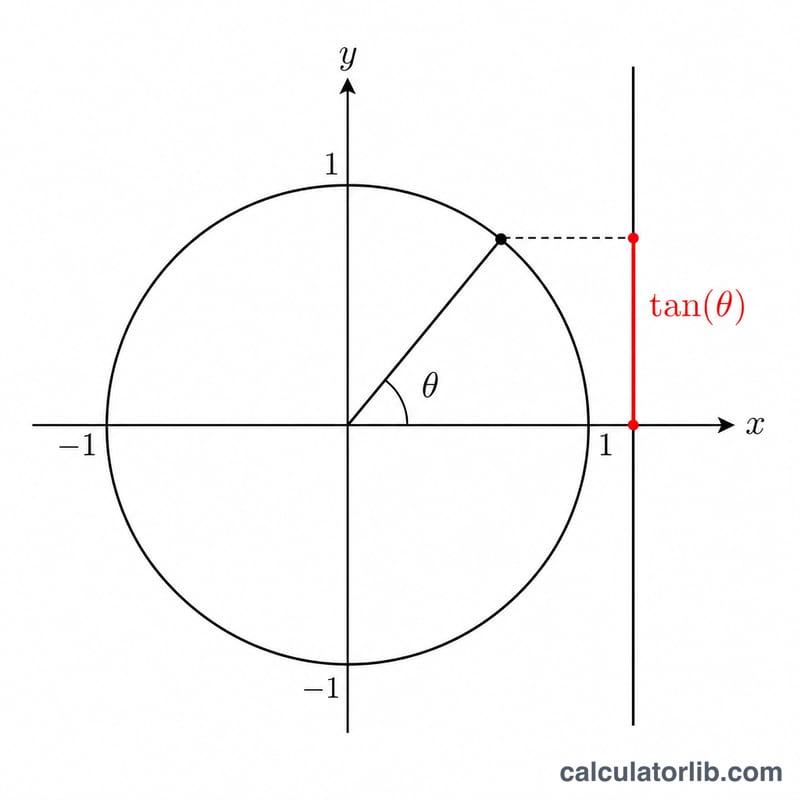
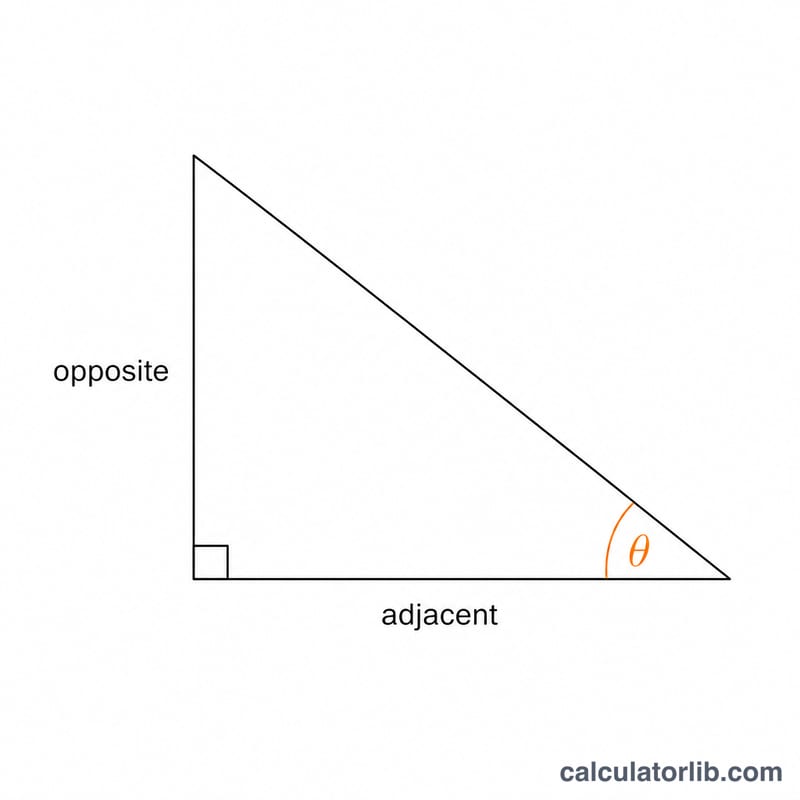
The tangent of an angle is the ratio of its sine to its cosine:
$$\tan(\theta) = \frac{\sin(\theta)}{\cos(\theta)}$$
Internally the calculator always works in radians. If you enter degrees, it first converts using \(\theta_{\text{rad}} = \theta_{\text{deg}} \times \frac{\pi}{180}\), then applies the standard tangent function. If you enter radians, it uses your value directly and also converts it back to degrees (\(\theta_{\text{deg}} = \theta_{\text{rad}} \times \frac{180}{\pi}\)) for display.
Worked Example
Suppose you enter Angle = 45 and Input Unit = Degrees.
- Convert to radians: \(45 \times \frac{\pi}{180} \approx 0.7854\) radians.
- Compute the tangent: \(\tan(0.7854) \approx\) 1.0000.
- The calculator displays: tangent ≈ 1, angle in radians ≈ 0.7854, angle in degrees = 45.
If instead you entered Angle = 0.7854 with Input Unit = Radians, you would get the same tangent of 1, with the angle shown as 45 degrees.
Frequently Asked Questions
Why does tan(90°) give a huge or undefined-looking number? Because cos(90°) is zero, so sin/cos blows up to infinity. Due to tiny floating-point rounding, 90° may return a very large number rather than an error — mathematically the tangent is undefined there.
Should I use degrees or radians? Use whichever your problem is stated in. School geometry usually uses degrees; calculus and physics typically use radians. The calculator handles both and shows you the equivalent in the other unit.
Can I enter negative angles? Yes. Tangent is an odd function, so \(\tan(-\theta) = -\tan(\theta)\). Entering −30 degrees, for example, returns about −0.5774.