
What the Hyperbolic Tangent Calculator Does
This calculator takes a single number, x, and instantly returns its hyperbolic tangent, tanh(x). To give you the full picture, it also computes the two related hyperbolic functions — sinh(x) (hyperbolic sine) and cosh(x) (hyperbolic cosine) — along with the underlying exponential building blocks ex and e−x. That makes it handy for checking homework, verifying results in calculus and trigonometry, or working through physics and engineering problems involving catenaries, special relativity, and neural network activation functions.
How to Use It
- Number (x): Enter any real number — positive, negative, a decimal, or zero.
- The tool returns tanh(x), sinh(x) and cosh(x), plus ex and e−x so you can see how each value is constructed.
x is measured as a plain dimensionless number, not an angle in degrees, so there is no need to switch units.
The Formula Explained
All three functions are defined directly from exponentials:
- sinh(x) = (ex − e−x) / 2
- cosh(x) = (ex + e−x) / 2
- tanh(x) = sinh(x) / cosh(x) = (ex − e−x) / (ex + e−x)
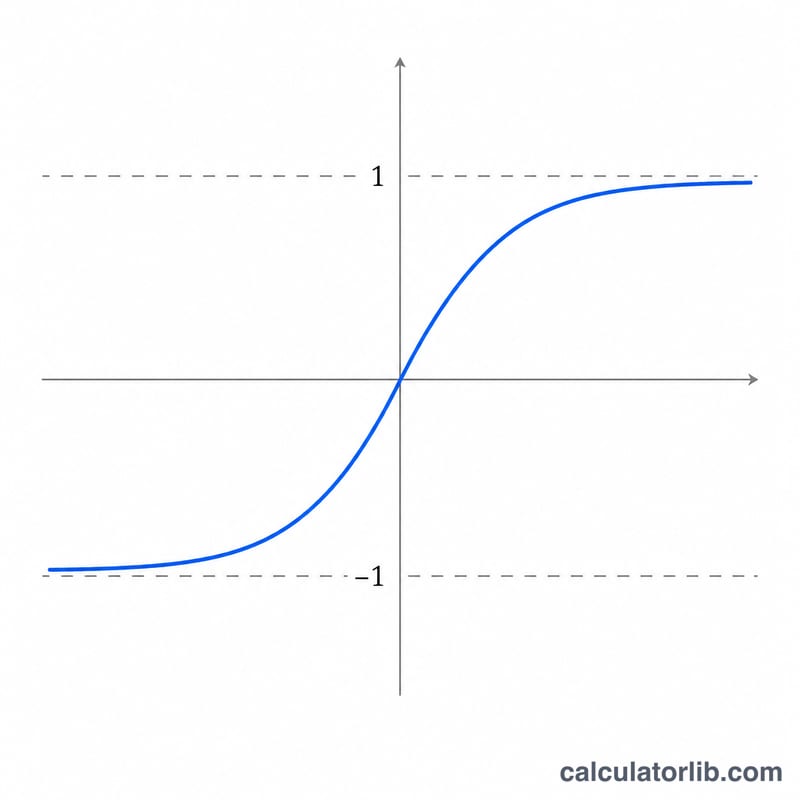
The calculator evaluates these exactly as your computer's math library does (Math.tanh, Math.sinh, Math.cosh). The output of tanh always lies strictly between −1 and 1, approaching those limits as x grows large in either direction.
Worked Example
Suppose you enter x = 1. The calculator first finds the exponentials:
- e1 ≈ 2.71828
- e−1 ≈ 0.36788
Then:
- sinh(1) = (2.71828 − 0.36788) / 2 ≈ 1.17520
- cosh(1) = (2.71828 + 0.36788) / 2 ≈ 1.54308
- tanh(1) = 1.17520 / 1.54308 ≈ 0.76159
Frequently Asked Questions
Is x an angle? No. Unlike ordinary trig functions, hyperbolic functions take a plain real number, not degrees or radians.
What is the range of tanh(x)? It is always between −1 and 1. It equals 0 at x = 0 and flattens toward ±1 for large |x|.
How are tanh, sinh and cosh related? tanh(x) = sinh(x) ÷ cosh(x). Also, cosh²(x) − sinh²(x) = 1, the hyperbolic identity that mirrors the Pythagorean one.