
What Is the Hyperbolic Sine Calculator?
The Hyperbolic Sine Calculator computes sinh(x), one of the core hyperbolic functions used throughout mathematics, physics and engineering. Unlike the ordinary sine function (which relates to circles), the hyperbolic sine relates to the geometry of a hyperbola and to exponential growth and decay. This tool takes a single number you supply and instantly returns its hyperbolic sine, along with the underlying exponential terms it uses to get there.
How to Use It
The calculator has just one input field:
- Number (x): Enter any real number — positive, negative, whole or decimal. This is the value whose hyperbolic sine you want.
Submit the value and the calculator returns sinh(x). It also reports the two exponential components, ex and e−x, so you can see exactly how the result is built.
The Formula Explained
Hyperbolic sine is defined using the exponential constant e (about 2.71828):
- sinh(x) = (ex − e−x) / 2
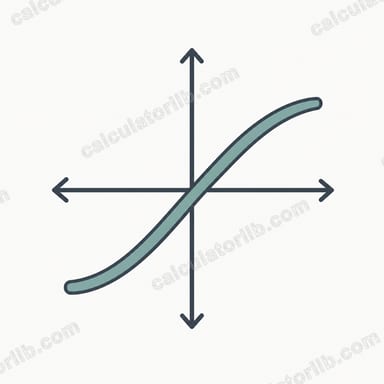
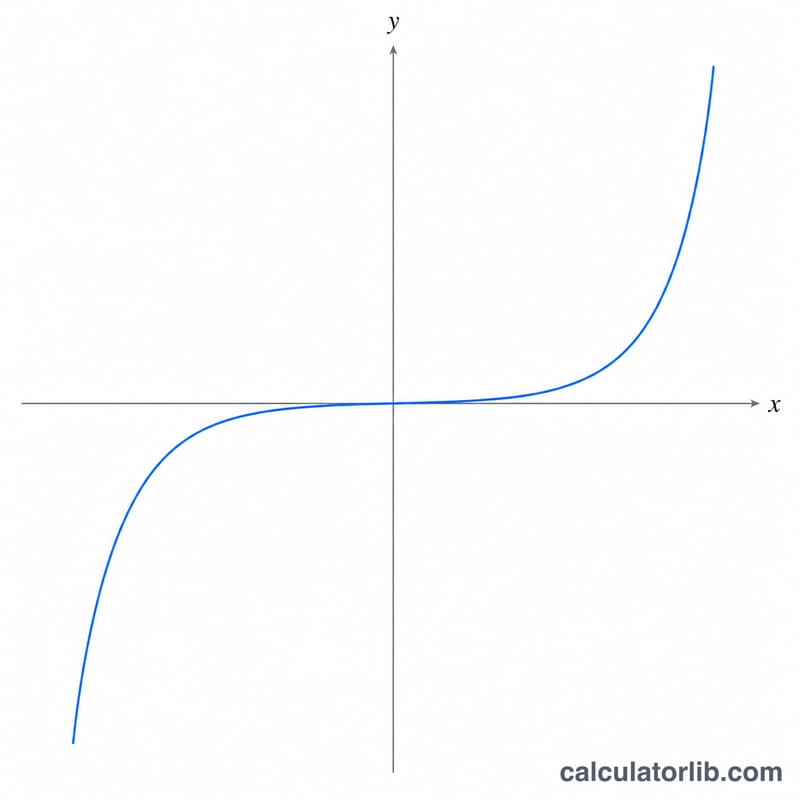
The calculator evaluates ex (the first component) and e−x (the second component), subtracts the second from the first, and divides by 2. Because of the subtraction, sinh(x) is an odd function: sinh(−x) = −sinh(x), and sinh(0) = 0.
Worked Example
Suppose you enter x = 2:
- e2 ≈ 7.389056 (first component)
- e−2 ≈ 0.135335 (second component)
- sinh(2) = (7.389056 − 0.135335) / 2 ≈ 7.253721 / 2 ≈ 3.626860
So the calculator returns sinh(2) ≈ 3.62686, with the two exponential terms shown alongside.
Frequently Asked Questions
What is the difference between sinh and sin? The regular sine, sin(x), oscillates between −1 and 1 and is built from circular geometry. The hyperbolic sine, sinh(x), has no upper or lower bound — it grows rapidly toward infinity as x increases and toward negative infinity as x decreases.
What is sinh of 0? sinh(0) = (e0 − e0)/2 = (1 − 1)/2 = 0. The hyperbolic sine always passes through the origin.
Where is hyperbolic sine used? It appears in the shape of a hanging cable or chain (the catenary), in special and general relativity, in heat transfer and signal processing, and in solving certain differential equations.