
What the Hyperbolic Secant Calculator Does
This calculator computes the hyperbolic secant, written sech(x), for any real number you enter. Hyperbolic secant is one of the six hyperbolic functions used throughout calculus, physics and engineering — for example, it describes the shape of a hanging-chain-derived bell curve and appears in solutions to certain wave and soliton equations. Alongside sech(x), the tool also shows you cosh(x) (hyperbolic cosine), since the two are directly related.
The Input Field
- Number (x): Enter any real value — positive, negative, a decimal, or zero. This single number is the argument the calculator feeds into the hyperbolic functions.
The Formula
The calculator works in two steps. First it finds the hyperbolic cosine:
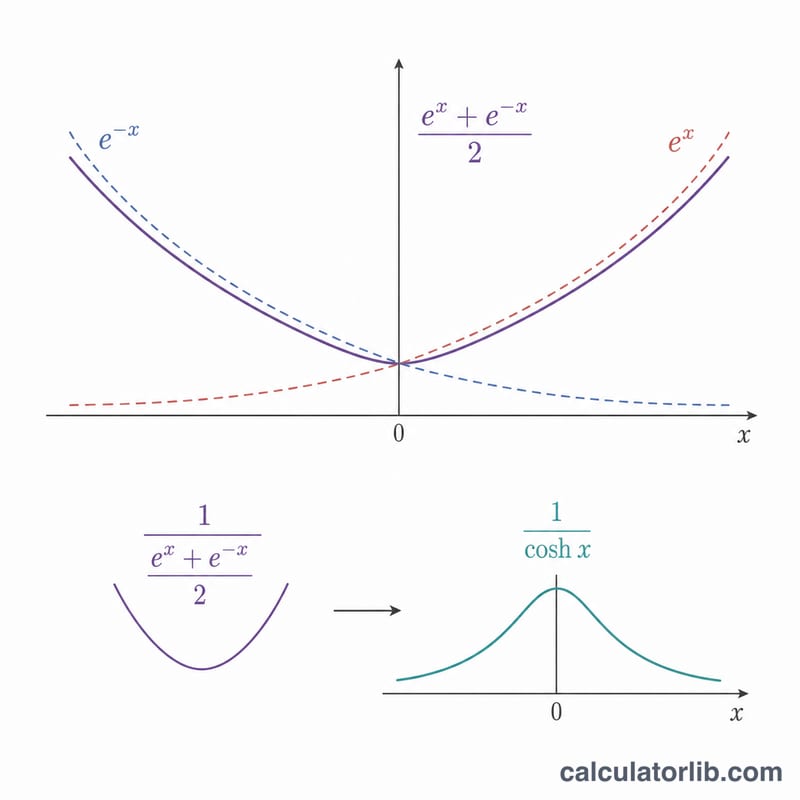
- cosh(x) = (eˣ + e⁻ˣ) / 2
Then the hyperbolic secant is simply its reciprocal:
- sech(x) = 1 / cosh(x) = 2 / (eˣ + e⁻ˣ)
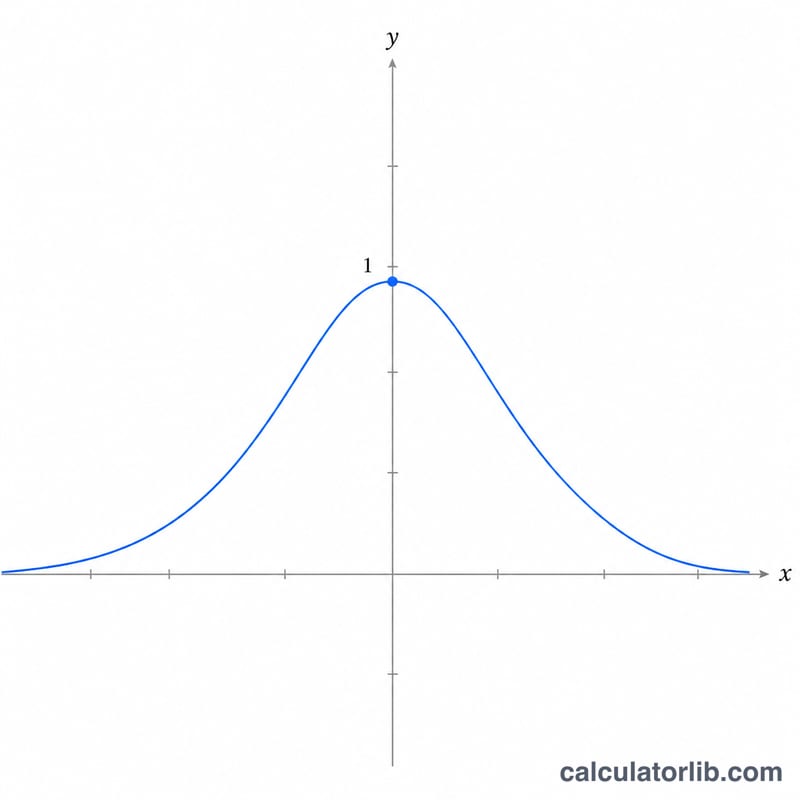
Internally the tool computes eˣ and e⁻ˣ separately, adds them together, and uses that sum to derive both cosh(x) and sech(x). Because cosh(x) is never zero (its minimum value is 1 at x = 0), sech(x) is always defined and always falls between 0 and 1.
Worked Example
Suppose you enter x = 1:
- e¹ ≈ 2.71828 and e⁻¹ ≈ 0.36788
- Their sum ≈ 3.08616, so cosh(1) = 3.08616 / 2 ≈ 1.54308
- sech(1) = 1 / 1.54308 ≈ 0.64805
So the calculator returns sech(1) ≈ 0.6481 with cosh(1) ≈ 1.5431 shown alongside.
Frequently Asked Questions
What is sech(0)? At x = 0, both eˣ and e⁻ˣ equal 1, so cosh(0) = 1 and sech(0) = 1/1 = 1. This is the maximum possible value of sech.
Can sech(x) ever be negative or zero? No. Since cosh(x) is always at least 1, sech(x) stays strictly between 0 and 1 for every real input. As x grows large in either direction, sech(x) approaches 0 but never reaches it.
Does it accept negative numbers? Yes. sech is an even function, meaning sech(-x) = sech(x), so entering -2 gives the same result as entering 2.