
What Is the Rule of 72?
The Rule of 72 is a quick mental-math shortcut that estimates how long it takes for an investment to double in value at a fixed annual rate of return. Instead of working through complex compound-interest formulas, you simply divide 72 by the annual interest or growth rate. The result is the approximate number of years needed to double your money. This rule applies universally to any compounding scenario — savings accounts, stocks, mutual funds, inflation, or even debt — and is not tied to any single country's tax or financial system.
How to Use This Calculator
Using the Rule of 72 Calculator takes just a few seconds:
- Enter the expected annual interest rate or growth rate as a percentage (for example, 8 for 8%).
- Click calculate to see the estimated number of years for your money to double.
- Adjust the rate to compare different investment scenarios side by side.
The calculator removes the guesswork, giving you an instant projection you can use for planning savings goals, retirement timelines, or comparing investment options.
The Formula Explained
The formula behind the calculation is refreshingly simple:
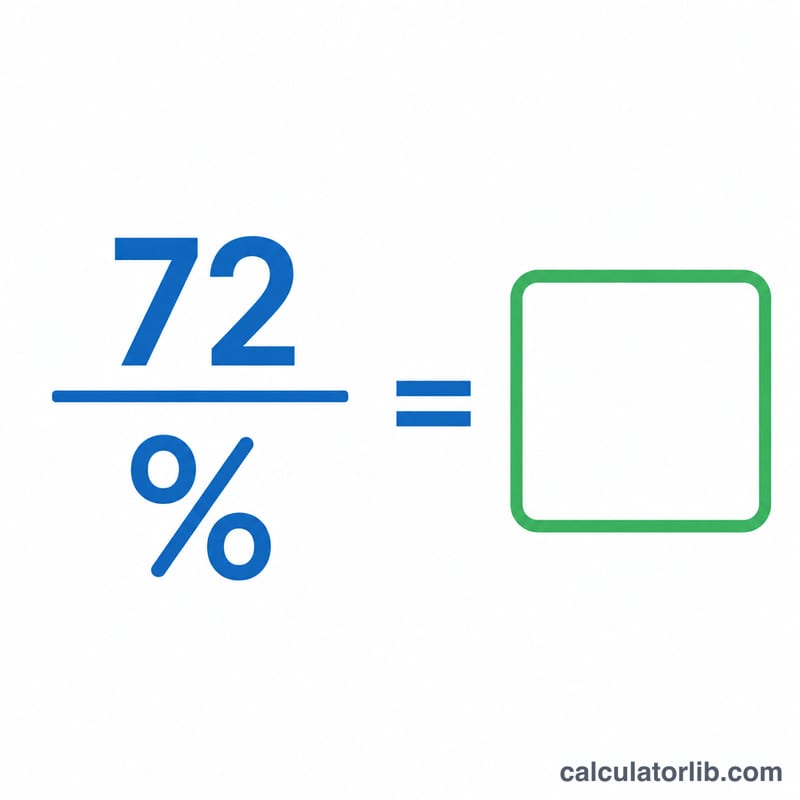
- Years to double = 72 ÷ annual rate of return (%)
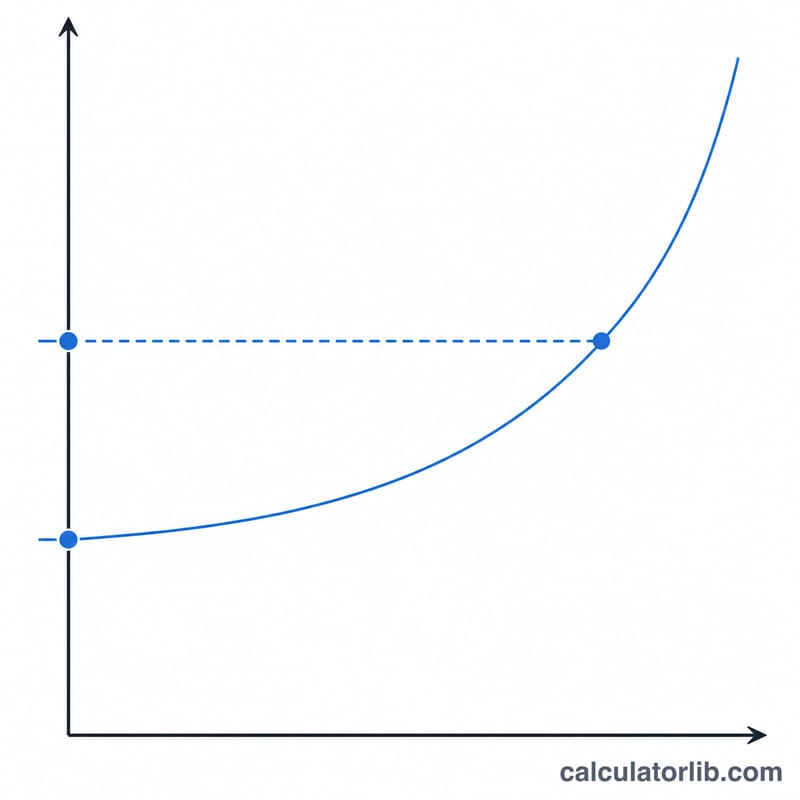
Because compound interest grows exponentially, dividing 72 by the percentage rate produces a close approximation of the true doubling time. The rule is most accurate for rates between roughly 6% and 10%. For very high or very low rates, the estimate drifts slightly from the exact figure, but it remains a reliable back-of-the-envelope tool.
Worked Example
Suppose you invest in a fund expected to return 9% per year. Applying the formula:
- 72 ÷ 9 = 8 years
So your investment would roughly double every 8 years. If you started with $10,000, you could expect about $20,000 after 8 years, $40,000 after 16 years, and $80,000 after 24 years — assuming the rate holds steady and gains stay invested.
Frequently Asked Questions
Is the Rule of 72 exact? No, it is an approximation. The precise doubling time uses logarithms, but the Rule of 72 is close enough for quick planning and is easy to do in your head.
Can I use it for inflation? Yes. Divide 72 by the inflation rate to see how quickly prices double — useful for understanding how purchasing power erodes over time.
Why 72 and not another number? The number 72 has many divisors (2, 3, 4, 6, 8, 9, 12), making mental division simple, while still closely matching the true exponential result for common interest rates.