
What Is the Hyperbolic Cosine Calculator?
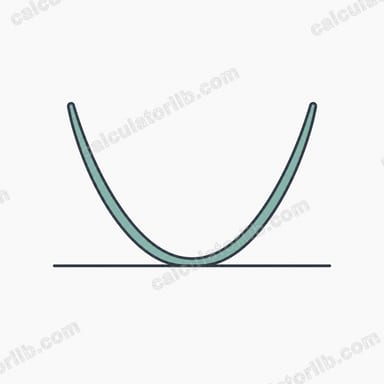
The Hyperbolic Cosine Calculator computes cosh(x) for any real number you enter. Hyperbolic cosine is one of the core hyperbolic functions used throughout mathematics, physics and engineering — most famously to describe the shape of a hanging cable or chain, known as a catenary. This tool takes a single value, applies the exact mathematical definition, and returns a precise result instantly. The calculation is universal and not tied to any country or unit system.
How to Use It
Using the calculator takes one step:
- Number (x): Enter the value whose hyperbolic cosine you want. This can be positive, negative, zero, a whole number or a decimal (for example 0, 1, -2.5, or 3.14).
Once you submit, the calculator returns cosh(x). Behind the scenes it also computes the two building blocks of the result — ex and e-x — so you can see exactly how the answer is formed.
The Formula Explained
The calculator uses the standard definition of hyperbolic cosine:
- cosh(x) = (ex + e-x) / 2
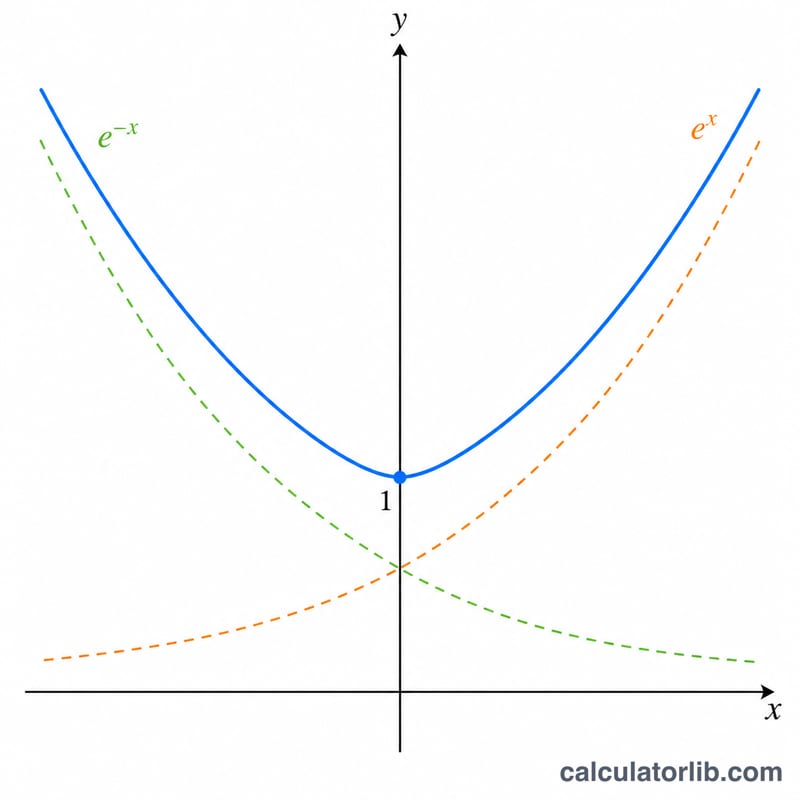
Here e is Euler's number (approximately 2.71828). The tool evaluates ex and e-x separately, adds them, and divides by 2. Because both exponential terms are always positive, cosh(x) is always greater than or equal to 1, and it is symmetric — cosh(x) equals cosh(-x).
Worked Example
Suppose you enter x = 2:
- e2 ≈ 7.389056
- e-2 ≈ 0.135335
- Sum ≈ 7.524391
- cosh(2) = 7.524391 / 2 ≈ 3.762196
So the hyperbolic cosine of 2 is approximately 3.7622. If you instead enter x = 0, both exponential terms equal 1, giving cosh(0) = (1 + 1) / 2 = 1.
Frequently Asked Questions
Can cosh(x) ever be less than 1?
No. The minimum value of cosh(x) is exactly 1, which occurs at x = 0. For every other input the result is larger than 1.
What does a negative input do?
Negative numbers are fully supported. Because cosh is an even function, cosh(-3) gives the same result as cosh(3).
Where is hyperbolic cosine used?
It describes catenary curves (hanging cables, arches and power lines), appears in special relativity and signal processing, and is the building block for related functions like the hyperbolic secant.