
What Is the Cosh Calculator?
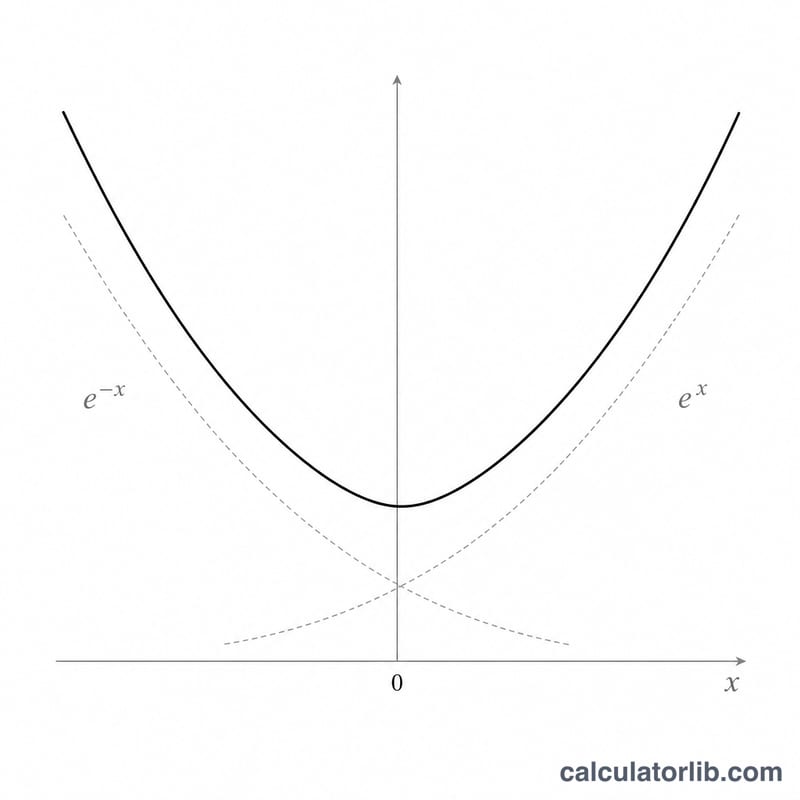
The hyperbolic cosine, written \(\cosh(x)\), is one of the fundamental hyperbolic functions. It is defined directly in terms of the exponential function as $$\cosh(x) = \frac{e^{x} + e^{-x}}{2}.$$ This calculator evaluates \(\cosh(x)\) for any real number you enter, returning a full-precision result. Hyperbolic functions appear throughout physics, engineering, and mathematics — most famously in the shape of a hanging chain or cable, known as a catenary, which follows a cosh curve.
How to Use It
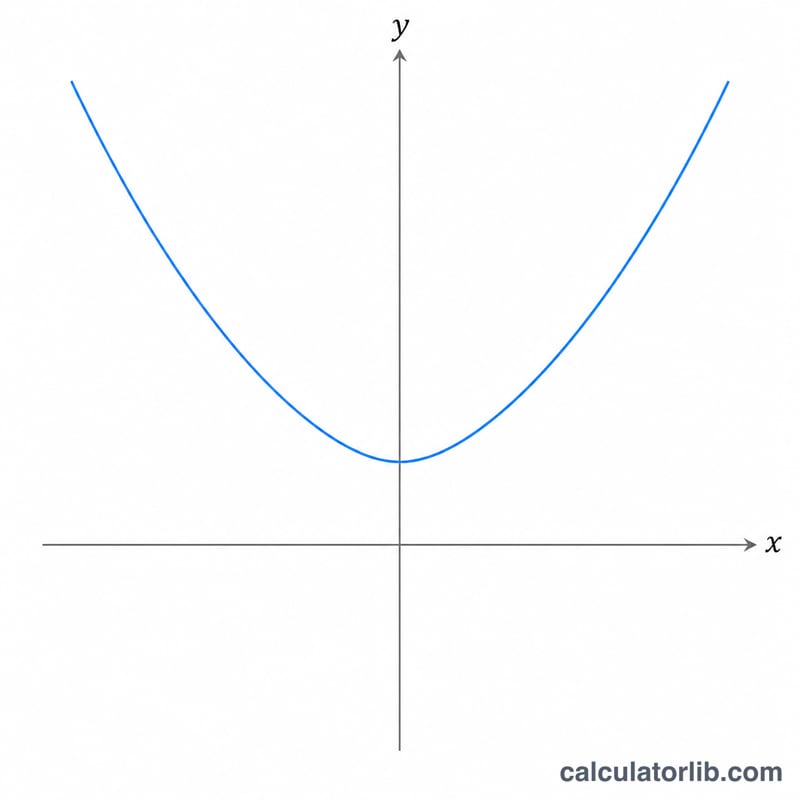
Enter any real number for x — it can be positive, negative, an integer, or a decimal. Press calculate and the tool returns \(\cosh(x)\). Because cosh is an even function, \(\cosh(-x)\) equals \(\cosh(x)\), so the sign of your input does not change the answer. The minimum possible value of \(\cosh(x)\) is 1, which occurs at \(x = 0\).
The Formula Explained
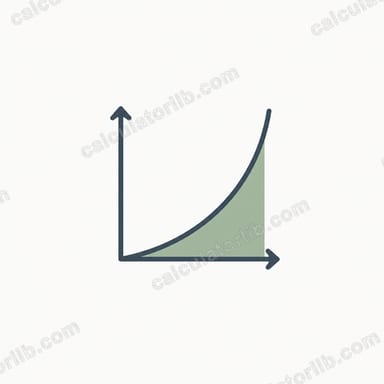
The exponential \(e^{x}\) grows for positive \(x\) while \(e^{-x}\) grows for negative \(x\). Averaging them produces a smooth, U-shaped (convex) curve that is symmetric about the y-axis. As \(|x|\) becomes large, \(\cosh(x)\) behaves like \(\tfrac{1}{2}e^{|x|}\), growing very quickly.
Worked Example
For \(x = 1\): \(e^{1} \approx 2.718281828\) and \(e^{-1} \approx 0.367879441\). Their sum is 3.086161270, and dividing by 2 gives $$\cosh(1) \approx 1.543080635.$$
FAQ
What is cosh(0)? \(\cosh(0) = \frac{1 + 1}{2} = 1\), the minimum value of the function.
Is cosh ever negative? No. Because \(e^{x}\) and \(e^{-x}\) are always positive, \(\cosh(x) \geq 1\) for every real \(x\).
How does cosh relate to sinh? They satisfy the identity \(\cosh^{2}(x) - \sinh^{2}(x) = 1\), the hyperbolic analogue of the Pythagorean identity.