
What Is the Hyperbolic Cotangent Calculator?
This calculator finds the hyperbolic cotangent (coth) of any real number you enter. Hyperbolic functions appear throughout physics, engineering and advanced mathematics — for example in modelling hanging cables (catenaries), heat transfer, special relativity and electrical transmission lines. Instead of computing exponentials by hand, you type one value and get an instant, accurate result.
How to Use It
There is a single input field:
- Number (x): the value whose hyperbolic cotangent you want. Enter any positive or negative number.
One important restriction: x cannot equal 0. Because sinh(0) = 0, coth(0) would require dividing by zero, so it is undefined. The calculator also returns the underlying sinh(x), cosh(x), eˣ and e⁻ˣ values so you can see how the answer is built.
The Formula Explained
Hyperbolic cotangent is the ratio of hyperbolic cosine to hyperbolic sine:
- coth(x) = cosh(x) / sinh(x)
- where sinh(x) = (eˣ − e⁻ˣ) / 2 and cosh(x) = (eˣ + e⁻ˣ) / 2
Substituting these gives the equivalent exponential form: coth(x) = (eˣ + e⁻ˣ) / (eˣ − e⁻ˣ). The calculator computes sinh and cosh directly, then divides cosh by sinh, exactly as shown in this formula.
Worked Example
Suppose you enter x = 2:
- eˣ = e² ≈ 7.389056
- e⁻ˣ = e⁻² ≈ 0.135335
- sinh(2) = (7.389056 − 0.135335) / 2 ≈ 3.626860
- cosh(2) = (7.389056 + 0.135335) / 2 ≈ 3.762196
- coth(2) = 3.762196 / 3.626860 ≈ 1.037315
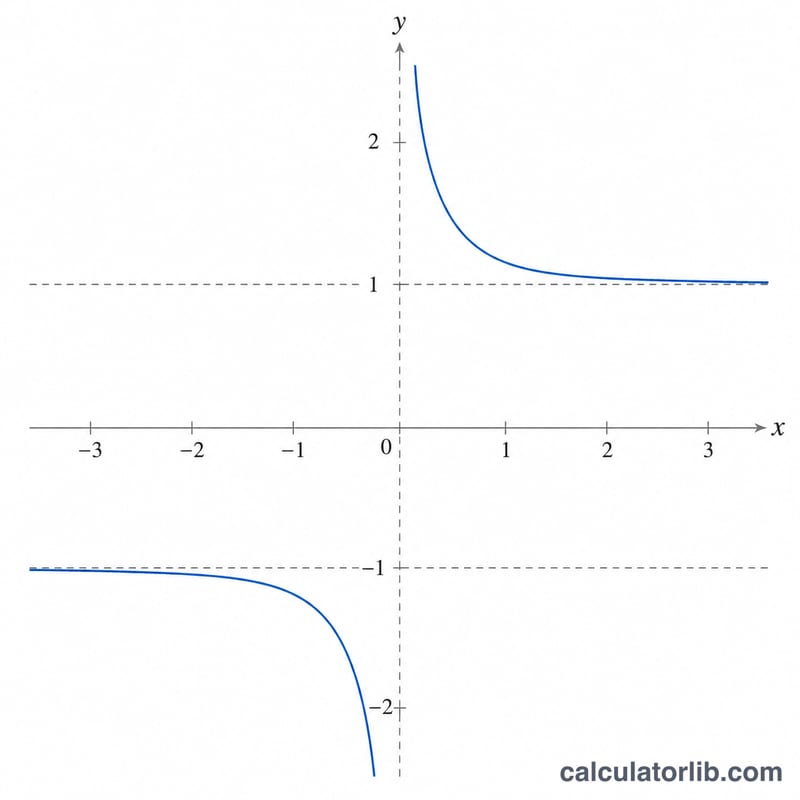
So coth(2) ≈ 1.0373. Notice that as x grows larger, coth(x) approaches 1.
Frequently Asked Questions
Why can't I enter 0? At x = 0, sinh(0) = 0, and division by zero is undefined. coth(x) has a vertical asymptote there, so no finite value exists.
What range of values does coth produce? For positive x it is always greater than 1 and decreases toward 1 as x increases. For negative x it is always less than −1, approaching −1 as x decreases. It never takes values between −1 and 1.
How does coth relate to tanh? Hyperbolic cotangent is the reciprocal of hyperbolic tangent: coth(x) = 1 / tanh(x). If you know tanh(x), you can find coth(x) by inverting it.