
What is the Cubic Inches of a Cylinder Calculator?
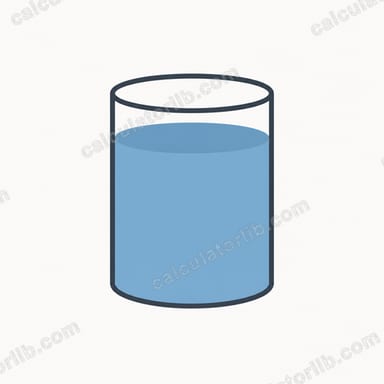
This tool computes the volume of a right circular cylinder in cubic inches (in³). Just enter the cylinder's diameter and height in inches and the calculator returns the enclosed volume, plus a handy conversion to US gallons. It's useful for tanks, pipes, cans, mugs, hydraulic cylinders, and any cylindrical container.
How to use it
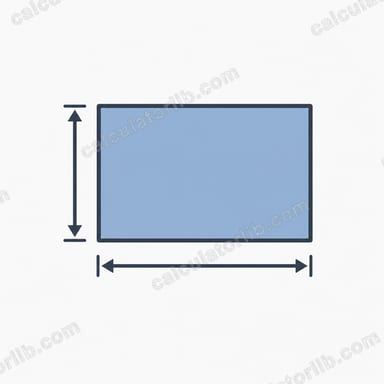
Measure the inside diameter across the circular face and the straight-line height (length) of the cylinder, both in inches. Type those two numbers into the form and read off the volume. The calculator automatically halves the diameter to get the radius, so you don't need to convert it yourself.
The formula explained
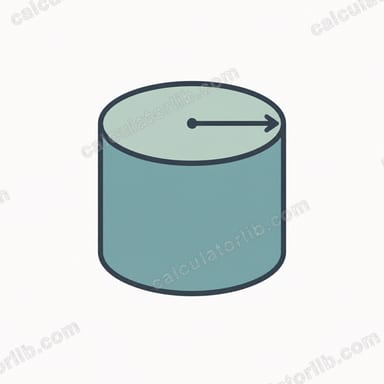
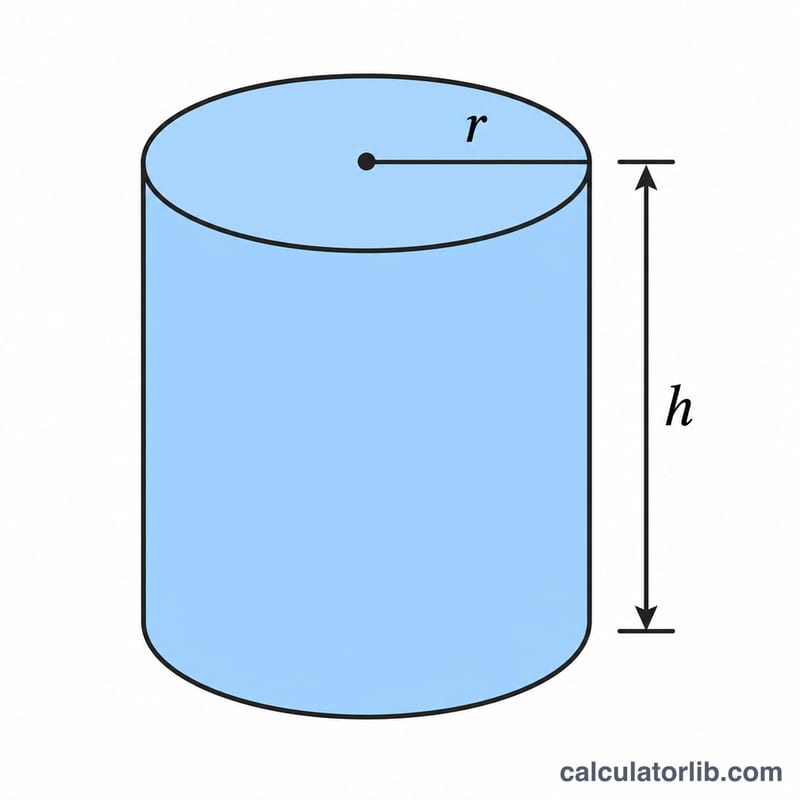
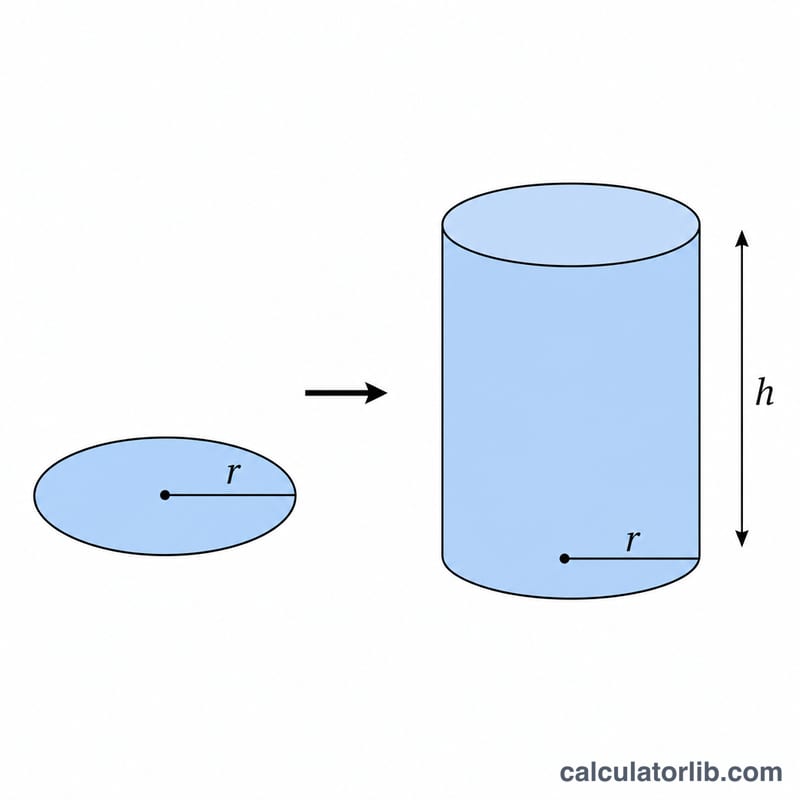
The volume of a cylinder is the area of its circular base multiplied by its height. The base is a circle of area \(\pi \cdot r^{2}\), and stacking that area over a height \(h\) gives:
$$V = \pi \times r^{2} \times h$$
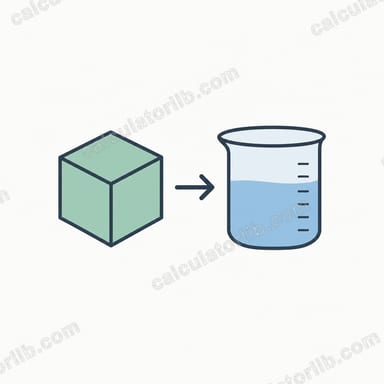
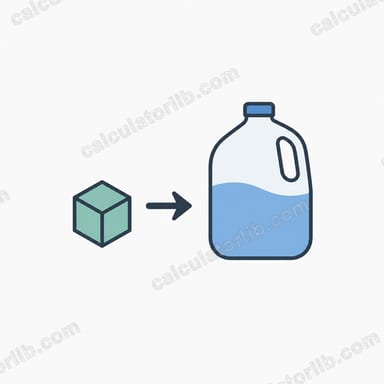
Because the radius \(r\) equals half the diameter \(d\), you can also write \(V = \pi \times (d/2)^{2} \times h\). To convert cubic inches to US liquid gallons, divide by 231, since one US gallon is defined as exactly 231 cubic inches.
Worked example
Suppose a cylinder has a diameter of 6 inches and a height of 12 inches. The radius is \(6 \div 2 = 3\) inches. Then $$V = \pi \times 3^{2} \times 12 = \pi \times 9 \times 12 = 108\pi \approx 339.29 \text{ cubic inches.}$$ Dividing by 231 gives about 1.469 US gallons.
FAQ
Do I enter diameter or radius? Enter the diameter; the calculator divides it by 2 to get the radius automatically.
What units does it use? Diameter and height are in inches, so the result is in cubic inches. Mixing units (e.g., feet and inches) will give an incorrect answer.
How do I get the volume in gallons? The result table shows US gallons by dividing the cubic inches by 231.