
What is a Cuboid Calculator?
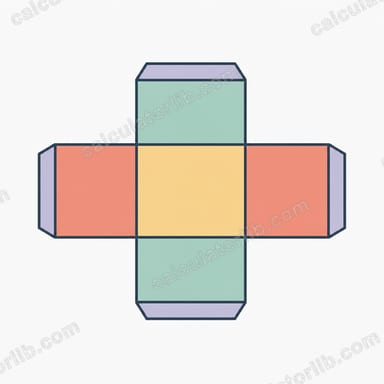
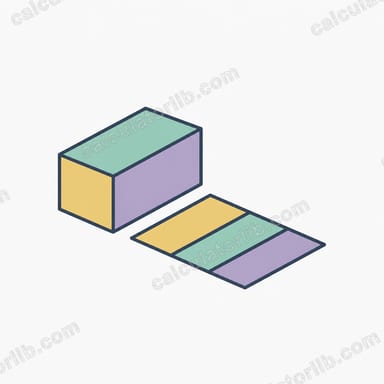
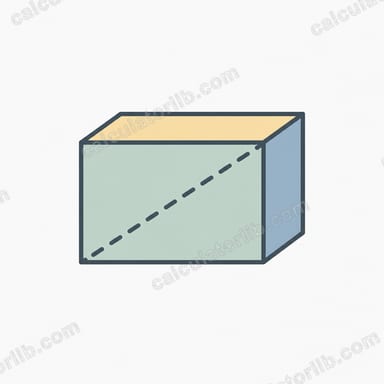
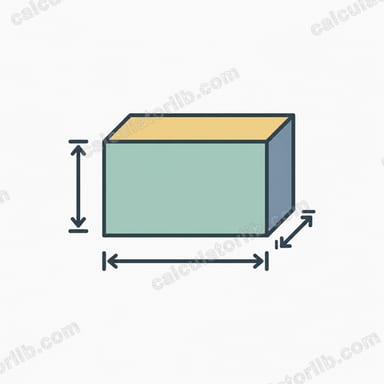
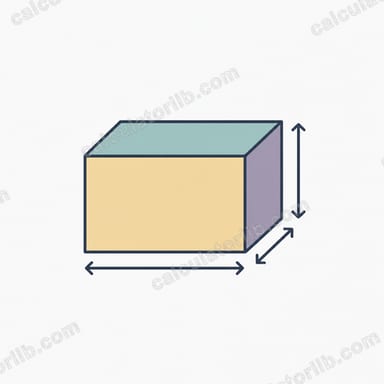
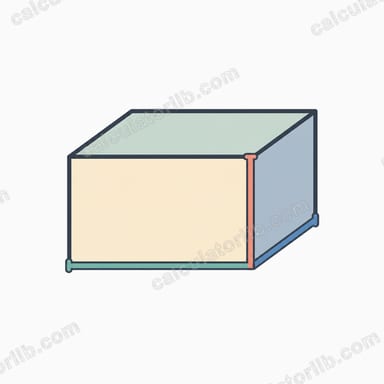
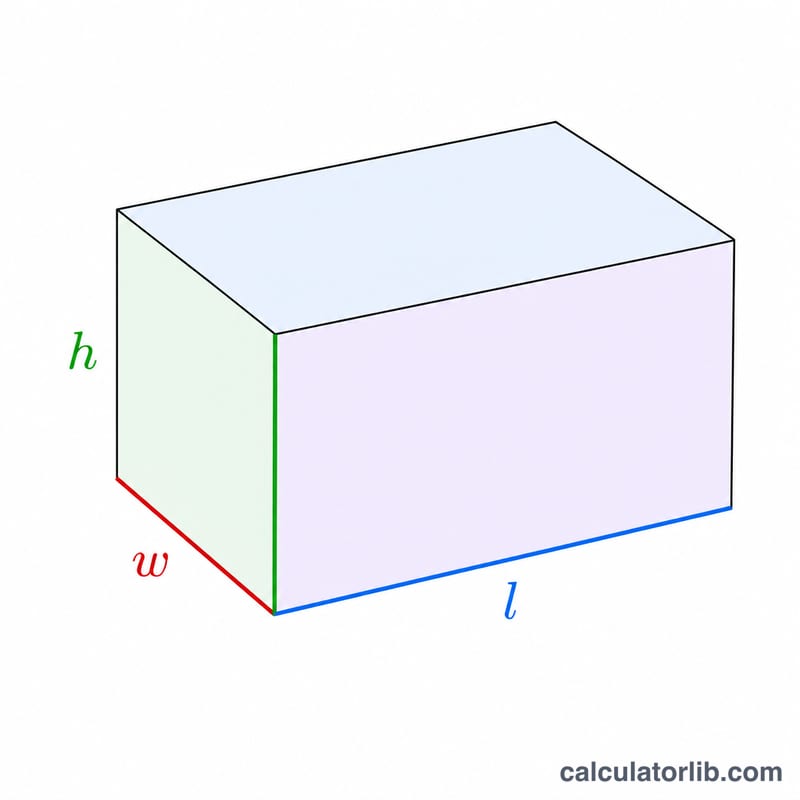
A cuboid (also called a rectangular box or rectangular prism) is a three-dimensional solid with six rectangular faces. This calculator computes its volume, surface area, space diagonal and total edge length from the three side lengths: length, width and height. The tool works with any consistent unit — centimetres, metres, inches and so on — and applies to all cuboids universally.
How to Use It
Enter the length, width and height of your box using the same unit for all three. The calculator instantly returns the volume in cubic units, the surface area in square units, the space diagonal (the longest straight line that fits inside the box), and the combined length of all 12 edges.
The Formulas Explained
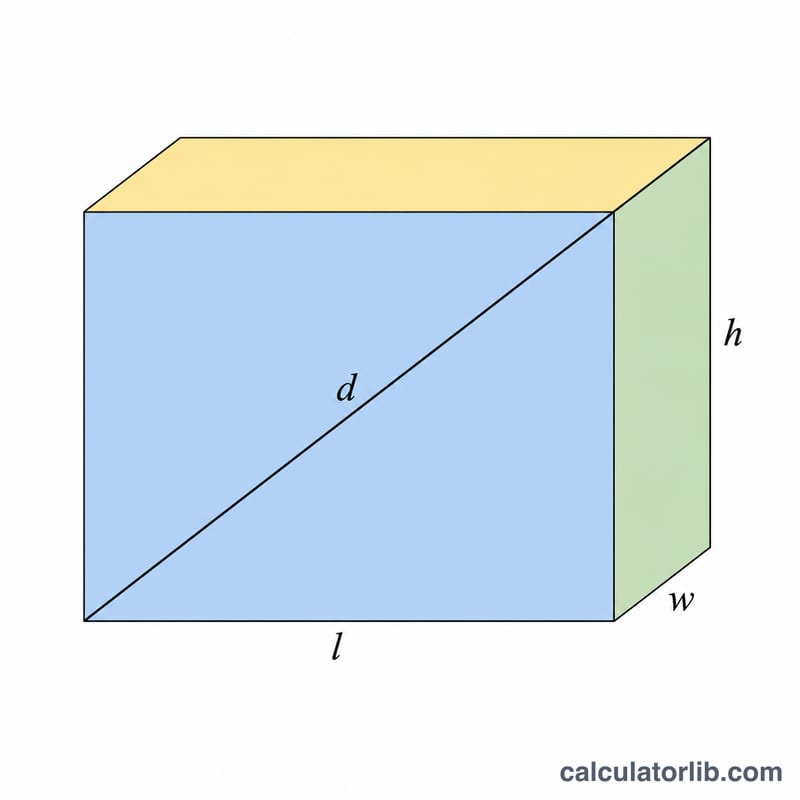
The volume is simply the three dimensions multiplied together: \(V = l \times w \times h\). The surface area sums the areas of the three distinct pairs of faces: \(SA = 2(lw + lh + wh)\). The space diagonal comes from the 3D Pythagorean theorem: \(d = \sqrt{l^{2} + w^{2} + h^{2}}\). A cuboid has 12 edges — four of each length — so the total edge length is \(4(l + w + h)\).
Worked Example
For a box measuring 4 × 3 × 2 units: Volume $$= 4 \times 3 \times 2 = \mathbf{24}$$ cubic units. Surface area $$= 2(4\times3 + 4\times2 + 3\times2) = 2(12 + 8 + 6) = 2 \times 26 = \mathbf{52}$$ square units. Diagonal $$= \sqrt{16 + 9 + 4} = \sqrt{29} \approx \mathbf{5.385}$$ units. Total edge length $$= 4(4 + 3 + 2) = \mathbf{36}$$ units.
FAQ
What is the difference between a cuboid and a cube? A cube is a special cuboid where all three sides are equal.
What units does the result use? Whatever unit you input — volume is in cubic units, surface area in square units, and diagonal/edge length in the original units.
What is the space diagonal? It is the longest internal line connecting two opposite corners through the interior of the box.