

What this converter does
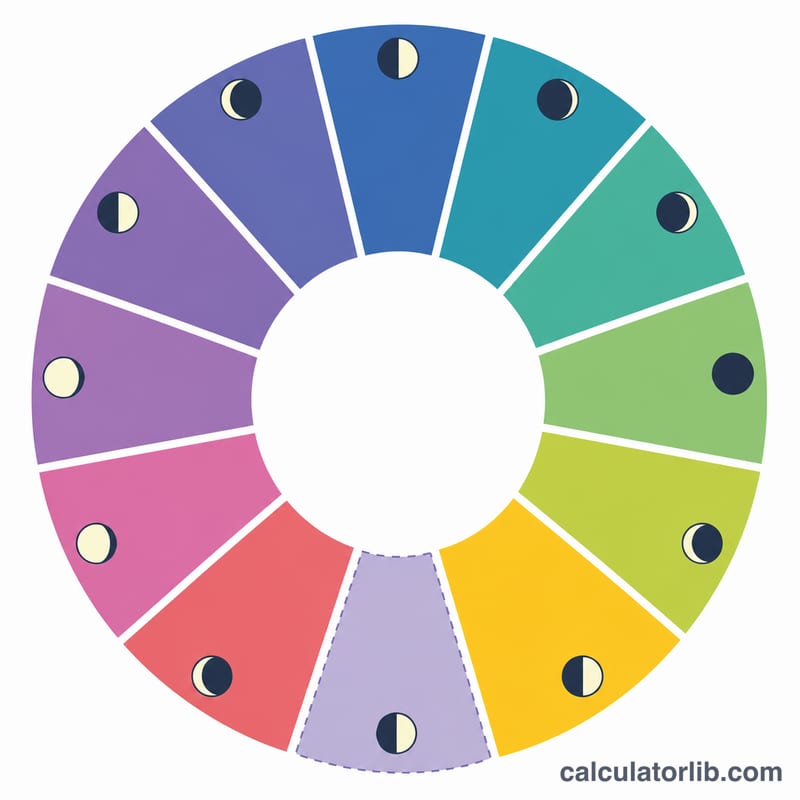
This tool converts a civil (Western) calendar date into the corresponding date on the Hebrew (Jewish) calendar. The Hebrew calendar is a lunisolar calendar used worldwide in Jewish religious life, so this converter is universal and not specific to any single country. You can input dates from either the Gregorian calendar or the proleptic Julian calendar, in either the AD or BC era, and the tool returns the Hebrew year (Anno Mundi), the Hebrew month name, the Hebrew day, and a formatted date string.
How to use it
Choose the Western calendar system (Gregorian for modern dates, Julian for historical dates before the 1582 reform), pick the era (AD or BC), then enter the year, month and day. Press calculate to see the equivalent Hebrew date. For BC years the tool internally maps the year to the astronomical scale (1 BC becomes year 0, 2 BC becomes year -1) so the arithmetic stays continuous.
The formula explained
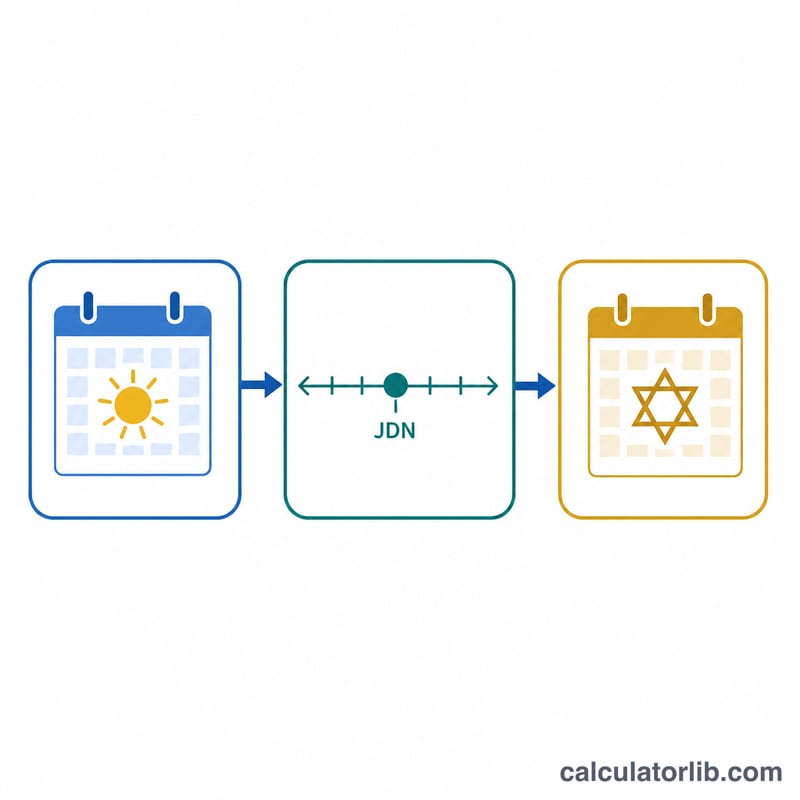
Both calendar systems first convert to a single Julian Day Number (JDN), an integer count of days that acts as a neutral pivot. The JDN is computed as
$$\text{JDN} = \text{Day} + \left\lfloor \tfrac{153m + 2}{5} \right\rfloor + 365y + \left\lfloor \tfrac{y}{4} \right\rfloor - \left\lfloor \tfrac{y}{100} \right\rfloor + \left\lfloor \tfrac{y}{400} \right\rfloor - 32045$$where
$$\left\{ \begin{aligned} Y &= \text{Year}\ (\text{or } 1 - \text{Year if } \text{Era}=\text{BC}) \\ a &= \left\lfloor \tfrac{14 - \text{Month}}{12} \right\rfloor \\ y &= Y + 4800 - a \\ m &= \text{Month} + 12a - 3 \end{aligned} \right.$$The JDN is then turned into a fixed date (JDN minus 1721425) and compared against the computed Rosh Hashanah (1 Tishrei) of candidate Hebrew years using the Dershowitz and Reingold algorithm. Once the Hebrew year is found, cumulative month lengths locate the month and day. A Hebrew year is a leap year when \((7y + 1) \bmod 19\) is less than 7, in which case the month Adar splits into Adar I and Adar II.
Worked example
For Gregorian, AD, year 2024, month 4 (April), day 23: the JDN is \(2460424\). Converting that JDN through the Hebrew algorithm gives 15 Nisan AM 5784 — the first day of Passover. Because
$$(7 \times 5784 + 1) \bmod 19 = 5$$which is less than 7, the year 5784 is a Hebrew leap year.
FAQ
Why does the result sometimes seem one day off? The Hebrew day begins at sunset the previous evening. Like most simple converters, this tool maps the whole civil daytime to the Hebrew date in effect during the day and ignores the sunset boundary.
When should I choose Julian instead of Gregorian? Use Julian for dates before the Gregorian reform of 1582 if your source records use the old-style calendar; otherwise use Gregorian.
What is Anno Mundi? Anno Mundi (AM) means "in the year of the world" and counts years from the traditional Hebrew epoch of creation.