
What this calculator does
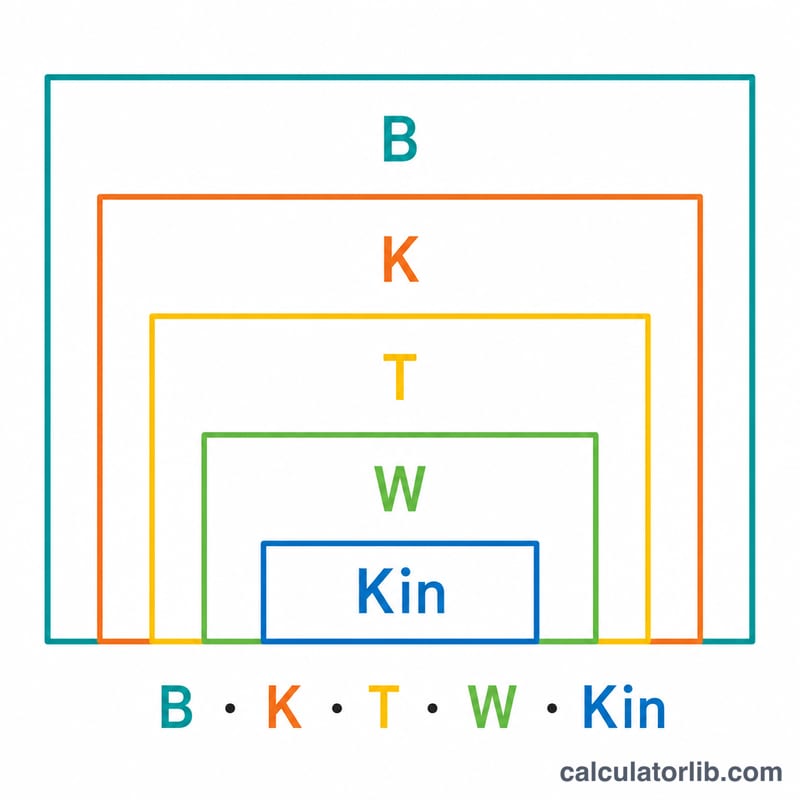
This tool converts a Mesoamerican Maya Long Count date — written as Baktun.Katun.Tun.Winal.Kin — into the equivalent Western calendar date. It reports the proleptic Gregorian date, the proleptic Julian calendar date, the Julian Day Number, and the matching positions in the two Maya cyclical calendars: the 260-day Tzolkin and the 365-day Haab. It uses only universal arithmetic, so it applies worldwide with no jurisdictional assumptions.
How to use it
Select each of the five Long Count places from the dropdowns. Note that the Winal place only runs 0 to 17, because 18 Winal complete one Tun. Choose a correlation constant: GMT(584283) is the modern Lounsbury/modified Goodman–Martinez–Thompson value (the default, giving 21 December 2012 for the cycle end), while GMT(584285) is the classic GMT value (giving 23 December 2012). The two differ by exactly two days.
The formula explained
First the Long Count is reduced to a day count D using the place values in days: Baktun = 144,000, Katun = 7,200, Tun = 360, Winal = 20, Kin = 1. The Julian Day Number is then $$\text{JDN} = D + \text{GMT correlation},$$ where the correlation is the JDN of the origin 0.0.0.0.0. The JDN is converted to a calendar date with the Fliegel–Van Flandern integer algorithm (Gregorian) and a parallel algorithm for the proleptic Julian calendar. The Tzolkin and Haab positions come from modular arithmetic on \(D\), anchored so that the origin is 4 Ahau 8 Kumku.
$$\begin{gathered} \text{JDN} = D + \text{GMT} \\[1.5em] \text{where}\quad \left\{ \begin{aligned} D &= 144000\,\text{Baktun} + 7200\,\text{Katun} \\ &\quad + 360\,\text{Tun} + 20\,\text{Winal} + \text{Kin} \end{aligned} \right. \end{gathered}$$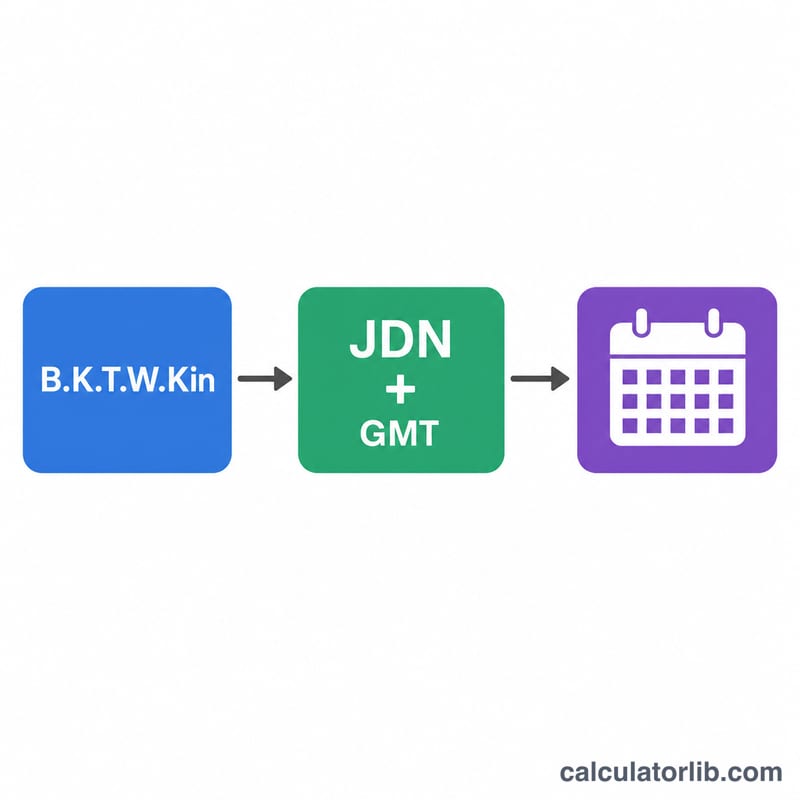
Worked example
Take Long Count 13.0.0.0.0 with GMT(584283). $$D = 13 \times 144{,}000 = 1{,}872{,}000 \text{ days}.$$ $$\text{JDN} = 1{,}872{,}000 + 584{,}283 = 2{,}456{,}283,$$ which is 21 December 2012 in the Gregorian calendar. The Calendar Round returns to the famous 4 Ahau 3 Kankin.
FAQ
Why are there two correlation constants? Scholars debate exactly which Julian Day corresponds to the Maya origin. The 584283 and 584285 values are the two most cited; they shift every Western date by two days but leave the Tzolkin and Haab names unchanged because those depend only on \(D\).
What is the difference between Gregorian and Julian here? Both are projections of modern calendars backward in time. For dates before 1582 the proleptic Julian calendar differs from the proleptic Gregorian by an increasing number of days.
How is 1 BC handled? Internally the algorithm uses astronomical year numbering where year 0 equals 1 BC, and the displayed result converts non-positive years to a "BC" label.