What Is the Equation of a Circle?
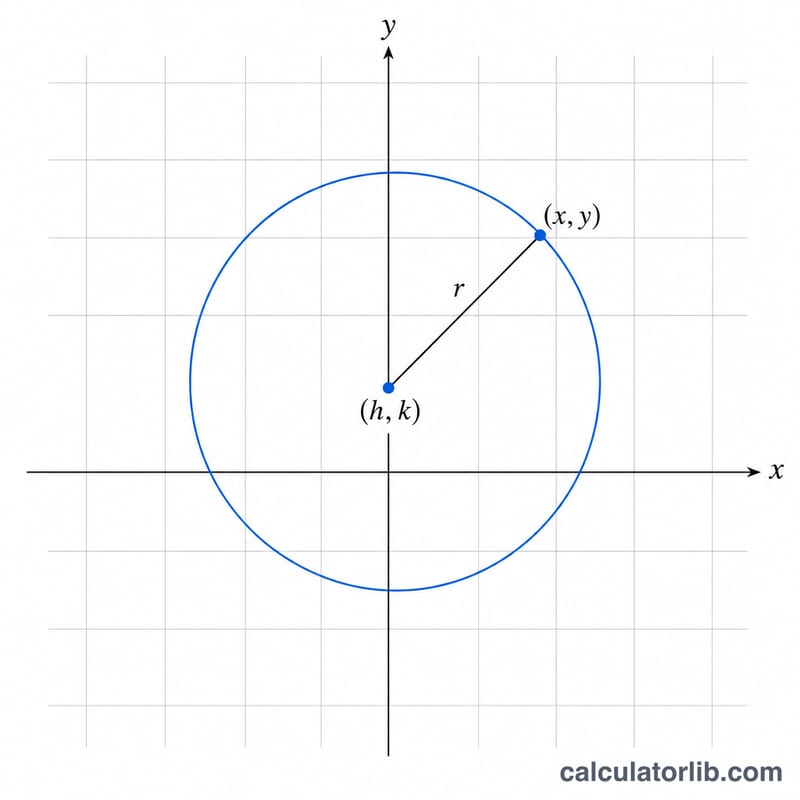
A circle is the set of all points in a plane that are a fixed distance — the radius r — from a fixed center point (h, k). This calculator takes the center coordinates and the radius and produces both the standard form and the general form of the circle's equation, along with its diameter, circumference, and area.
How to Use the Calculator
Enter the x-coordinate of the center (h), the y-coordinate of the center (k), and the radius (r). Press calculate to see the standard-form equation, the expanded general form, and key measurements. A radius of 0 produces a single point, so use a positive value for a true circle.
The Formula Explained
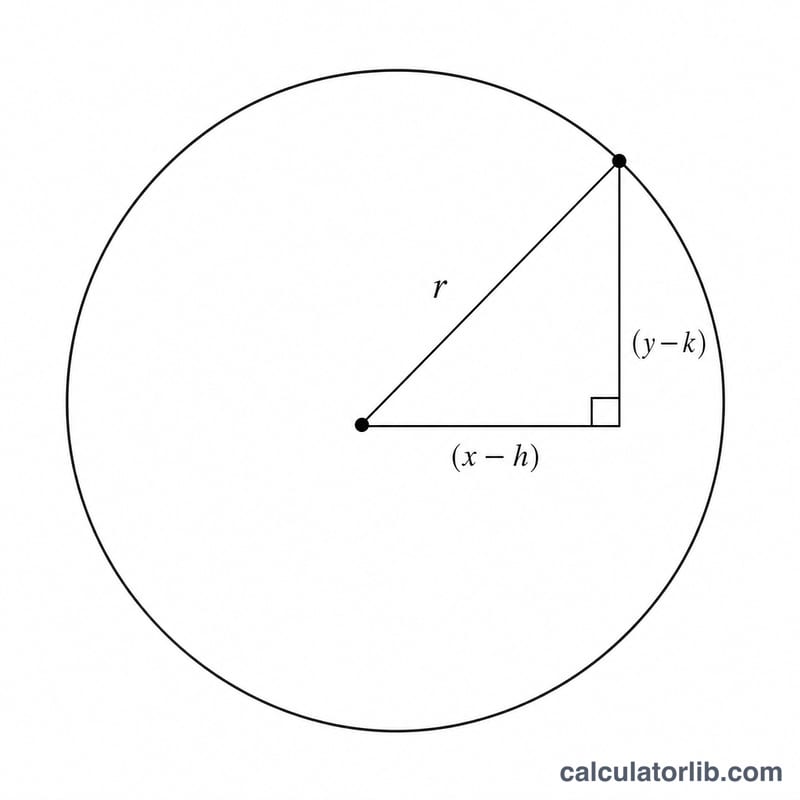
The standard form comes directly from the distance formula: the distance from any point \((x, y)\) to the center \((h, k)\) equals \(r\), so \(\sqrt{(x-h)^2 + (y-k)^2} = r\). Squaring both sides gives $$(x-h)^2 + (y-k)^2 = r^2.$$ Expanding the squares produces the general form $$x^2 + y^2 + Dx + Ey + F = 0,$$ where \(D = -2h\), \(E = -2k\), and \(F = h^2 + k^2 - r^2\).
Worked Example
Suppose the center is \((3, -2)\) and the radius is \(5\). The standard form is $$(x - 3)^2 + (y + 2)^2 = 25,$$ since \(r^2 = 25\). The general form: \(D = -6\), \(E = 4\), \(F = 3^2 + (-2)^2 - 25 = 9 + 4 - 25 = -12\), giving $$x^2 + y^2 - 6x + 4y - 12 = 0.$$ The diameter is \(10\), the circumference is \(2\pi \cdot 5 \approx 31.42\), and the area is \(\pi \cdot 25 \approx 78.54\).
FAQ
What if the center is at the origin? When \((h, k) = (0, 0)\), the equation simplifies to \(x^2 + y^2 = r^2\).
How do I find the center and radius from the general form? Complete the square: \(h = -D/2\), \(k = -E/2\), and \(r = \sqrt{h^2 + k^2 - F}\).
Can the radius be negative? No. Radius is a distance, so the calculator uses its absolute value.