
What Is the Standard Equation of a Circle?
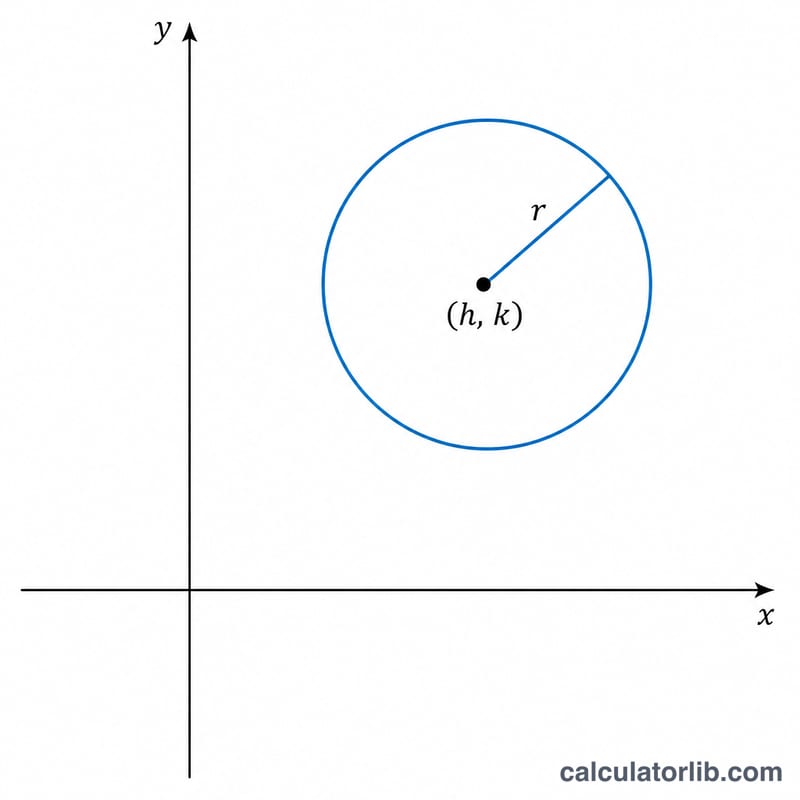
A circle is the set of all points in a plane that are a fixed distance — the radius r — from a fixed point called the center, written as the coordinates (h, k). The standard (or center-radius) form of a circle's equation is \((x - h)^2 + (y - k)^2 = r^2\). This calculator builds that equation instantly from the center and radius you enter, and also reports the diameter, circumference, area, and the equivalent general form.
How to Use This Calculator
Enter the x-coordinate of the center (h), the y-coordinate of the center (k), and the radius (r). The calculator substitutes these directly into the standard form and computes the additional measurements. A radius of 0 collapses the circle to a single point, so use a positive radius for a true circle.
The Formula Explained
The standard form comes straight from the distance formula. The distance between any point (x, y) on the circle and the center (h, k) equals r, so \(\sqrt{(x-h)^2 + (y-k)^2} = r\). Squaring both sides gives $$(x - h)^2 + (y - k)^2 = r^2.$$ Expanding it produces the general form \(x^2 + y^2 + Dx + Ey + F = 0\), where \(D = -2h\), \(E = -2k\), and \(F = h^2 + k^2 - r^2\).
Worked Example
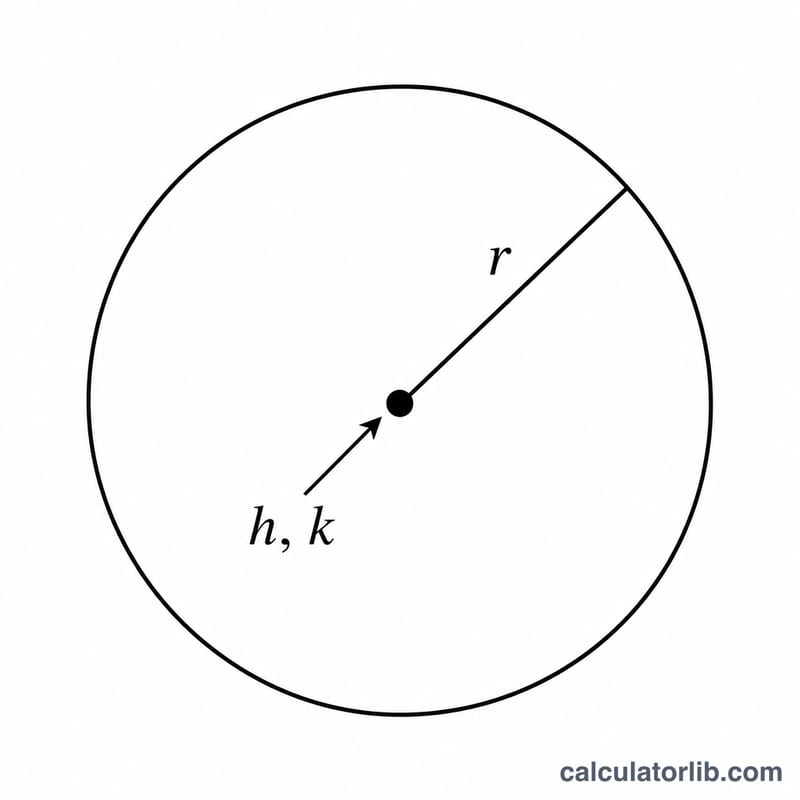
Suppose the center is (3, −2) and the radius is 5. The standard equation is $$(x - 3)^2 + (y - (-2))^2 = 5^2,$$ which simplifies to $$(x - 3)^2 + (y + 2)^2 = 25.$$ The diameter is \(2 \times 5 = 10\), the circumference is \(2\pi(5) \approx 31.42\), and the area is \(\pi(5^2) \approx 78.54\). In general form: \(D = -6\), \(E = 4\), \(F = 9 + 4 - 25 = -12\), giving $$x^2 + y^2 - 6x + 4y - 12 = 0.$$
FAQ
What if the center is at the origin? When \(h = 0\) and \(k = 0\), the equation simplifies to \(x^2 + y^2 = r^2\).
How do I find the radius from the standard equation? The right-hand side equals \(r^2\), so take its square root to get \(r\).
Can the radius be negative? No. Radius is a distance and must be zero or positive; the equation only uses \(r^2\), so a negative input would describe no real circle.