
What This Calculator Does
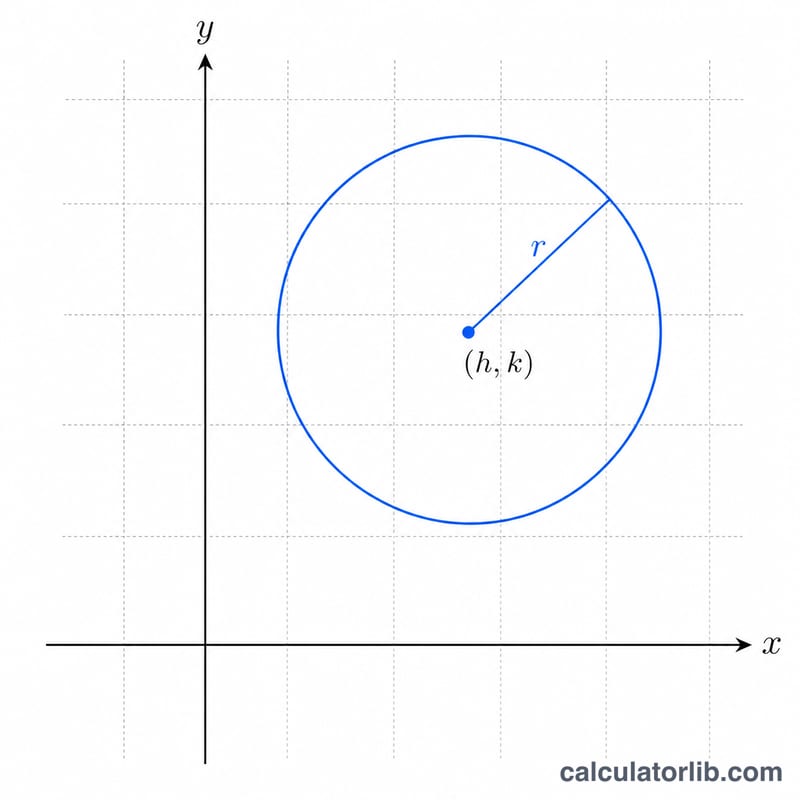
This tool converts a circle written in general form, \(x^2 + y^2 + Dx + Ey + F = 0\), into standard form, \((x - h)^2 + (y - k)^2 = r^2\). It does this by completing the square on both the x and y terms, then reports the circle center \((h, k)\) and the radius \(r\). Enter the three coefficients D, E, and F and the result appears instantly.
How to Use It
Match your equation to \(x^2 + y^2 + Dx + Ey + F = 0\). The coefficient in front of x is D, the coefficient in front of y is E, and the lone constant is F. Signs matter: in \(x^2 + y^2 - 6x + 8y + 9 = 0\), \(D = -6\), \(E = 8\), and \(F = 9\). If your equation has coefficients on \(x^2\) and \(y^2\) (like \(2x^2 + 2y^2 + \ldots\)), divide the whole equation by that number first so the squared terms have coefficient 1.
The Formula Explained
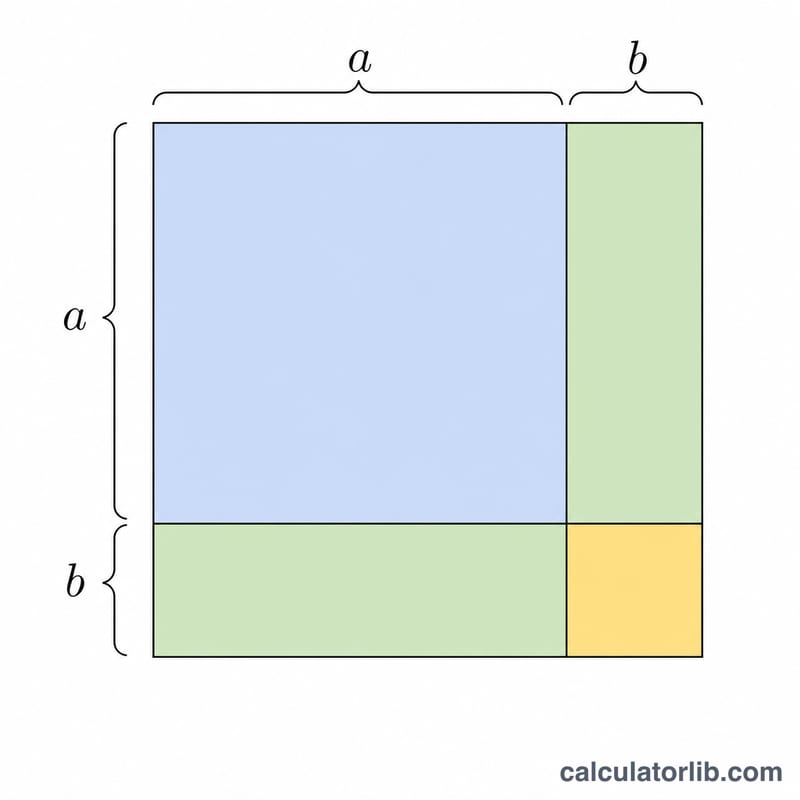
Completing the square on \(x^2 + Dx\) adds and subtracts \((D/2)^2\), and likewise \((E/2)^2\) for the y terms. Moving the constants to the right gives $$(x + \tfrac{D}{2})^2 + (y + \tfrac{E}{2})^2 = \frac{D^2}{4} + \frac{E^2}{4} - F.$$ So the center is \((-D/2, -E/2)\) and the radius is the square root of the right-hand side. If that value is negative there is no real circle; if it is zero the equation represents a single point.
Worked Example
Take \(x^2 + y^2 - 6x + 8y + 9 = 0\), so \(D = -6\), \(E = 8\), \(F = 9\). $$\text{Center} = \left(-\frac{-6}{2}, -\frac{8}{2}\right) = (3, -4).$$ $$r^2 = \frac{36}{4} + \frac{64}{4} - 9 = 9 + 16 - 9 = 16,$$ so \(r = 4\). The circle is centered at \((3, -4)\) with radius 4.
FAQ
What if the radius is imaginary? If \(\frac{D^2}{4} + \frac{E^2}{4} - F\) is negative, the equation has no real solutions and does not describe an actual circle.
Can the center be at the origin? Yes — when \(D = 0\) and \(E = 0\), the center is \((0, 0)\) and \(r = \sqrt{-F}\).
Why divide by the leading coefficient first? The formulas assume the \(x^2\) and \(y^2\) coefficients are both 1, which is the defining property of a circle in general form.