
What is the absolute value of a complex number?
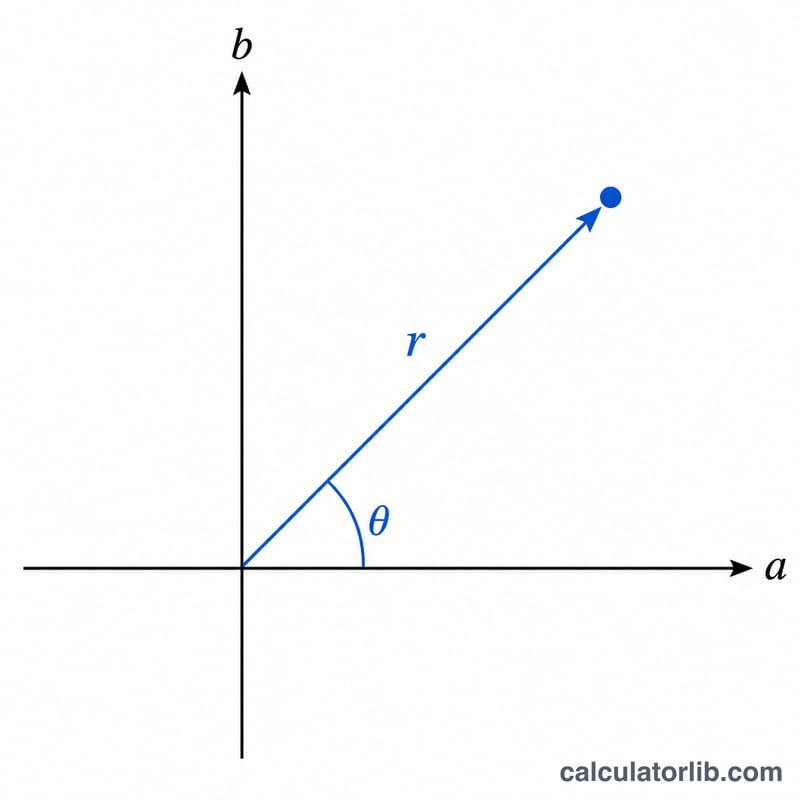
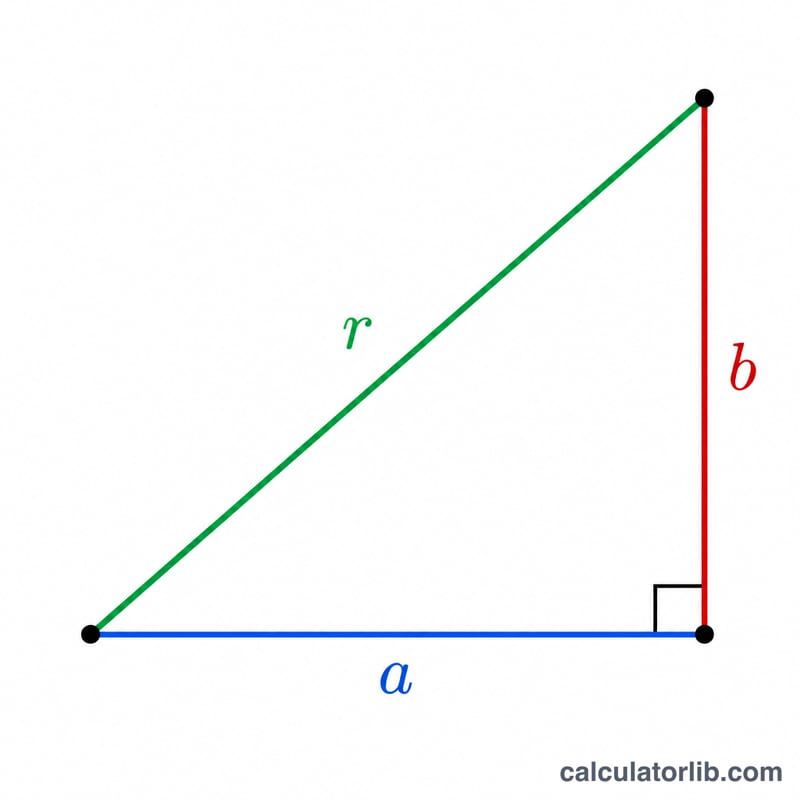
The absolute value (also called the modulus or magnitude) of a complex number a + bi is its distance from the origin in the complex plane. It is written |a + bi| and is always a non-negative real number. Because the real part a and the imaginary part b form the two legs of a right triangle, the modulus is the hypotenuse — found directly with the Pythagorean theorem.
How to use this calculator
Enter the real part a and the imaginary part b of your complex number. The calculator returns the modulus along with the argument (the angle of the number) in both radians and degrees. Negative values are allowed for either part.
The formula explained
The modulus is computed as:
$$|a + bi| = \sqrt{a^{2} + b^{2}}$$
Squaring each component removes any sign, so the result depends only on the size of the real and imaginary parts. The argument is found with \(\theta = \operatorname{atan2}(b, a)\), which gives the correct angle in all four quadrants.
Worked example
Take the complex number 3 + 4i. Then \(a^{2} = 9\) and \(b^{2} = 16\), so \(a^{2} + b^{2} = 25\). The square root of 25 is 5, so \(|3 + 4i| = 5\). The argument is \(\operatorname{atan2}(4, 3) \approx 0.9273\) rad \(\approx 53.13^{\circ}\).
FAQ
Is the modulus ever negative? No. Because it is a square root of a sum of squares, the modulus is always zero or positive.
What if both a and b are zero? Then the complex number is 0 and its modulus is 0. The argument is undefined but conventionally returned as 0.
Why is it called the absolute value? It generalizes the real-number absolute value: for a real number (b = 0), \(|a + 0i| = |a|\), the familiar distance from zero.