
What this calculator does
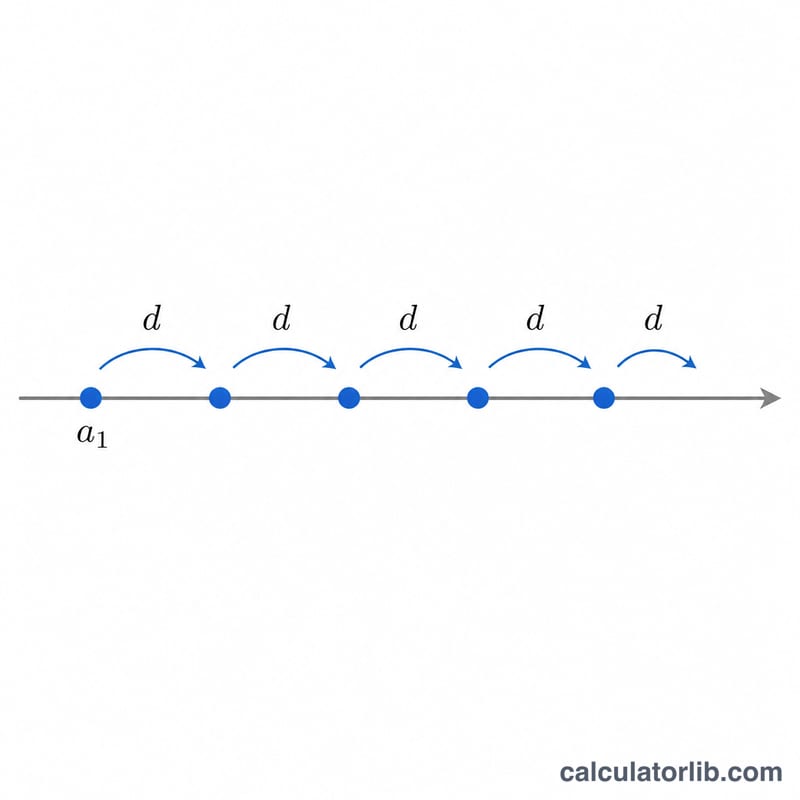
An arithmetic sequence is a list of numbers where each term increases (or decreases) by a fixed amount called the common difference, \(d\). This calculator adds up the first \(n\) terms of such a sequence, given the first term \(a_1\), the common difference \(d\), and how many terms you want to sum. It returns the total \(S_n\), the value of the last term \(a_n\), and the average of the terms.
How to use it
Enter the first term \(a_1\), the common difference \(d\) (the constant gap between consecutive terms — negative for a decreasing sequence), and \(n\), the number of terms you want to add. Click calculate to see the running total instantly.
The formula explained
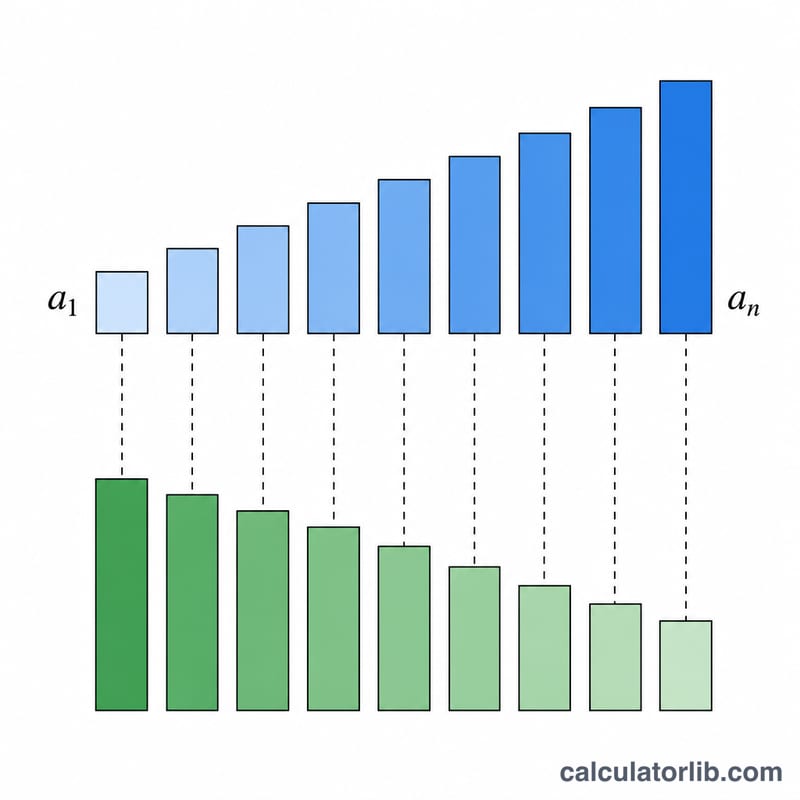
The sum of the first \(n\) terms is $$S_n = \frac{n}{2}\left(2a_1 + (n-1)d\right).$$ This works because pairing the first and last terms of the series always gives the same value, and there are \(n\) such half-pairs. An equivalent form is $$S_n = \frac{n}{2}\left(a_1 + a_n\right),$$ where \(a_n = a_1 + (n-1)d\) is the last term.
Worked example
Suppose \(a_1 = 2\), \(d = 3\), and \(n = 5\), giving the sequence 2, 5, 8, 11, 14. Then $$S_n = \frac{5}{2}\left(2\times 2 + (5-1)\times 3\right) = 2.5 \times (4 + 12) = 2.5 \times 16 = 40.$$ The last term is \(2 + 4\times 3 = 14\), and the average is \(40/5 = 8\).
FAQ
What if d is negative? Use a negative common difference for a decreasing sequence — the formula handles it directly.
Can n be a fraction? No. \(n\) is a count of terms, so it must be a positive whole number.
What is the difference between a sequence and a series? A sequence is the ordered list of terms; a series is the sum of those terms, which is exactly what \(S_n\) represents.