
What is an arithmetic sequence?
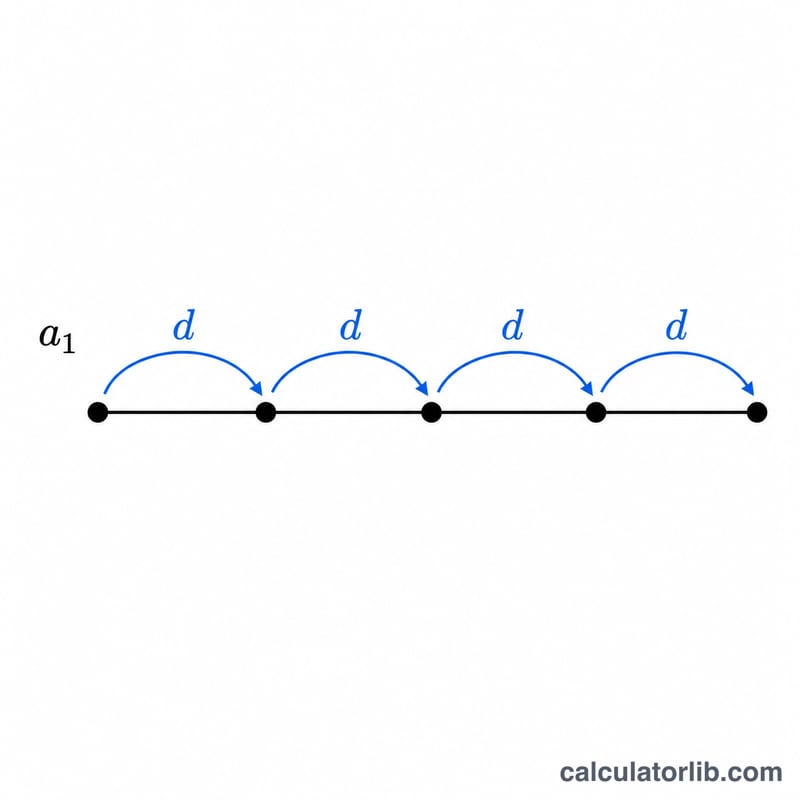
An arithmetic sequence is a list of numbers where each term differs from the previous one by a fixed amount called the common difference (\(d\)). Starting from a first term \(a_1\), the sequence reads \(a_1, a_1+d, a_1+2d\), and so on. The corresponding arithmetic series is simply the sum of those terms. This calculator finds both the nth term and the running sum for any arithmetic progression.
How to use this calculator
Enter the first term (\(a_1\)), the common difference (\(d\)), and how many terms you want (\(n\)). The tool returns the value of the nth term (\(a_n\)) and the total sum \(S_n\) of those \(n\) terms. The common difference can be positive, negative, or zero, and the first term may be any real number.
The formulas explained
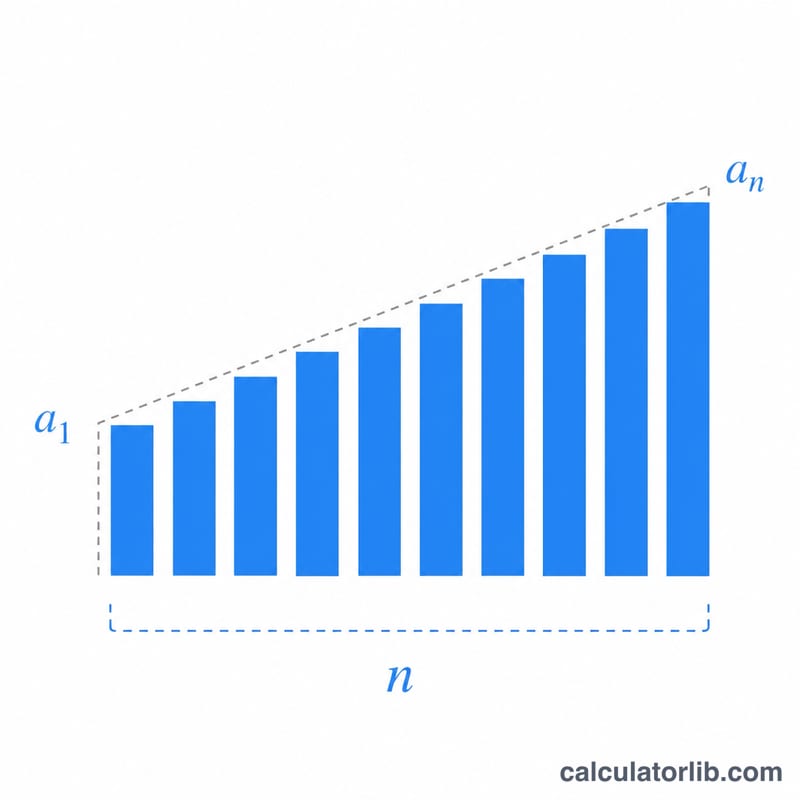
The nth term is found by adding the common difference \((n-1)\) times to the first term: $$a_n = a_1 + (n-1)d$$. The sum uses the elegant pairing trick attributed to Gauss — pair the first and last terms, the second and second-to-last, and so on. Each pair sums to \((a_1 + a_n)\), and there are \(n/2\) such pairs, giving $$S_n = \frac{n}{2}\,(a_1 + a_n)$$.
Worked example
Suppose \(a_1 = 3\), \(d = 5\), and \(n = 10\). The 10th term is $$a_{10} = 3 + (10-1)\cdot 5 = 3 + 45 = 48.$$ The sum of the first 10 terms is $$S_{10} = \frac{10}{2}\cdot(3 + 48) = 5 \cdot 51 = 255.$$ So the series \(3, 8, 13, \ldots, 48\) totals 255.
FAQ
What if the common difference is 0? Every term equals \(a_1\), so \(a_n = a_1\) and the sum is simply \(n \times a_1\).
Can the terms be negative or decimal? Yes. Any real values work for \(a_1\) and \(d\); the formulas still hold exactly.
What's the difference between a sequence and a series? A sequence is the ordered list of terms; a series is the sum of those terms.