
What this calculator does
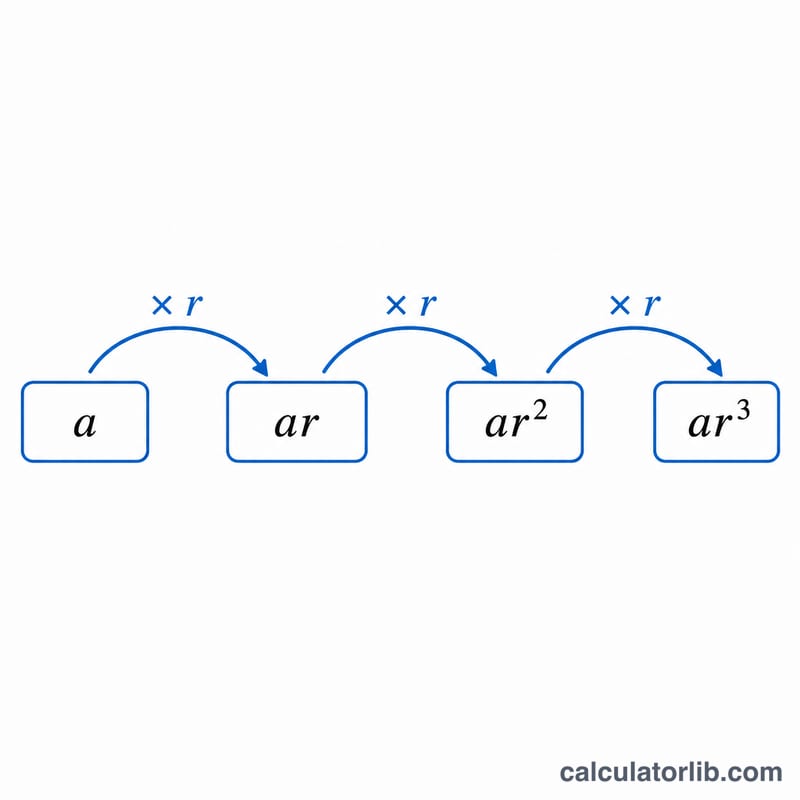
A geometric series is a sum of terms in which each term is found by multiplying the previous one by a fixed number called the common ratio. The sequence looks like a, ar, ar², ar³, …, ar^(n−1). This calculator finds two things at once: the nth term of the progression and the sum of its first n terms (the partial sum), given the first term a, the common ratio r, and the number of terms n.
How to use it
Enter the first term a (any real number, positive, negative, or fractional), the common ratio r, and the number of terms n (a positive whole number). Optionally choose a display precision to control how many significant digits are shown — this affects the display only, not the calculation. Press calculate to see both the nth term aₙ and the sum Sₙ.
The formula explained
The nth term is \(a_n = a \cdot r^{\,n-1}\). For the sum, when r is not equal to 1 we use the closed form $$S_n = a \cdot \frac{1 - r^{\,n}}{1 - r}$$ When r equals 1 every term is identical, so the denominator \(1 - r\) would be zero; in that special case the sum is simply \(S_n = n \cdot a\). The calculator branches automatically to avoid division by zero.
Worked example
With a = 1, r = 2, n = 10: the 10th term is \(a_n = 1 \cdot 2^{9} = 512\). The sum is $$S_n = 1 \cdot \frac{1 - 2^{10}}{1 - 2} = \frac{1 - 1024}{-1} = 1023$$
FAQ
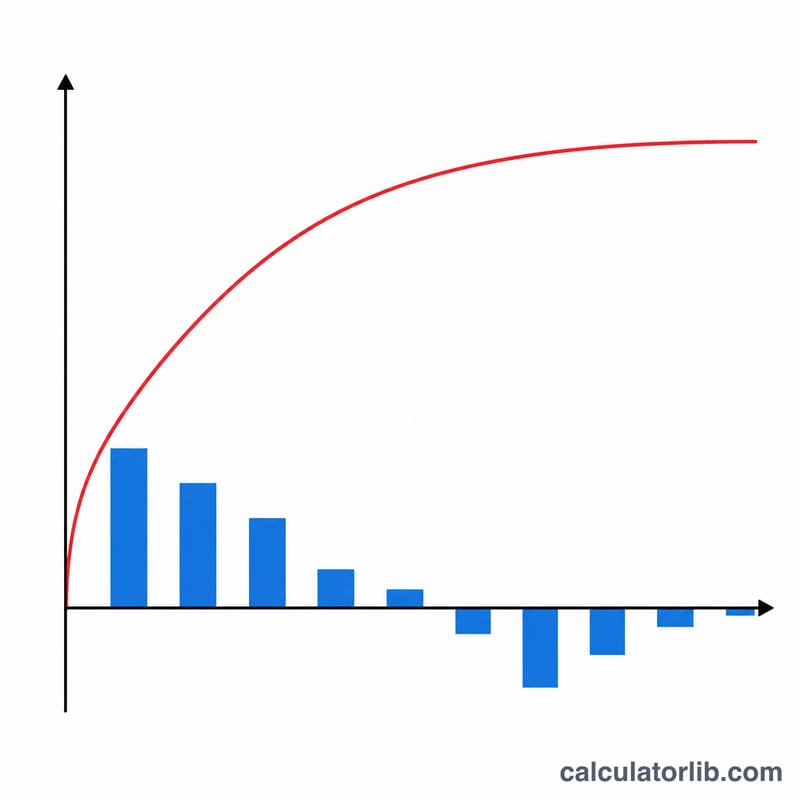
Does this compute the infinite sum? No. It always computes the finite partial sum of exactly n terms. When |r| < 1 the partial sum approaches \(a/(1-r)\) as n grows, but this tool never assumes an infinite number of terms.
Can the ratio be negative? Yes. A negative r makes the terms alternate in sign, and the formula remains valid.
What if r = 0? Then the first term contributes a and all later terms are zero, so Sₙ = a and aₙ = a only when n = 1 (otherwise 0).