
What this calculator does
This tool generates a high-precision table of the sine integral \(\operatorname{Si}(x)\) and the cosine integral \(\operatorname{Ci}(x)\) over a sequence of arguments. You choose a starting value, a step (increment), and how many points to compute, and it lists \(\operatorname{Si}(x)\) and \(\operatorname{Ci}(x)\) for every row. These are standard special functions of pure mathematics — they apply identically everywhere and involve no region-specific rules. The argument \(x\) is a dimensionless real number, interpreted in radians by the sine and cosine inside the integrals.
The formulas explained
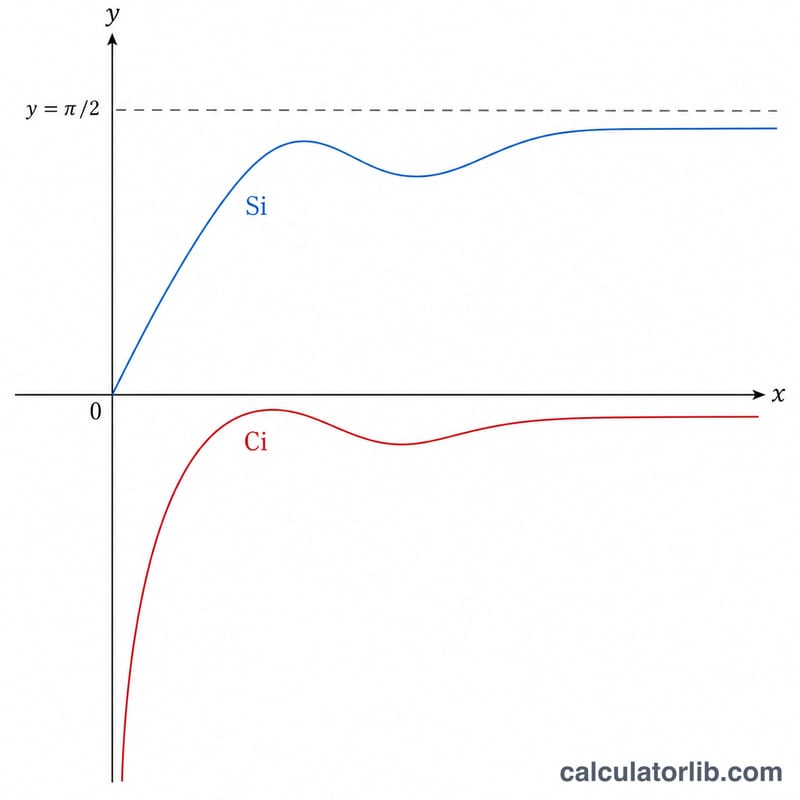
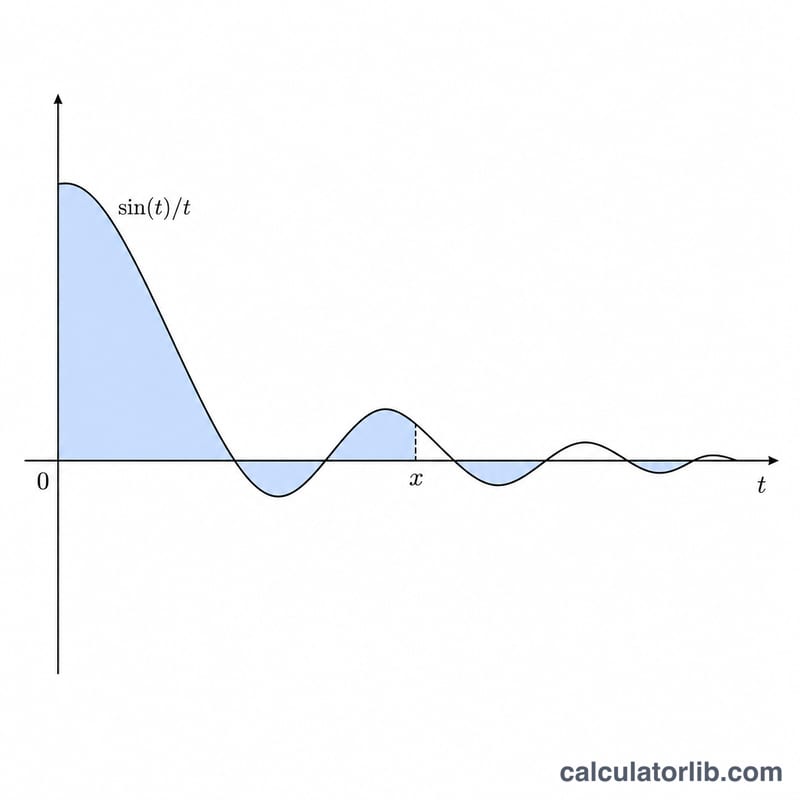
The sine integral is defined as \(\operatorname{Si}(x) = \int_0^x \frac{\sin t}{t}\, dt\). Because \(\frac{\sin t}{t}\) has a removable singularity at \(t = 0\) (its limit there is 1), \(\operatorname{Si}(0) = 0\), and \(\operatorname{Si}\) is an odd entire function: \(\operatorname{Si}(-x) = -\operatorname{Si}(x)\), with \(\operatorname{Si}(\infty) = \frac{\pi}{2}\). The cosine integral is $$\operatorname{Ci}(x) = \gamma + \ln x + \int_0^x \frac{\cos t - 1}{t}\, dt,$$ where \(\gamma \approx 0.5772156649\) is the Euler–Mascheroni constant. \(\operatorname{Ci}(x)\) is real only for \(x > 0\); for \(x \le 0\) it is reported as undefined (shown as a dash). We evaluate both with their convergent power series, summing until additional terms fall below machine precision: $$\operatorname{Si}(x) = \sum_{n=0}^{\infty} \frac{(-1)^n\, x^{2n+1}}{(2n+1)\,(2n+1)!}, \qquad \operatorname{Ci}(x) = \gamma + \ln x + \sum_{n=1}^{\infty} \frac{(-1)^n\, x^{2n}}{(2n)\,(2n)!}$$
How to use it
Enter the initial value of x, the increment, and the number of iterations. The table rows are $$x_i = \text{start} + i \cdot \text{step}, \quad i = 0, 1, \ldots, \text{count}-1.$$ For example, start 0, step 0.2, count 51 spans \(x\) from 0 to 10.
Worked example
With start = 0, step = 0.2, count = 6 the arguments are 0, 0.2, 0.4, 0.6, 0.8, 1.0. The series give $$\operatorname{Si}(1.0) = 1 - \frac{1}{18} + \frac{1}{600} - \cdots \approx 0.9460831$$ and $$\operatorname{Ci}(1.0) = \gamma + 0 + (-0.25 + 0.0104167 - \cdots) \approx 0.3374039.$$ The first row shows \(\operatorname{Si}(0) = 0\), while \(\operatorname{Ci}(0)\) is undefined (a dash) because \(\operatorname{Ci}\) diverges to \(-\infty\) as \(x \rarr 0^+\).
FAQ
Why is Ci blank for x = 0 or negative x? \(\operatorname{Ci}(x)\) contains \(\ln(x)\), which is not real for \(x \le 0\), and \(\operatorname{Ci}(x) \rarr -\infty\) as \(x \rarr 0^+\), so we mark those rows undefined.
Is Si defined for negative x? Yes — \(\operatorname{Si}\) is defined for all real \(x\) and is odd, so \(\operatorname{Si}(-x) = -\operatorname{Si}(x)\).
What is the limiting value of Si? As \(x \rarr \infty\), \(\operatorname{Si}(x) \rarr \frac{\pi}{2} \approx 1.5707963\).