
What is the Fresnel Cosine Integral?
The Fresnel cosine integral C(x) is a special function defined as the integral from 0 to x of cos(pi*t^2/2). It appears throughout optics (the intensity pattern of near-field diffraction at a straight edge), wave physics, and civil engineering, where the related clothoid or Euler spiral is used to design smooth highway and railway transition curves whose curvature grows linearly with arc length.
How to Use This Calculator
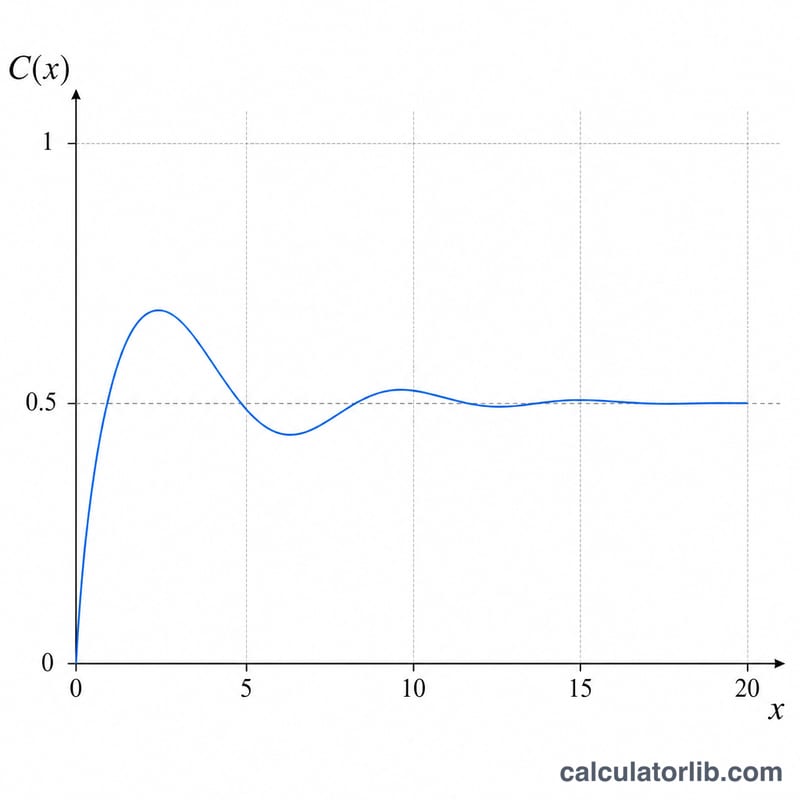
Enter the upper limit of integration \(x\) as any real number (positive, negative, or zero) and the calculator returns \(C(x)\). The value is dimensionless because \(x\) itself is a pure number. As \(|x|\) grows large, \(C(x)\) oscillates around and converges to \(+0.5\) (for \(x\) to plus infinity) or \(-0.5\) (for \(x\) to minus infinity).
The Formula and Convention
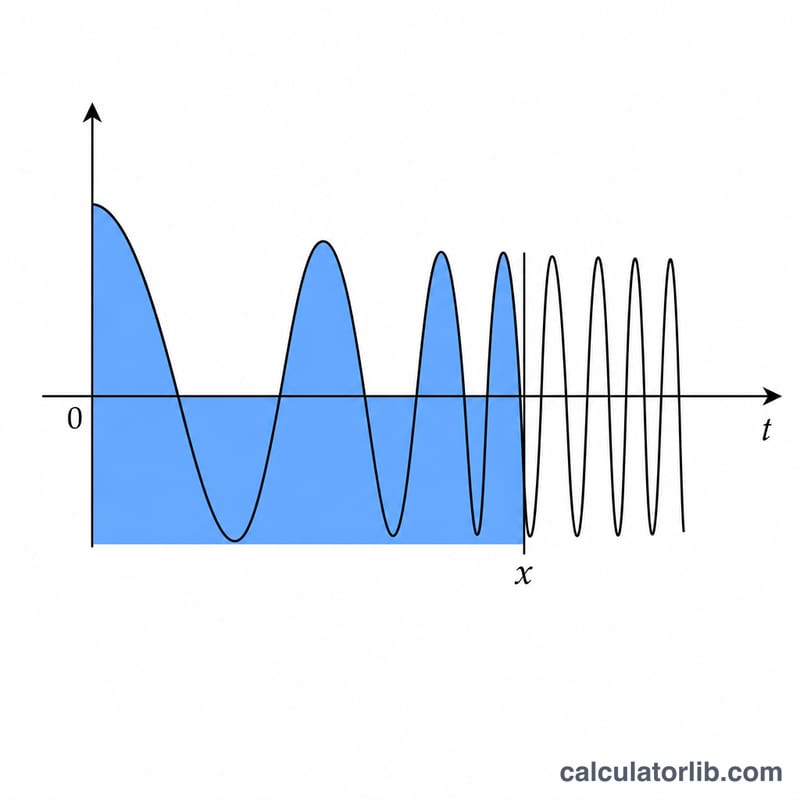
This tool uses the normalized convention, which places a \(\pi/2\) factor inside the cosine: $$C(x) = \int_{0}^{x} \cos\!\left(\frac{\pi}{2}\,t^{2}\right) dt$$ This differs from the unnormalized form \(\int \cos(t^{2})\). Because no closed form exists, the value is obtained by composite Simpson's rule using a fine, \(x\)-dependent grid of \(n = \max(1000, \lceil 200\,|x| \rceil)\) subintervals; an asymptotic expansion is used for very large \(|x|\) to avoid integrating enormous numbers of oscillations.
Worked Example
For \(x = 1\), $$C(1) = \int_{0}^{1} \cos\!\left(\frac{\pi}{2}\,t^{2}\right) dt$$ Numerical integration gives the standard value \(C(1) \approx 0.7798934004\). For \(x = 0.5\), \(C(0.5) \approx 0.4923442275\). For \(x = 0\), \(C(0) = 0\) exactly.
FAQ
Is C(x) odd or even? It is an odd function: \(C(-x) = -C(x)\), so a negative input returns the negative mirror of \(C(|x|)\).
What is the limit at infinity? \(C(x)\) approaches \(+1/2\) as \(x\) grows positive and \(-1/2\) as \(x\) grows negative.
How accurate is the result? The double-precision Simpson scheme delivers roughly 10 reliable significant digits for ordinary inputs; true 50-digit output would require arbitrary-precision arithmetic.