
What is a conical frustum?
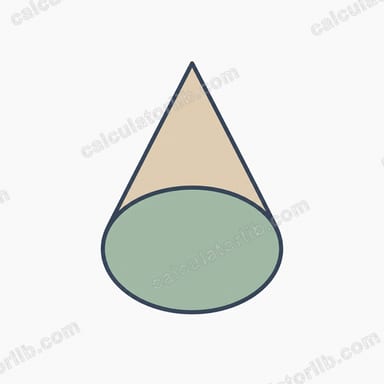
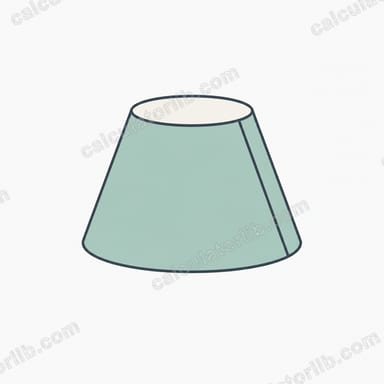
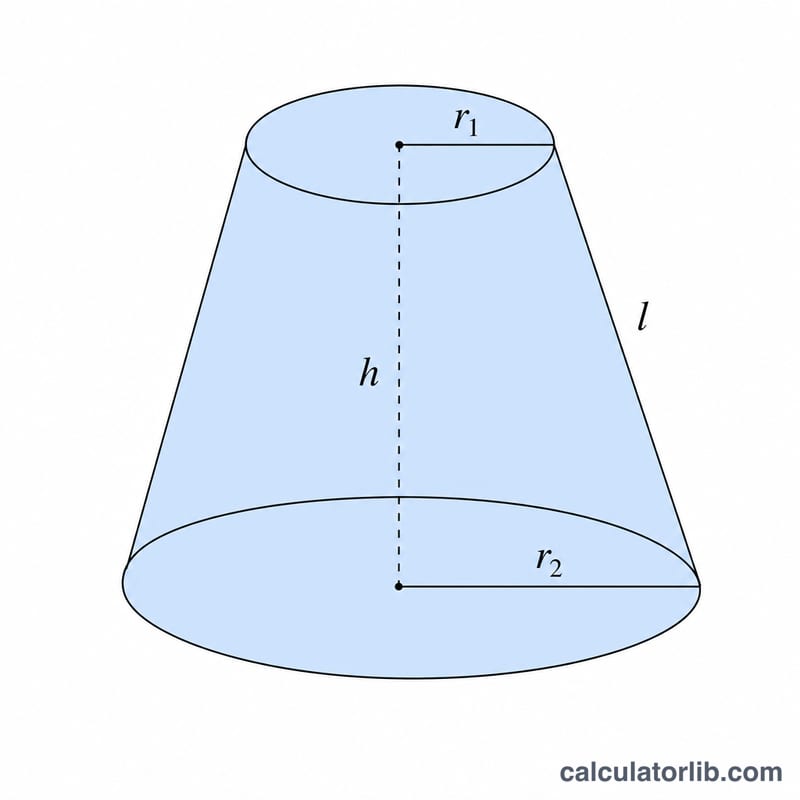
A conical frustum, also called a truncated cone, is the solid that remains when you slice the top off a cone with a cut parallel to its base. It has two parallel circular faces: a larger bottom face of radius \(r_1\) and a smaller top face of radius \(r_2\), separated by a perpendicular height \(h\). This calculator finds the volume, the lateral (side) surface area, the total surface area, and the slant height. It is pure geometry and works with any consistent length unit.
How to use it
Enter the bottom radius (\(r_1\)), the top radius (\(r_2\)) and the perpendicular height (\(h\)), then pick a length unit. Use the same unit for all three measurements. The volume is reported in that unit cubed and the surface areas in that unit squared. Set \(r_2 = 0\) to model a full cone, or \(r_1 = r_2\) to model a cylinder.
The formula explained
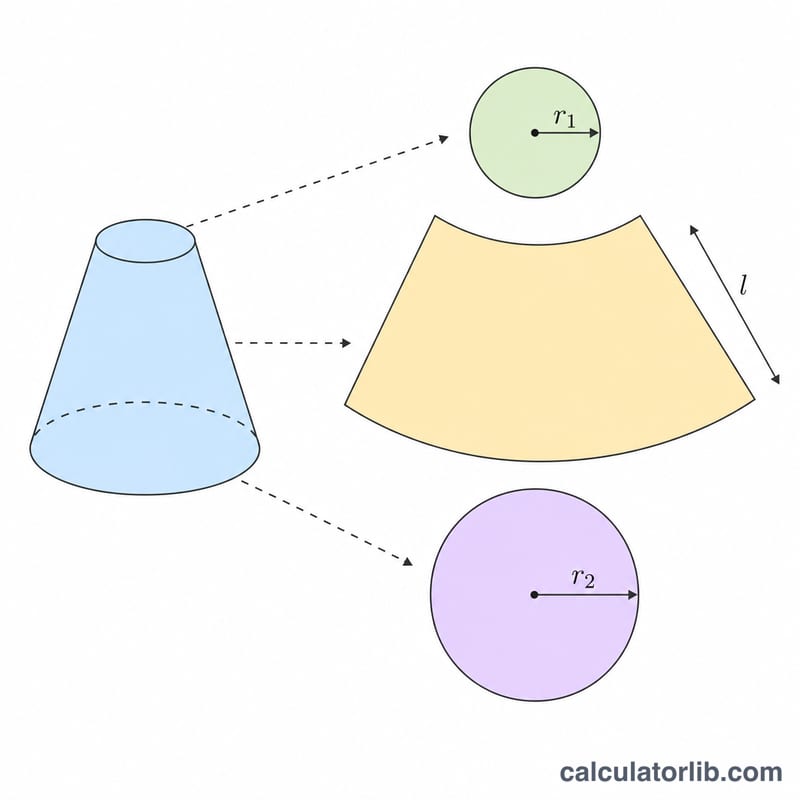
The volume is $$V = \frac{\pi \cdot h}{3}\left(r_1^{2} + r_1\cdot r_2 + r_2^{2}\right).$$ The slant height is the diagonal distance along the side: $$\ell = \sqrt{h^{2} + \left(r_1 - r_2\right)^{2}}.$$ The lateral surface area is $$S_{\text{side}} = \pi\left(r_1 + r_2\right)\ell.$$ Adding both circular caps gives the total surface area $$S = S_{\text{side}} + \pi r_1^{2} + \pi r_2^{2}.$$
Worked example
For \(r_1 = 3\), \(r_2 = 2\), \(h = 5\) (meters): \(r_1^{2} + r_1\cdot r_2 + r_2^{2} = 9 + 6 + 4 = 19\), so $$V = \frac{\pi\cdot 5}{3}\cdot 19 \approx 99.4838 \text{ m}^3.$$ The slant height \(\ell = \sqrt{25 + 1} = \sqrt{26} \approx 5.099 \text{ m}\). Lateral area $$S_{\text{side}} = \pi\cdot 5\cdot 5.099 \approx 80.1037 \text{ m}^2.$$ Caps add \(\pi\cdot 9 + \pi\cdot 4 \approx 40.8407 \text{ m}^2\), giving total \(S \approx 120.9444 \text{ m}^2\).
FAQ
Does the order of the radii matter? No. The slant height uses \(\left(r_1 - r_2\right)^{2}\), so swapping the two radii gives the same surface area and volume.
What if the top radius is zero? The frustum becomes a full cone, and the formulas reduce to the standard cone volume \(V = \frac{\pi h}{3} r_1^{2}\) and slant height \(\sqrt{h^{2} + r_1^{2}}\).
What if both radii are equal? You get a cylinder, where \(\ell = h\), \(V = \pi r_1^{2} h\) and \(S_{\text{side}} = 2\pi r_1\cdot h\).