
What is the Wake-Up Time Calculator?
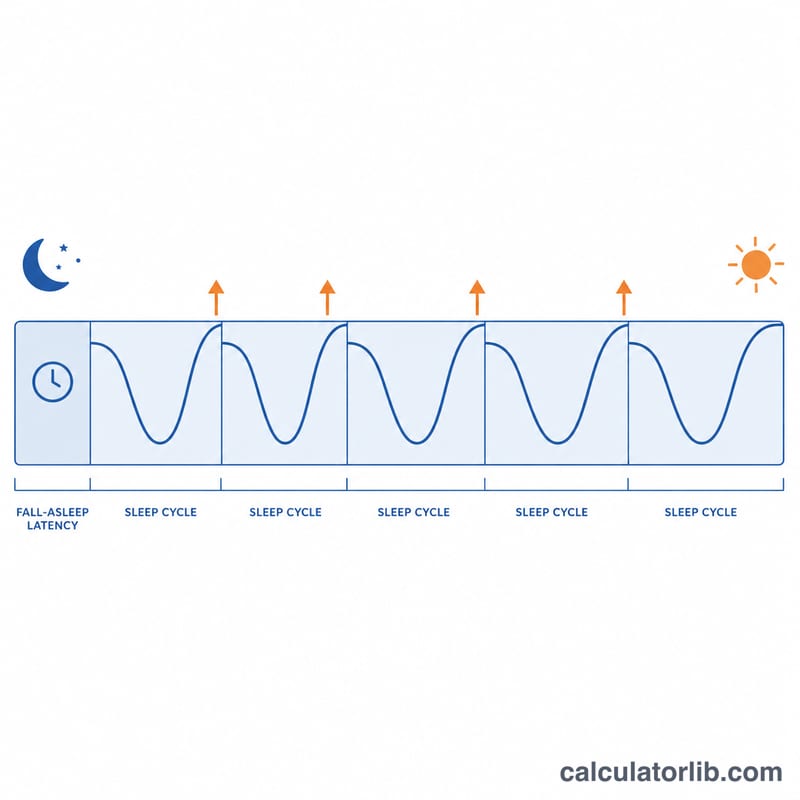
This calculator tells you the best times to wake up based on natural 90-minute sleep cycles. Waking at the end of a cycle — rather than in the middle of deep sleep — helps you feel more refreshed. Enter your bedtime and how long it usually takes you to fall asleep, and the tool shows wake times for 4, 5, and 6 complete cycles.
How to use it
Choose your bedtime hour, minute, and AM/PM, then enter your fall-asleep latency (the time it takes to drift off, often 10–20 minutes). The calculator adds the latency to your bedtime to estimate sleep onset, then adds whole 90-minute cycles. Six cycles (about 9 hours including some lighter sleep) is the highlighted recommendation, with 5 and 4 cycles listed for shorter nights.
The formula explained
WakeUpTime = SleepTime + fallAsleepLatency + n × 90 minutes.
$$\text{WakeUpTime} = \text{SleepTime} + \text{fallAsleepLatency} + n \times 90 \text{ minutes}$$Sleep onset equals bedtime plus latency. Each cycle averages 90 minutes, so \(n\) cycles add \(n\times 90\) minutes. The result wraps around midnight using modulo 24 hours.
Worked example
Bedtime 10:30 PM with 14 minutes latency: sleep onset is 10:44 PM. Adding 6 cycles (540 minutes) gives 7:44 AM (about 9 hours of cycle time).
$$6 \times 90 = 540 \text{ minutes} \;\Rightarrow\; 10{:}44\text{ PM} + 540 = 7{:}44\text{ AM}$$Five cycles (450 minutes) gives 6:14 AM (7.5 h); four cycles (360 minutes) gives 4:44 AM (6 h).
$$5 \times 90 = 450 \text{ minutes} \;\Rightarrow\; 6{:}14\text{ AM} \quad (7.5\text{ h})$$$$4 \times 90 = 360 \text{ minutes} \;\Rightarrow\; 4{:}44\text{ AM} \quad (6\text{ h})$$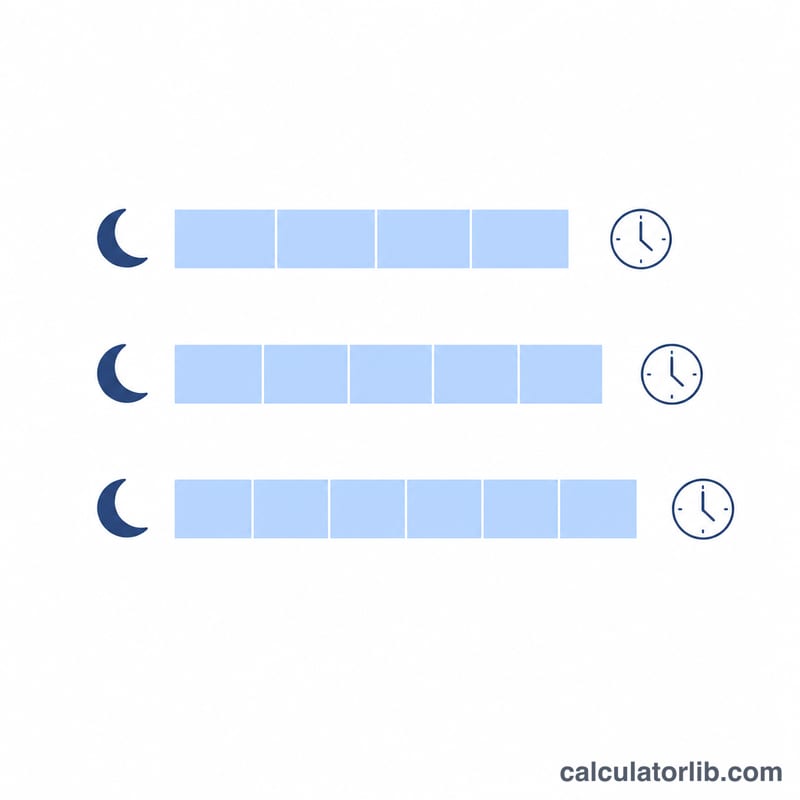
FAQ
Why 90 minutes? A typical sleep cycle through light, deep, and REM stages lasts roughly 90 minutes for most adults.
Is the latency required? It improves accuracy. If you fall asleep instantly, set it to 0.
Why does more sleep not always feel better? Waking mid-cycle can cause grogginess (sleep inertia), so a slightly shorter night that ends at a cycle boundary may feel better.