
What this calculator does
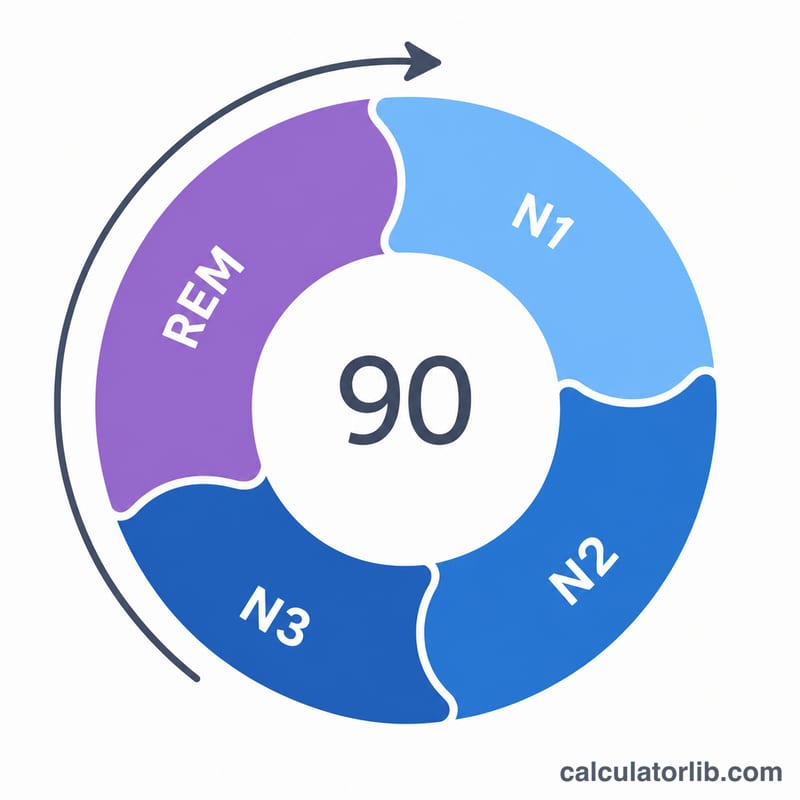
This Wake-Up Time Calculator turns your planned bedtime into a short list of ideal alarm times. Sleep happens in repeating cycles of roughly 90 minutes, each moving from light sleep through deep sleep and REM. Waking at the end of a cycle — rather than in the middle of deep sleep — tends to leave you feeling alert instead of groggy. The tool offers four practical options corresponding to 3, 4, 5 and 6 complete cycles, which equal 4.5, 6, 7.5 and 9 hours of sleep.
How to use it
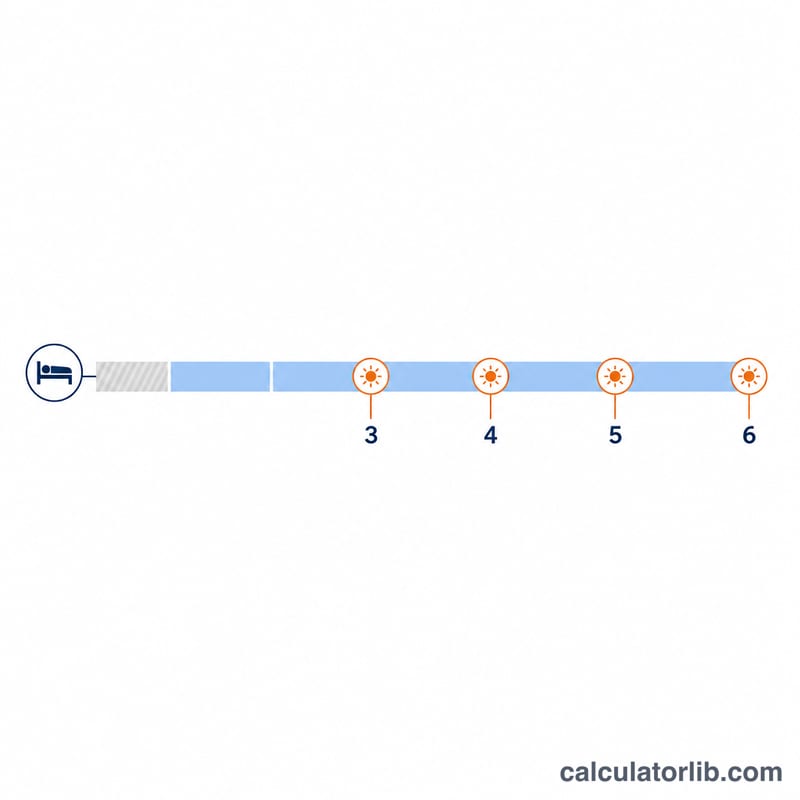
Pick the hour and minute you plan to get into bed, choose AM or PM, and set how many minutes it usually takes you to fall asleep (15 minutes is typical). The calculator adds your fall-asleep buffer and then layers on whole 90-minute cycles, returning the clock time for each option. Aim for 7.5 or 9 hours on most nights; the shorter options are useful for naps or unavoidable short nights.
The formula explained
The math is simple addition on the clock:
$$\text{wake} = \text{bedtime} + \text{fall-asleep minutes} + 90 \times n$$With \(n = 3, 4, 5, 6\) you get the four cycle counts. Total sleep is just \(1.5 \times n\) hours. We compute everything in minutes since midnight and wrap past midnight automatically so the displayed time is always a valid 12-hour clock value.
Worked example
Bedtime 11:00 PM with 15 minutes to fall asleep means you are asleep at 11:15 PM (1395 minutes after midnight). Five cycles add 450 minutes → 1845 minutes → \(1845 - 1440 = 405\) minutes past midnight = 6:45 AM for 7.5 hours. Six cycles add 540 minutes → 8:15 AM for 9 hours.
FAQ
Is a sleep cycle always exactly 90 minutes? No — it ranges from about 70 to 120 minutes and varies by person and night. Ninety minutes is a reliable average for planning.
Should I include time to fall asleep? Yes. Counting cycles from when you actually drift off (not when you lie down) makes the wake times more accurate.
Which option is best? For most adults, 7.5 or 9 hours (5 or 6 cycles) supports full rest. Use 4.5 or 6 hours only when a longer sleep isn't possible.