

What is the Wake Up Time Calculator?
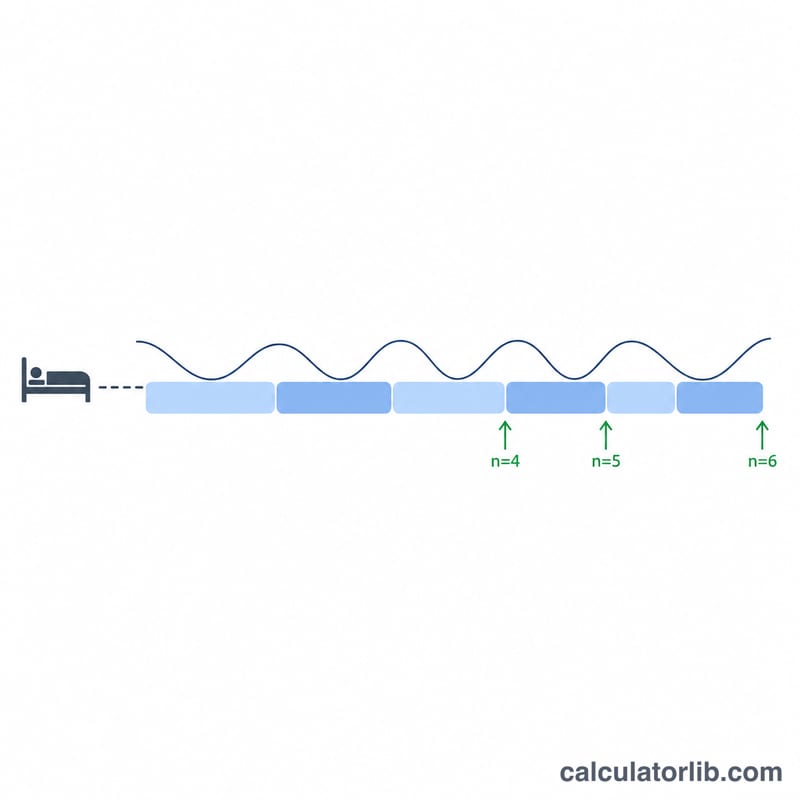
Sleep happens in repeating cycles of roughly 90 minutes, each moving you from light sleep through deep sleep and into REM. Waking up at the end of a cycle — rather than in the middle of deep sleep — helps you feel refreshed instead of groggy. This calculator takes your planned bedtime, adds about 14 minutes to fall asleep, and then suggests wake-up times that land at the end of 4, 5, or 6 full sleep cycles.
How to use it
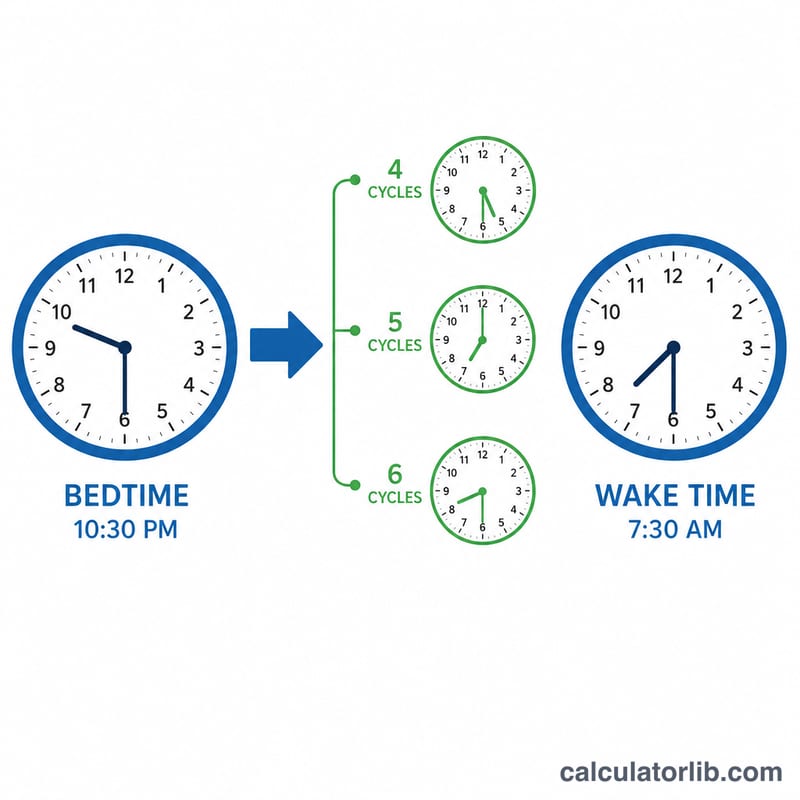
Enter the hour and minute you plan to get into bed and choose AM or PM. The calculator shows three good wake-up times. Five cycles (about 7.5 hours) is the recommended sweet spot for most adults; six cycles (about 9 hours) suits those who need more rest, and four cycles (about 6 hours) is a shorter option for a tight schedule.
The formula explained
The core equation is $$\text{WakeTime} = \text{Bedtime} + 14 \text{ minutes} + n \times 90 \text{ minutes}$$, where \(n\) is the number of complete cycles. The 14-minute buffer is the average time it takes a person to drift off. Each cycle adds 90 minutes of sleep, so the math simply stacks whole cycles on top of your sleep-onset moment.
Worked example
Suppose you go to bed at 11:00 PM. Adding 14 minutes puts sleep onset at 11:14 PM. Five cycles add 450 minutes (7.5 hours), giving a wake-up time of 6:44 AM. Four cycles (6 hours) gives 5:14 AM, and six cycles (9 hours) gives 8:14 AM.
FAQ
Why 14 minutes? Studies estimate the average healthy adult takes 10–20 minutes to fall asleep, so 14 minutes is a reasonable default buffer.
Is 90 minutes exact for everyone? No — cycle length varies from about 80 to 110 minutes between people and across the night. Treat the results as helpful targets, not strict rules.
Which option should I pick? Most adults feel best with 5 cycles (~7.5 hours). Choose 6 if you've been sleep-deprived, or 4 only occasionally when time is short.