
What is the EASI Score?
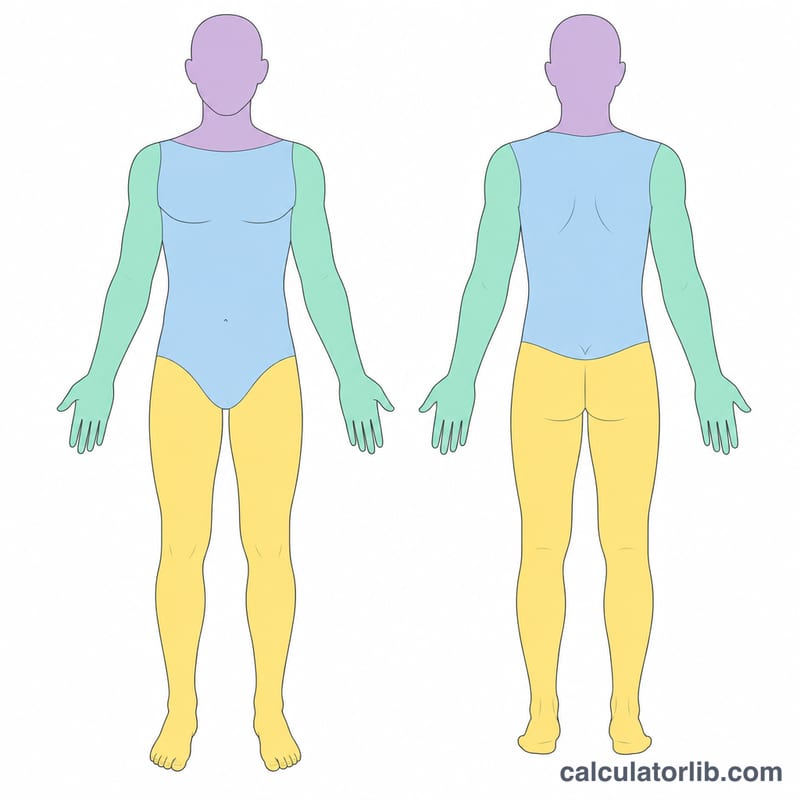
The Eczema Area and Severity Index (EASI) is a validated clinical tool used worldwide to grade the severity of atopic dermatitis (eczema). It scores four body regions — head/neck, upper limbs, trunk and lower limbs — for four signs of disease and combines them with the percentage of skin involved in each region. The final EASI ranges from 0 (clear) to 72 (most severe) and is widely used in clinical trials and routine care to track response to treatment.
How to use this calculator
For each of the four regions, rate the four clinical signs — Erythema (redness), Induration/Papulation (thickness/swelling), Excoriation (scratch marks) and Lichenification (leathery skin) — on a 0–3 scale (0 = none, 3 = severe). Then choose the Area score (0–6) representing the proportion of that region affected: 0 = 0%, 1 = 1–9%, 2 = 10–29%, 3 = 30–49%, 4 = 50–69%, 5 = 70–89%, 6 = 90–100%. The calculator applies each region's weight and returns the total.
The formula explained
For each region the four signs are added (0–12), multiplied by the area score (0–6), then by a region weight. The weights — 0.1, 0.2, 0.3, 0.4 for head/neck, upper limbs, trunk and lower limbs — reflect the relative body surface area of each region in adults. Adding the four regional contributions gives the EASI.
$$\begin{gathered} \text{EASI} = 0.1\,S_{H}A_{H} + 0.2\,S_{U}A_{U} + 0.3\,S_{T}A_{T} + 0.4\,S_{L}A_{L} \\[1.5em] \text{where}\quad \left\{ \begin{aligned} S_{H} A_{H} &= \left(\text{E} + \text{I} + \text{Ex} + \text{L}\right)\cdot\text{Area}_{H} \\ S_{U} A_{U} &= \left(\text{E} + \text{I} + \text{Ex} + \text{L}\right)\cdot\text{Area}_{U} \\ S_{T} A_{T} &= \left(\text{E} + \text{I} + \text{Ex} + \text{L}\right)\cdot\text{Area}_{T} \\ S_{L} A_{L} &= \left(\text{E} + \text{I} + \text{Ex} + \text{L}\right)\cdot\text{Area}_{L} \end{aligned} \right. \end{gathered}$$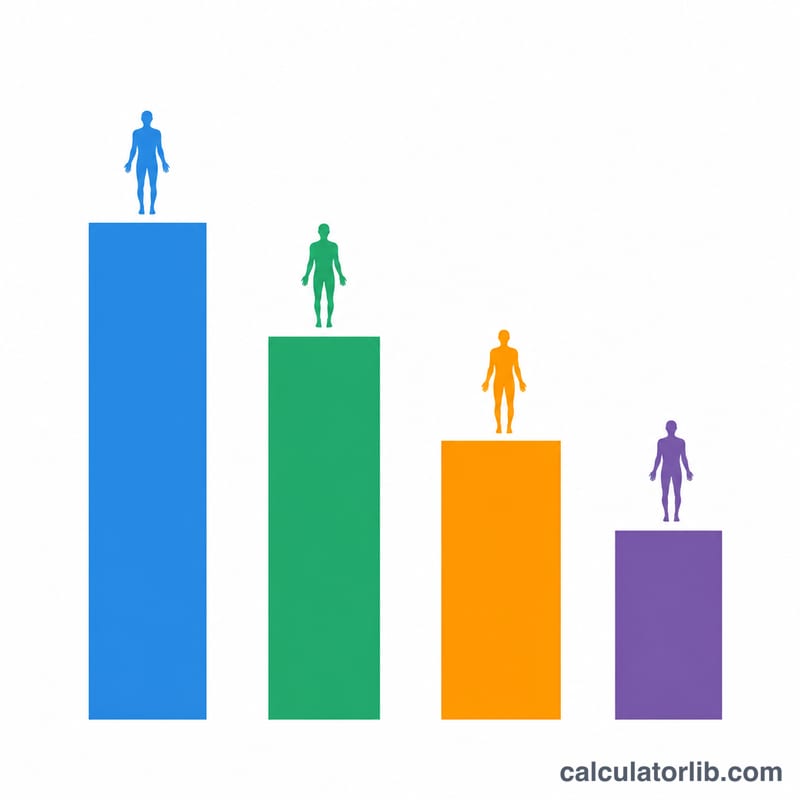
Worked example
Suppose head/neck has E=2, I=1, Ex=1, L=0 (sum 4) with area 3: \(4 \times 3 \times 0.1 = 1.2\). Upper limbs sum 4, area 2: \(4 \times 2 \times 0.2 = 1.6\). Trunk sum 3, area 3: \(3 \times 3 \times 0.3 = 2.7\). Lower limbs sum 2, area 2: \(2 \times 2 \times 0.4 = 1.6\). Total EASI =
$$\text{EASI} = 1.2 + 1.6 + 2.7 + 1.6 = 7.1$$in the "moderate" band.
FAQ
What do the score bands mean? Common interpretation: 0 = clear, 0.1–1.0 almost clear, 1.1–7.0 mild, 7.1–21.0 moderate, 21.1–50.0 severe, 50.1–72 very severe.
Does EASI include itch? No — EASI measures only objective signs and area, not symptoms like itch or sleep loss.
Is this a diagnosis? No. This calculator is an educational aid; clinical assessment by a qualified professional is required for diagnosis and treatment decisions.