
What is the LRINEC Score?
The Laboratory Risk Indicator for Necrotizing Fasciitis (LRINEC) score is a clinical scoring system developed by Wong et al. (2004) to help distinguish necrotizing fasciitis from other severe soft tissue infections such as cellulitis or abscess. It combines six routine blood test results into a single number from 0 to 13. Because necrotizing fasciitis is rapidly progressive and life-threatening, early recognition is critical, and the LRINEC score offers an objective adjunct to clinical assessment.
How to use this calculator
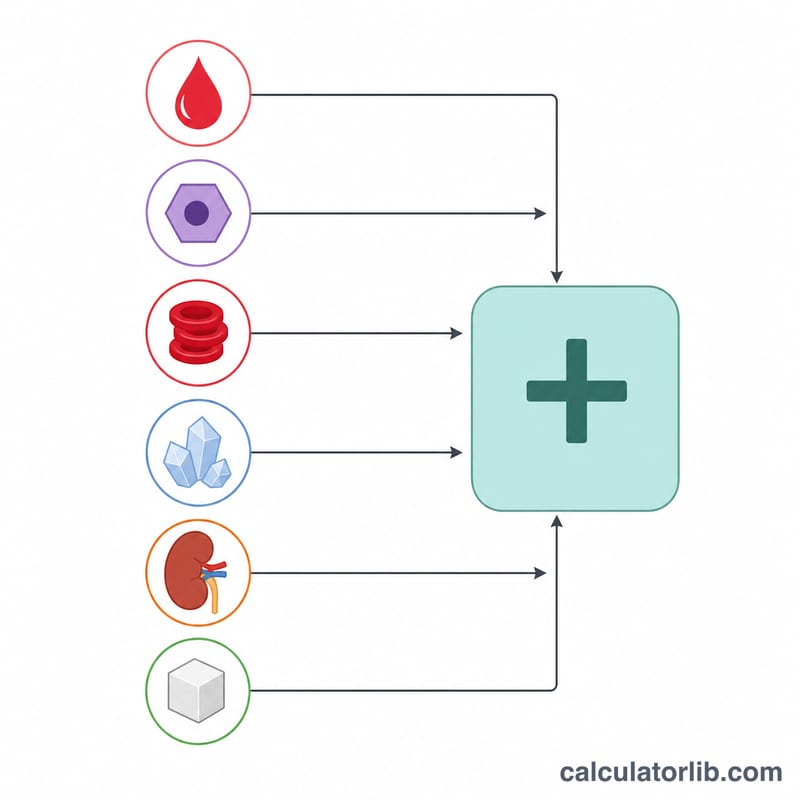
Enter the patient's most recent values for C-reactive protein (CRP, mg/L), white blood cell count (×10⁹/L), hemoglobin (g/dL), serum sodium (mmol/L), creatinine (µmol/L) and glucose (mmol/L). The calculator awards points for each abnormal result, sums them, and reports the total along with a risk category.
The formula explained
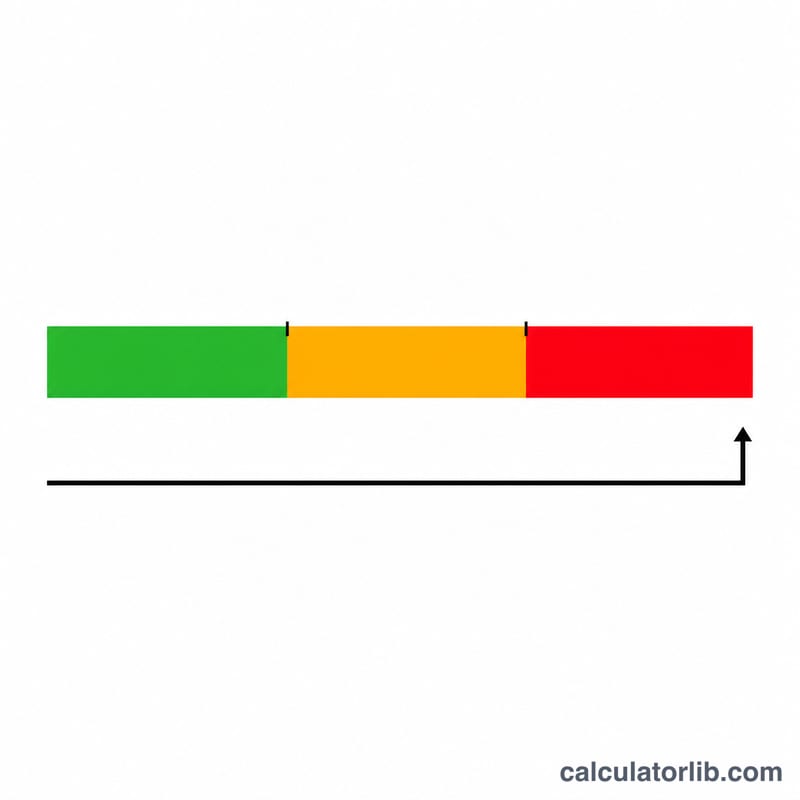
Points are assigned as follows: CRP ≥150 mg/L = 4 points; WBC 15–25 = 1, >25 = 2; hemoglobin 11–13.5 = 1, <11 = 2; sodium <135 = 2; creatinine >141 = 2; glucose >10 = 1. A total of 6 or more raises concern. Interpretation: ≤5 indicates low risk (<50% probability), 6–7 intermediate risk (50–75%), and ≥8 high risk (>75%).
$$\text{LRINEC} = \underbrace{\big[\text{CRP}\!\ge\!150\big]\!\cdot\!4}_{\text{C-Reactive Protein}} + f_{\text{WBC}}\!\left(\text{WBC}\right) + f_{\text{Hb}}\!\left(\text{Hb}\right) + \big[\text{Na}\!<\!135\big]\!\cdot\!2 + \big[\text{Cr}\!>\!141\big]\!\cdot\!2 + \big[\text{Glucose}\!>\!10\big]\!\cdot\!1$$
$$f_{\text{WBC}} = \begin{cases} 2 & \text{WBC} > 25 \\ 1 & 15 \le \text{WBC} \le 25 \\ 0 & \text{otherwise} \end{cases} \qquad f_{\text{Hb}} = \begin{cases} 2 & \text{Hb} < 11 \\ 1 & 11 \le \text{Hb} \le 13.5 \\ 0 & \text{otherwise} \end{cases}$$
Worked example
Consider CRP 160, WBC 16, Hb 12, Na 134, Cr 150, glucose 11. CRP ≥150 → 4; WBC 15–25 → 1; Hb 11–13.5 → 1; Na <135 → 2; Cr >141 → 2; glucose >10 → 1. Total = $$4+1+1+2+2+1 = 11$$, placing the patient in the high-risk category.
FAQ
Can a low score rule out necrotizing fasciitis? No. A low LRINEC score does not exclude the diagnosis. Surgical exploration remains the gold standard, and a high index of clinical suspicion always overrides the score.
What units should I use? CRP in mg/L, WBC in ×10⁹/L, hemoglobin in g/dL, sodium and glucose in mmol/L, creatinine in µmol/L, matching the original validation study.
Is this a substitute for medical care? No. This calculator is for educational and decision-support purposes only and must be interpreted by a qualified clinician alongside the full clinical picture.