
What is the BED Calculator?
The Biologically Effective Dose (BED) calculator is a radiotherapy tool based on the linear-quadratic (LQ) model. It expresses the biological impact of a fractionated radiation schedule independent of the specific fraction size, allowing clinicians and physicists to compare different treatment regimens on a common scale. BED accounts for the fact that the same total physical dose can have very different biological effects depending on how it is split into fractions.
How to use it
Enter three values: the number of fractions (n), the dose delivered per fraction in Gray (d), and the alpha/beta ratio (α/β) of the tissue of interest. Typical α/β values are around 10 Gy for most tumors and acutely responding tissues, and 2–3 Gy for late-responding normal tissues. The calculator returns the BED, the total physical dose (n × d), and the EQD2 — the dose that, given in 2 Gy fractions, would produce the same biological effect.
The formula explained
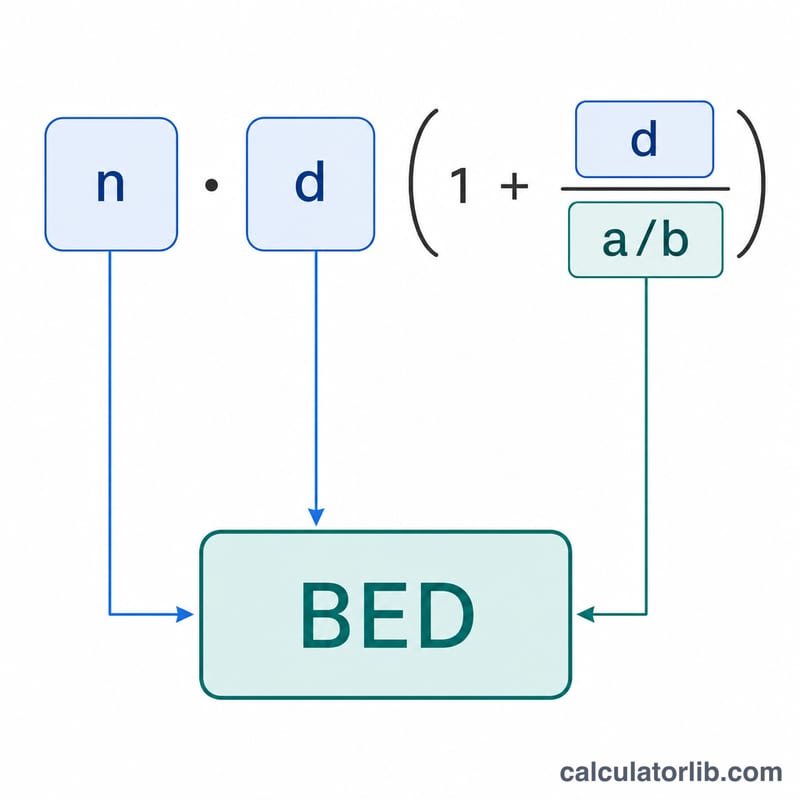
The core equation is $$\text{BED} = \text{n} \cdot \text{d} \left(1 + \frac{\text{d}}{\alpha/\beta}\right)$$. The term \(\text{n} \cdot \text{d}\) is the total physical dose, while the factor \(\left(1 + \frac{\text{d}}{\alpha/\beta}\right)\) scales it up to reflect the greater biological effect of larger fraction sizes. EQD2 is then BED divided by \(\left(1 + \frac{2}{\alpha/\beta}\right)\).
Worked example
For a conventional schedule of 25 fractions of 2 Gy with α/β = 10 Gy: $$\text{BED} = 25 \times 2 \times \left(1 + \frac{2}{10}\right) = 50 \times 1.2 = 60 \text{ Gy}$$ The total physical dose is 50 Gy, and the EQD2 is $$\frac{60}{1 + \frac{2}{10}} = \frac{60}{1.2} = 50 \text{ Gy}$$ — as expected for a 2 Gy-per-fraction schedule.
Common Alpha/Beta Ratios by Tissue Type
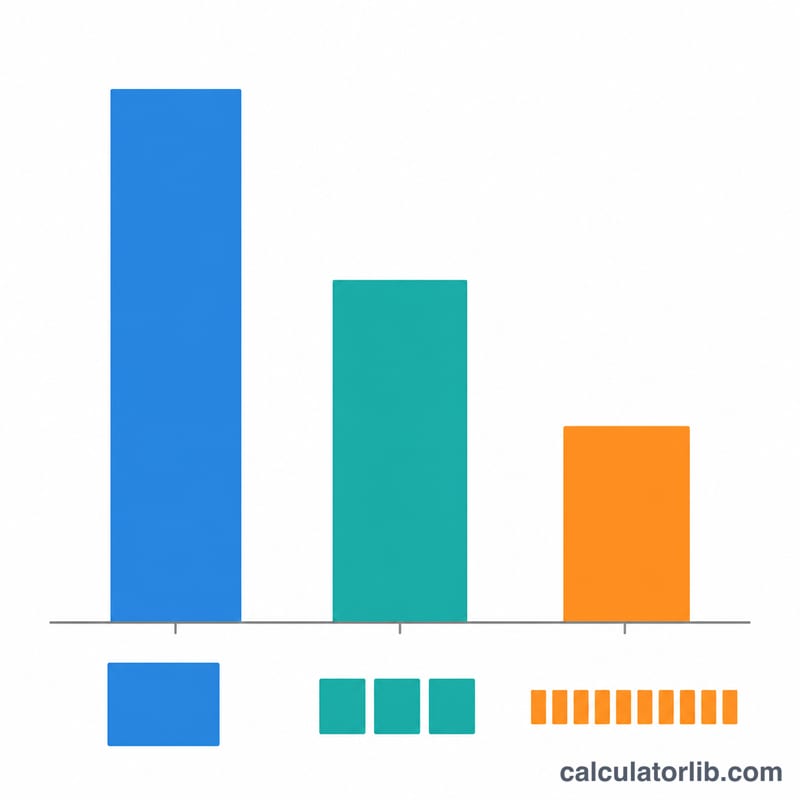
The α/β ratio (in Gy) describes how sensitive a tissue is to changes in dose per fraction. It is the dose at which the linear (\(\alpha\)) and quadratic (\(\beta\)) components of cell killing in the linear-quadratic model contribute equally. High α/β tissues respond mainly to total dose and are relatively insensitive to fraction size; low α/β tissues are strongly affected by larger doses per fraction.
| Tissue / Effect type | Response class | Typical α/β (Gy) |
|---|---|---|
| Most tumors / early-responding tissues | Early | ~10 |
| Skin (acute reaction), mucosa | Early | ~10 |
| Prostate carcinoma | Tumor (late-like) | ~1.5 |
| Breast carcinoma | Tumor (late-like) | ~4 |
| Lung (late, pneumonitis/fibrosis) | Late | ~3 |
| Spinal cord (myelopathy) | Late | ~2 |
| Late-responding normal tissues (general) | Late | 2–3 |
These are representative literature values used for planning and comparison; the appropriate α/β for an individual patient and endpoint should be selected by the treating radiation oncologist. This is general information, not professional medical advice.
Key Terms & Variables
- n — number of fractions
- How many separate treatment sessions the total dose is split into.
- d — dose per fraction (Gy)
- The absorbed dose delivered in a single session. Total physical dose is \(D = n \cdot d\).
- α/β ratio (Gy)
- A tissue-specific parameter from the linear-quadratic model; the dose at which the linear and quadratic cell-kill terms are equal. High values (~10 Gy) characterize tumors and early-responding tissue; low values (2–3 Gy) characterize late-responding tissue.
- BED — Biologically Effective Dose
- A measure of the true biological damage of a fractionation schedule, allowing schedules with different fraction sizes to be compared: \(\text{BED} = n\,d\left(1 + \frac{d}{\alpha/\beta}\right)\). Expressed in Gy.
- EQD2 — Equivalent Dose in 2 Gy fractions
- The dose that, given in 2 Gy fractions, would produce the same biological effect: \(\text{EQD2} = \text{BED} \big/ \left(1 + \frac{2}{\alpha/\beta}\right)\). Useful because 2 Gy is the conventional reference fraction size.
- Linear-quadratic (LQ) model
- The standard radiobiological model in which the surviving fraction of cells after a dose \(d\) is \(S = e^{-(\alpha d + \beta d^2)}\). It underlies the BED and EQD2 formulas.
- Gray (Gy)
- The SI unit of absorbed dose, equal to one joule of energy deposited per kilogram of tissue (1 Gy = 100 rad).
- Early-responding tissue
- Tissue with rapid turnover (skin, mucosa, most tumors) that shows reactions during or soon after treatment; high α/β, relatively insensitive to fraction size.
- Late-responding tissue
- Slowly proliferating tissue (spinal cord, lung, kidney) where injury appears months to years later; low α/β, highly sensitive to large doses per fraction.
This is general educational information about radiotherapy dosimetry, not professional or medical advice. Treatment decisions should be made by qualified radiation oncology professionals.
FAQ
What α/β value should I use? Use ~10 Gy for tumors/early effects and ~2–3 Gy for late normal-tissue effects; always confirm the appropriate value for your clinical context.
Is BED the same as the physical dose? No. BED is a biological quantity and is always greater than or equal to the physical dose; only as fraction size approaches zero do they converge.
Why EQD2? EQD2 lets you compare non-standard schedules against the familiar 2 Gy-per-fraction reference used in many clinical protocols.