
What Is the Child-Pugh Score?
The Child-Pugh score (also called the Child-Turcotte-Pugh, or CTP, score) is a clinical tool used to assess the severity and prognosis of chronic liver disease, primarily cirrhosis. It combines two laboratory values and three clinical findings into a single number that places a patient into Class A, B, or C. The score is widely used to estimate survival, guide treatment decisions, and assess surgical risk in patients with liver disease.
How to Use This Calculator
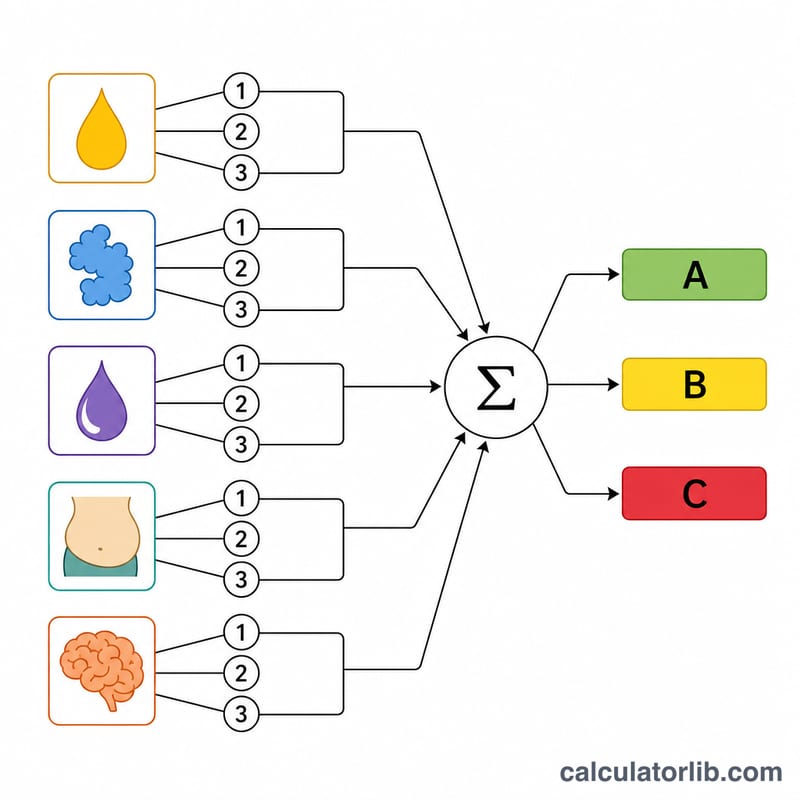
Enter the patient's total bilirubin (mg/dL), serum albumin (g/dL), and INR (prothrombin time ratio). Then select the severity of ascites and hepatic encephalopathy from the dropdowns. The calculator awards 1, 2, or 3 points for each parameter, sums them, and reports the total score (5-15) along with the Child-Pugh class.
The Scoring Formula
Each of the five parameters scores 1-3 points using these standard thresholds: Bilirubin \(<2 = 1\), \(2\text{-}3 = 2\), \(>3 = 3\) mg/dL. Albumin \(>3.5 = 1\), \(2.8\text{-}3.5 = 2\), \(<2.8 = 3\) g/dL. INR \(<1.7 = 1\), \(1.7\text{-}2.3 = 2\), \(>2.3 = 3\). Ascites and encephalopathy each score 1 (none), 2 (mild/controlled), or 3 (moderate-severe). The total ranges from 5 to 15.
$$\begin{gathered} \text{Score} = P_{\text{bili}} + P_{\text{alb}} + P_{\text{inr}} + \text{Ascites} + \text{Encephalopathy} \\[1.5em] \text{where}\quad \left\{ \begin{aligned} P_{\text{bili}} &= \begin{cases} 1 & \text{Bilirubin} < 2 \\ 2 & 2 \le \text{Bilirubin} \le 3 \\ 3 & \text{Bilirubin} > 3 \end{cases} \\[0.4em] P_{\text{alb}} &= \begin{cases} 1 & \text{Albumin} > 3.5 \\ 2 & 2.8 \le \text{Albumin} \le 3.5 \\ 3 & \text{Albumin} < 2.8 \end{cases} \\[0.4em] P_{\text{inr}} &= \begin{cases} 1 & \text{INR} < 1.7 \\ 2 & 1.7 \le \text{INR} \le 2.3 \\ 3 & \text{INR} > 2.3 \end{cases} \end{aligned} \right. \end{gathered}$$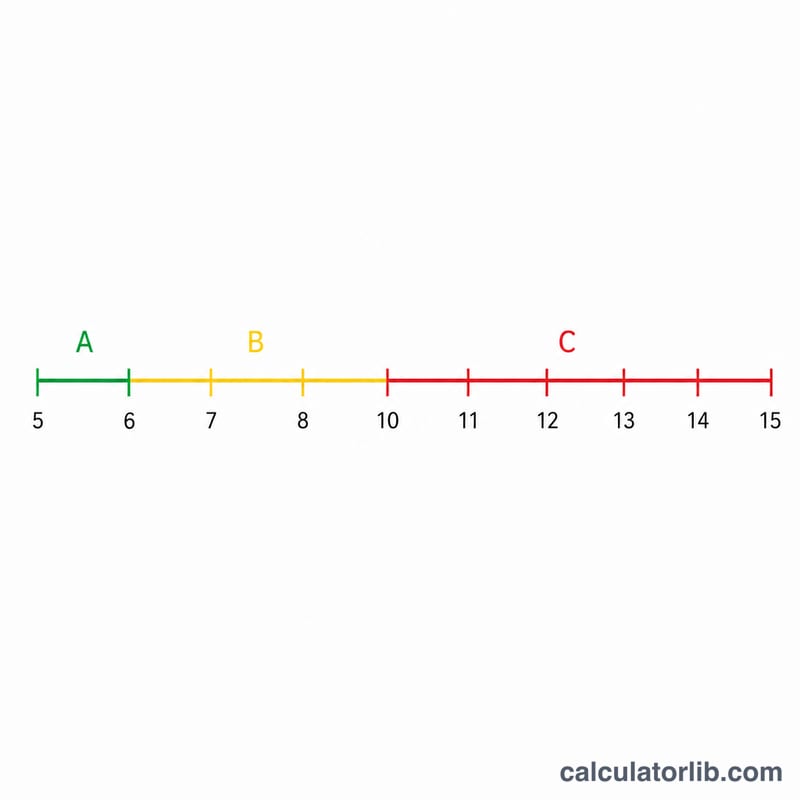
Worked Example
A patient has bilirubin 2.5 mg/dL (2 pts), albumin 3.0 g/dL (2 pts), INR 1.5 (1 pt), mild ascites (2 pts), and grade I encephalopathy (2 pts). Total =
$$2 + 2 + 1 + 2 + 2 = 9 \text{ points}$$which is Child-Pugh Class B. This corresponds to roughly 80% one-year survival.
FAQ
What does Class A, B, or C mean? Class A (5-6) indicates well-compensated disease with the best prognosis; Class B (7-9) is significant functional compromise; Class C (10-15) is decompensated disease with the worst prognosis.
How does it differ from the MELD score? MELD uses bilirubin, INR, and creatinine in a continuous formula and is used for transplant prioritization, while Child-Pugh is simpler and includes clinical signs (ascites, encephalopathy).
Is this a diagnostic tool? No. This calculator is for educational purposes and should not replace evaluation by a qualified clinician.