
What Is the Aldrete Score?
The Aldrete Score is a widely used clinical tool that assesses a patient's readiness for discharge from the Post-Anesthesia Care Unit (PACU) after surgery or sedation. Introduced by Dr. Antonio Aldrete in 1970 and later updated (the Modified Aldrete Score adds oxygen saturation), it evaluates five physiological parameters, each scored 0, 1, or 2, for a maximum total of 10.
How to Use This Calculator
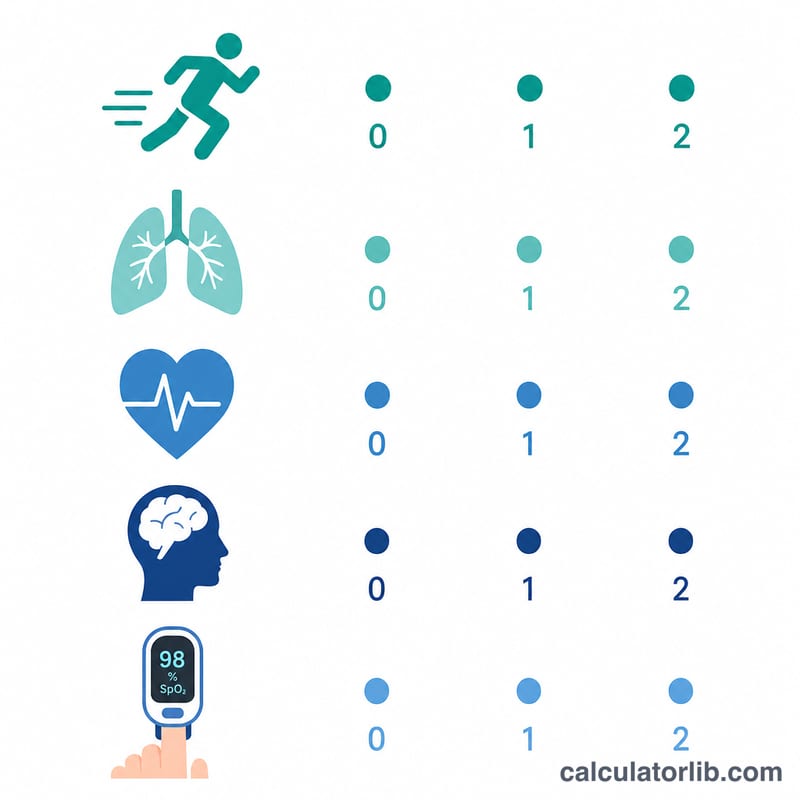
Select the best description for each of the five categories: activity (muscle movement), respiration, circulation (blood pressure), consciousness, and oxygen saturation. The calculator adds the five values and reports a total from 0 to 10, along with a recovery interpretation. A score of 9 or higher is commonly used as a threshold for discharge from the PACU, though final decisions always rest with the attending clinician.
The Formula Explained
The score is a simple sum: $$\text{Aldrete} = \text{Activity} + \text{Respiration} + \text{Circulation} + \text{Consciousness} + \text{Oxygen Saturation}$$ Each criterion contributes 0 (worst), 1 (intermediate), or 2 (best). Because all five are weighted equally, the minimum possible score is 0 and the maximum is 10.
Worked Example
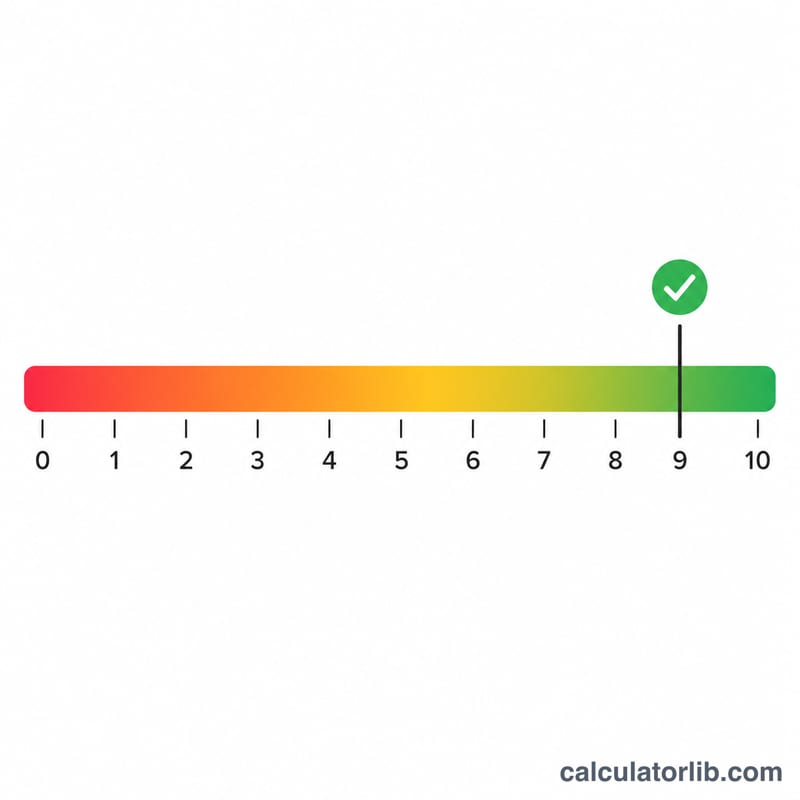
A patient moves all four extremities (Activity = 2), breathes deeply and coughs freely (Respiration = 2), has blood pressure within 20% of baseline (Circulation = 2), is fully awake (Consciousness = 2), and maintains SpO₂ above 92% on room air (Oxygen = 2). Total = $$2 + 2 + 2 + 2 + 2 = \mathbf{10}$$ indicating full recovery and discharge readiness.
Interpreting Your Aldrete Score
The Modified Aldrete Score sums five criteria—activity, respiration, circulation, consciousness, and oxygen saturation—each rated from 0 to 2, for a total ranging from 0 to 10. A higher score reflects more complete recovery from anesthesia. The total is used in the post-anesthesia care unit (PACU) to help decide when a patient is ready to move to a lower level of care.
| Score | General Interpretation | Typical Action |
|---|---|---|
| 9–10 | Recovery is essentially complete; patient generally meets criteria for PACU discharge. | Consider discharge from PACU per institutional protocol. |
| 8 | Recovery is nearly complete but one or more parameters remain borderline. | Often warrants continued monitoring and reassessment. |
| Below 8 | Recovery is incomplete; one or more systems have not adequately stabilized. | Continue active recovery and monitoring; do not discharge. |
For example, a patient who moves all four limbs (activity = 2), breathes deeply and coughs freely (respiration = 2), has blood pressure within 20 mmHg of baseline (circulation = 2), is fully awake (consciousness = 2), and maintains an oxygen saturation above 92% on room air (oxygen = 2) would score 10, indicating readiness for discharge under most protocols.
Many institutions use a threshold of 9 or higher as a common discharge criterion, though a score of 10 may be required if it represents the patient's pre-operative baseline. Discharge thresholds are institution-dependent and may be adjusted for a patient's baseline status (for instance, chronic mobility limitations or supplemental oxygen requirements). The Aldrete Score is a structured aid that complements, but does not replace, the clinical judgment of the anesthesia and nursing team, who also weigh factors such as pain control, nausea, surgical bleeding, and the type of anesthesia used.
This is general information, not medical advice. Discharge decisions should always be made by qualified clinicians following local protocols.
FAQ
What score is needed for discharge? Most institutions require a score of 9 or 10 before transferring a patient out of the PACU.
What is the difference from the original Aldrete? The original used skin color as the fifth criterion; the Modified Aldrete Score replaced it with oxygen saturation measured by pulse oximetry.
Is this a substitute for clinical judgment? No. The Aldrete Score is a structured aid only; discharge decisions must be made by qualified medical staff considering the full clinical picture.