
What this calculator does
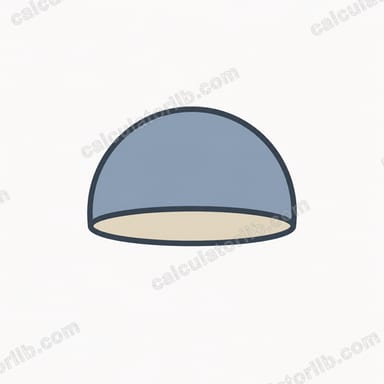
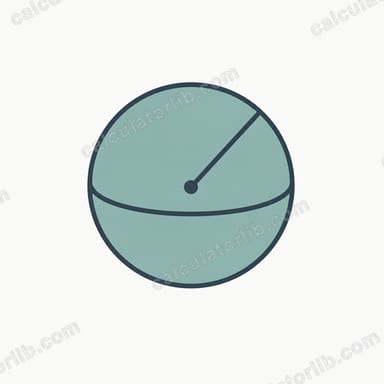
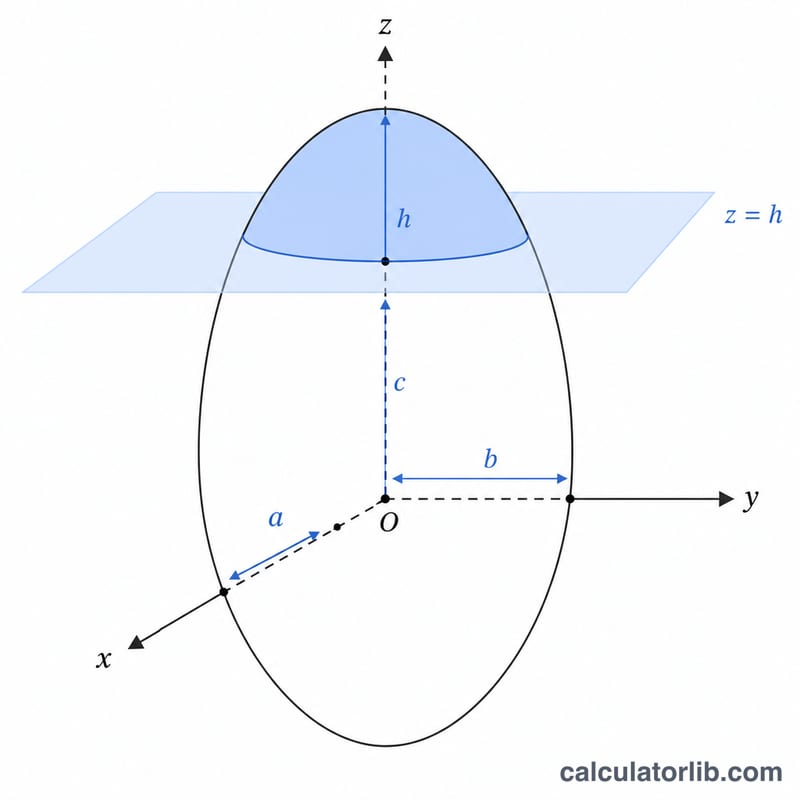
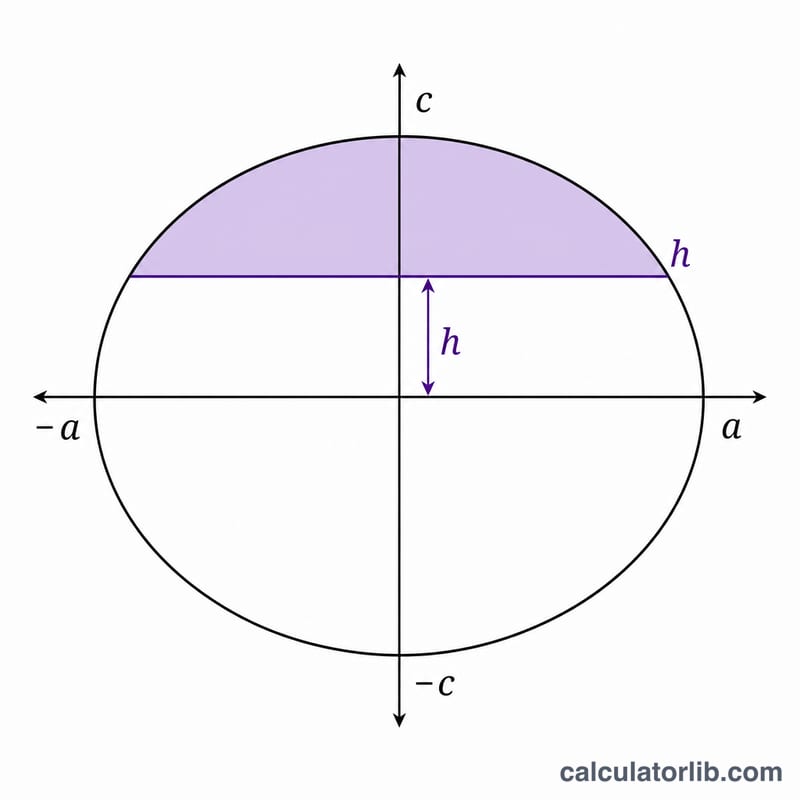
This tool computes the volume and surface area of a truncated (partial) triaxial ellipsoid. Start with a full ellipsoid centered at the origin with semi-axes a, b and c, defined by \((x/a)^2 + (y/b)^2 + (z/c)^2 = 1\). The c-axis is vertical, running from \(z = -c\) (bottom) to \(z = +c\) (top). We slice the solid with a horizontal plane and keep the bottom cap of height h measured up from \(z = -c\). This is pure, universal geometry and applies anywhere — all four inputs are plain numbers in one shared length unit.
How to use it
Enter the three semi-axes a, b, c and the cut height h. The height must satisfy \(0 \le h \le 2c\); at \(h = 2c\) you get the whole ellipsoid, and at \(h = c\) you get exactly half of it. Results are returned in the same length unit you used: volume in cubic units and surface area in square units. There are no unit dropdowns, so no scaling is applied.
The formula explained
Let \(u = h/c\) be the dimensionless fill fraction. Integrating the elliptical cross-section area \(\pi ab\left(1 - (t/c)^2\right)\) from the bottom upward gives the exact closed form $$V = \pi\,a\,b\,c\left[(u-1) - \frac{(u-1)^3}{3} + \frac{2}{3}\right]$$ The surface area splits into two pieces: a flat elliptical cut face of area $$A_{\text{flat}} = \pi\,a\,b\left(2u - u^2\right)$$ and a curved lateral cap. Because a triaxial ellipsoid surface has no elementary closed form, the curved part is computed by a numerical (Simpson) double integral of the ellipsoid surface element over \(\theta\) in \([0, 2\pi]\) and \(\phi\) in \([0, \arccos(u-1)]\). $$A_{\text{curved}} = \int_{0}^{2\pi}\!\!\int_{0}^{\phi_{\max}} \sin\phi\,\sqrt{c^{2}\sin^{2}\!\phi\,(b^{2}\cos^{2}\!\theta + a^{2}\sin^{2}\!\theta) + a^{2}b^{2}\cos^{2}\!\phi}\;\, d\phi\, d\theta$$ $$S = A_{\text{flat}} + A_{\text{curved}}$$
Worked example
Take \(a = 2\), \(b = 3\), \(c = 4\), \(h = 3\), so \(u = 0.75\). Volume term \(= (-0.25) - (-0.25)^3/3 + 2/3 = 0.421875\), giving $$V = \pi\cdot 24\cdot 0.421875 \approx \mathbf{31.81}$$ The flat face has \(k^2 = 2u - u^2 = 0.9375\), area \(= \pi\cdot 6\cdot 0.9375 \approx 17.67\). The curved cap integrates to about \(81.2\), so the total surface area \(S \approx \mathbf{98.9}\).
FAQ
Is the volume exact? Yes — the volume is a closed-form result with no approximation.
Is the surface area exact? The flat cut face is exact; the curved cap is computed by high-resolution numerical integration (\(64\times 64\) panels), which is accurate to several significant digits.
What if \(h > 2c\)? The height is clamped to \(2c\), which corresponds to the full ellipsoid (flat area becomes zero).