
What is the Berg Balance Scale?
The Berg Balance Scale (BBS) is a widely used clinical tool that measures static and dynamic balance in adults, especially older people and patients in stroke or neurological rehabilitation. It consists of 14 functional tasks — such as standing unsupported, reaching forward, turning around, and standing on one leg — each scored from 0 (unable) to 4 (independent and safe). This calculator adds your 14 task scores into a single total from 0 to 56 and reports a fall-risk category.
How to use this calculator
Perform or observe each of the 14 standardized tasks and assign a score between 0 and 4 according to the official BBS criteria. Enter each score in the matching field and the calculator instantly sums them and classifies the result. Higher totals indicate better balance and lower fall risk.
The formula explained
The score is a simple sum:
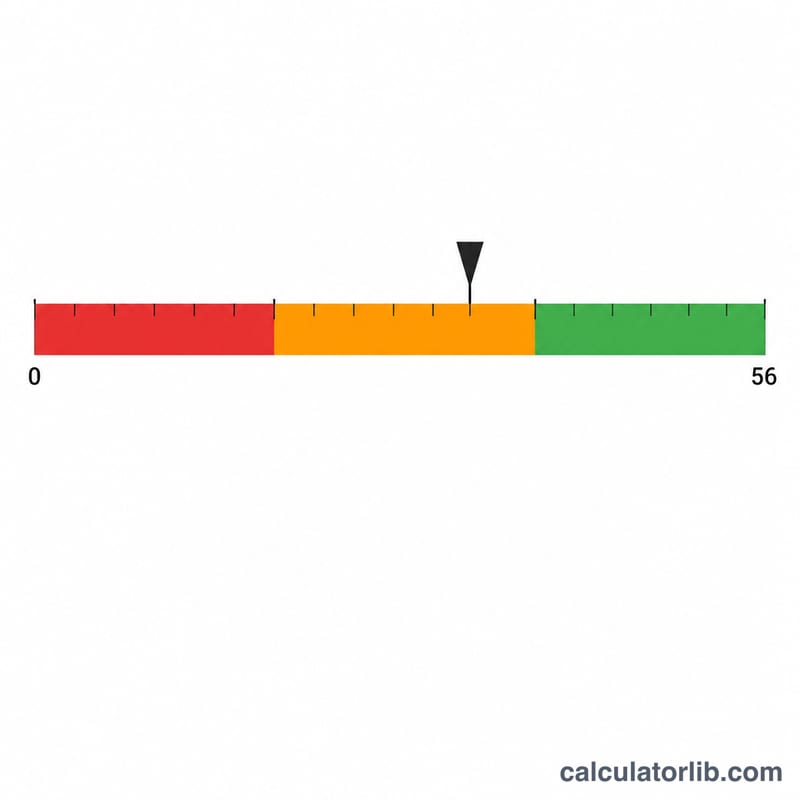
$$\text{BBS} = t_1 + t_2 + \ldots + t_{14}$$where each \(t_i\) is bounded between 0 and 4. The maximum possible total is \(14 \times 4 = 56\). Risk bands are applied to the total: 0–20 = high fall risk (often wheelchair-bound), 21–40 = medium fall risk (walking with assistance), and 41–56 = low fall risk (independent).
Worked example
Suppose a patient scores 4 on ten tasks and 3 on the remaining four. That is
$$(10 \times 4) + (4 \times 3) = 40 + 12 = 52$$A total of 52 falls in the 41–56 band, so the result is a low fall risk with good functional balance.
BBS Score Reference Table: Task-by-Task Scoring Criteria
The Berg Balance Scale (BBS) comprises 14 functional tasks, each scored from 0 (unable / unsafe) to 4 (able to perform independently and safely). The sum of all 14 tasks gives a total score from 0 to 56. The table below summarizes each task and the general meaning of its 0–4 scale. Scoring requires direct observation by a trained clinician using the standardized instructions; the descriptions below are summaries, not the full verbatim criteria.
| # | Task | Field | Score 4 (best) | Score 0 (worst) |
|---|---|---|---|---|
| 1 | Sitting to standing | t1 | Stands without using hands, stabilizes independently | Needs moderate/maximal assistance to stand |
| 2 | Standing unsupported | t2 | Stands safely for 2 minutes | Unable to stand 30 seconds unassisted |
| 3 | Sitting unsupported (feet on floor) | t3 | Sits safely and securely for 2 minutes | Unable to sit 10 seconds without support |
| 4 | Standing to sitting | t4 | Sits safely with minimal use of hands | Needs assistance to sit |
| 5 | Transfers (between chairs) | t5 | Transfers safely with minor use of hands | Needs two people to assist or supervise |
| 6 | Standing with eyes closed | t6 | Stands 10 seconds safely with eyes closed | Needs help to keep from falling |
| 7 | Standing with feet together | t7 | Places feet together independently, stands 1 minute safely | Needs help, cannot hold 15 seconds |
| 8 | Reaching forward with outstretched arm | t8 | Reaches forward confidently >25 cm (10 in) | Needs help / loses balance while trying |
| 9 | Retrieving object from floor | t9 | Picks up object safely and easily | Unable / needs assistance to keep from falling |
| 10 | Turning to look behind over shoulders | t10 | Looks behind both sides with good weight shift | Needs assistance to prevent loss of balance |
| 11 | Turning 360 degrees | t11 | Turns 360° safely in ≤4 seconds each direction | Needs assistance while turning |
| 12 | Placing alternate foot on step/stool | t12 | Stands independently, completes 8 steps in 20 seconds | Needs assistance to keep from falling / unable |
| 13 | Standing with one foot in front (tandem) | t13 | Places foot tandem independently, holds 30 seconds | Loses balance stepping or standing |
| 14 | Standing on one leg | t14 | Lifts leg independently, holds >10 seconds | Unable to try or needs help to prevent falling |
A perfect performance scores 4 on every item for a maximum total of \(4 \times 14 = 56\). The intermediate scores (1, 2, 3) reflect increasing time held, increasing distance reached, or decreasing need for supervision and assistance as defined in the standardized BBS instructions.
Interpreting Your BBS Score
The total BBS score ranges from 0 to 56, with higher scores indicating better functional balance. Scores are commonly grouped into three fall-risk bands:
| Total score | Fall-risk category | General interpretation |
|---|---|---|
| 0–20 | High risk | Marked balance impairment; typically wheelchair-bound or requires assistance for most mobility tasks |
| 21–40 | Medium risk | Moderate impairment; often walks with assistance or an assistive device |
| 41–56 | Low risk | Good functional balance; generally independent ambulation |
For example, a person scoring 4 on the first ten items and 3 on the last four tasks would total \(40 + 12 = \) 52, placing them in the low-risk band.
Cutoff for independent ambulation. A score of approximately 45 is frequently cited in the literature as a threshold below which an individual may be at greater risk of falling and may require closer supervision or an assistive device for safe independent ambulation. As with any single cutoff, it should be applied cautiously and in context rather than as an absolute rule.
Tracking change over time. Because the BBS is often repeated to monitor progress, it is important to know how large a change must be to exceed measurement error. Reported minimal detectable change (MDC) values vary by population and baseline score, but changes on the order of 4 to 8 points are commonly used as a guide for a real, clinically meaningful change rather than normal test-to-test variability. Smaller shifts may simply reflect day-to-day or rater variation. Notably, the scale shows ceiling effects near the top of the range, so high-functioning individuals may score 56 even when subtle balance deficits remain.
Use as a screening and tracking tool. The BBS is a screening and outcome-tracking instrument, not a stand-alone diagnosis. A score should always be interpreted alongside clinical judgment, gait assessment, fall history, medication review, and other balance measures such as the Tinetti Performance-Oriented Mobility Assessment. This page provides general educational information and is not a substitute for professional medical evaluation; balance and fall-risk decisions should be made by a qualified clinician.
FAQ
What is a good Berg Balance Scale score? A score of 41–56 generally indicates good balance and low fall risk, while scores below 45 have been associated with increased fall risk in some studies.
Is this a medical diagnosis? No. The BBS is a screening and tracking tool. Use it alongside clinical judgment and other assessments; consult a qualified clinician for diagnosis and treatment.
How long does the assessment take? A full Berg Balance Scale assessment typically takes about 15–20 minutes to administer.