
What Is the Braden Scale?
The Braden Scale for Predicting Pressure Sore Risk is a widely used clinical tool that estimates a patient's risk of developing pressure ulcers (bedsores). It assesses six factors and produces a total score between 6 and 23. A lower total signals greater risk, prompting earlier preventive interventions such as repositioning, support surfaces, and nutritional support. It is used internationally in hospitals and long-term care settings.
How to Use the Calculator
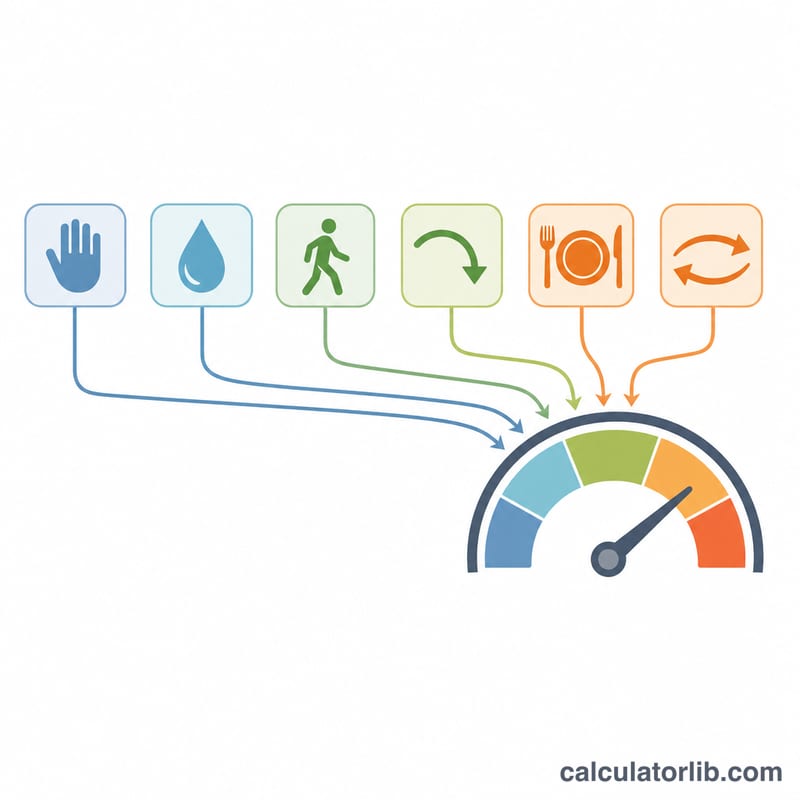
Score each of the six subscales by selecting the option that best describes the patient. Five subscales (sensory perception, moisture, activity, mobility, and nutrition) are scored 1–4, while friction and shear is scored 1–3. The calculator sums your selections to give the total Braden score and its corresponding risk category automatically.
The Formula Explained
The total is a simple sum: Braden = Sensory + Moisture + Activity + Mobility + Nutrition + Friction/Shear.
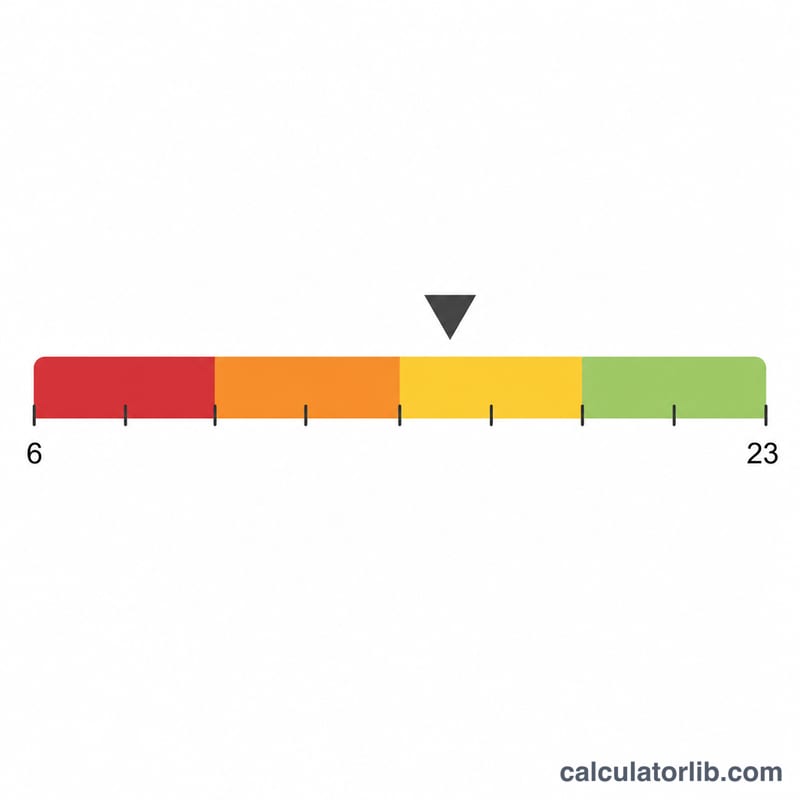
$$\text{Score} = \text{Sensory} + \text{Moisture} + \text{Activity} + \text{Mobility} + \text{Nutrition} + \text{Friction \& Shear}$$The minimum possible score is 6 (all worst values) and the maximum is 23. Common risk thresholds are: ≤9 very high risk, 10–12 high risk, 13–14 moderate risk, 15–18 mild risk, and 19–23 little to no risk.
Worked Example
A patient scores Sensory 3, Moisture 2, Activity 2, Mobility 2, Nutrition 3, and Friction/Shear 2. The total is
$$3 + 2 + 2 + 2 + 3 + 2 = 14$$placing them in the Moderate Risk category, which warrants a structured prevention plan.
Braden Subscale Scoring Criteria
The Braden Scale for Predicting Pressure Sore Risk assesses six subscales. Five subscales (Sensory Perception, Moisture, Activity, Mobility, and Nutrition) are each scored from 1 to 4, while Friction & Shear is scored from 1 to 3. The total score is the sum of all six subscale scores: \(\text{Score} = \text{Sensory} + \text{Moisture} + \text{Activity} + \text{Mobility} + \text{Nutrition} + \text{Friction \& Shear}\), giving a possible range of 6 to 23.
| Subscale | 1 | 2 | 3 | 4 |
|---|---|---|---|---|
| Sensory Perception Ability to respond to pressure-related discomfort |
Completely limited — unresponsive to painful stimuli, or limited ability to feel pain over most of body | Very limited — responds only to painful stimuli; cannot communicate discomfort except by moaning/restlessness, or has sensory impairment over half the body | Slightly limited — responds to verbal commands but cannot always communicate discomfort, or some sensory impairment in 1–2 extremities | No impairment — responds to verbal commands; no sensory deficit limiting ability to feel or voice pain |
| Moisture Degree of skin exposure to moisture |
Constantly moist — skin kept moist almost constantly by perspiration, urine, etc.; dampness detected every time patient is moved | Very moist — skin often but not always moist; linen must be changed at least once per shift | Occasionally moist — skin occasionally moist; linen requires an extra change about once a day | Rarely moist — skin usually dry; linen changed only at routine intervals |
| Activity Degree of physical activity |
Bedfast — confined to bed | Chairfast — ability to walk severely limited or nonexistent; cannot bear own weight, must be assisted into chair | Walks occasionally — walks short distances during day with or without assistance; spends most of each shift in bed or chair | Walks frequently — walks outside the room at least twice a day and inside the room at least every 2 hours during waking hours |
| Mobility Ability to change and control body position |
Completely immobile — does not make even slight changes in body or extremity position without assistance | Very limited — makes occasional slight changes in body or extremity position but unable to make frequent or significant changes independently | Slightly limited — makes frequent though slight changes in body or extremity position independently | No limitation — makes major and frequent changes in position without assistance |
| Nutrition Usual food intake pattern |
Very poor — never eats a complete meal; rarely eats more than ⅓ of food offered; little protein intake; takes poorly or NPO/clear liquids/IV more than 5 days | Probably inadequate — rarely eats a complete meal; generally eats about ½ of food offered; occasionally takes a dietary supplement, or receives less than optimum tube/IV feeding | Adequate — eats over half of most meals; usually takes a supplement if offered, or is on tube feeding/TPN meeting most nutritional needs | Excellent — eats most of every meal; never refuses a meal; usually eats 4 or more servings of protein; does not require supplementation |
| Friction & Shear (scored 1–3 only) |
Problem — requires moderate to maximum assistance in moving; frequently slides down in bed/chair; spasticity, contractures, or agitation lead to almost constant friction | Potential problem — moves feebly or requires minimum assistance; skin probably slides to some extent during movement; maintains relatively good position most of the time | No apparent problem — moves in bed and chair independently with sufficient muscle strength to lift up completely during a move; maintains good position at all times | — |
Interpreting Your Braden Score
The total Braden score ranges from 6 (highest risk) to 23 (lowest risk). Lower scores indicate greater risk of developing a pressure ulcer because they reflect greater limitation across the contributing subscales. The widely cited risk categories below come from the work of Braden and Bergstrom and are used as an established framework, not as individualized medical advice. For example, a fully dependent bedfast patient who scores Sensory 2, Moisture 2, Activity 1, Mobility 1, Nutrition 2, and Friction & Shear 1 has a total Braden score of 9, placing them in the very high risk category.
| Total Score | Risk Category | Clinical indication & typical preventive focus |
|---|---|---|
| ≤ 9 | Very high risk | Profound limitations across most subscales. Standard practice emphasizes aggressive prevention: a pressure-redistributing support surface, frequent and documented repositioning (often every 2 hours or per protocol), meticulous moisture and skin management, nutritional support, and protection of heels and bony prominences. |
| 10–12 | High risk | Substantial risk warranting a structured prevention plan: pressure-redistribution surfaces, a written turning/repositioning schedule, foam wedges for positioning at no more than 30°, and management of moisture and friction/shear. |
| 13–14 | Moderate risk | Intermediate risk requiring routine preventive measures: regular repositioning, attention to nutrition and hydration, moisture control, and protection of heels, with reassessment as the patient's condition changes. |
| 15–18 | Mild (low) risk | Lower but non-negligible risk. Preventive attention typically focuses on basic skin care, encouraging mobility and activity, managing incontinence/moisture, and reassessing whenever clinical status changes. Risk may be elevated by other factors such as advanced age, fever, or poor perfusion. |
| 19–23 | No risk / minimal | Minimal pressure-ulcer risk under the Braden framework. General skin-health practices and routine reassessment are generally considered sufficient unless the patient's condition deteriorates. |
Reassessment frequency depends on the care setting (commonly on admission and then at regular intervals or with any change in condition). The Braden Scale is a screening tool that supports, but does not replace, clinical judgment. This is general educational information and not a substitute for professional medical assessment.
FAQ
What score means high risk? Generally, a total of 18 or below indicates some risk, with scores of 12 or less considered high risk and 9 or less very high risk.
How often should the Braden Scale be assessed? Reassessment frequency depends on the care setting—often on admission and then daily or with any change in condition. Follow your facility's protocol.
Is this a substitute for clinical judgment? No. The Braden Scale supports, but does not replace, professional nursing assessment and individualized care planning.