
What Is the Glasgow Coma Scale?
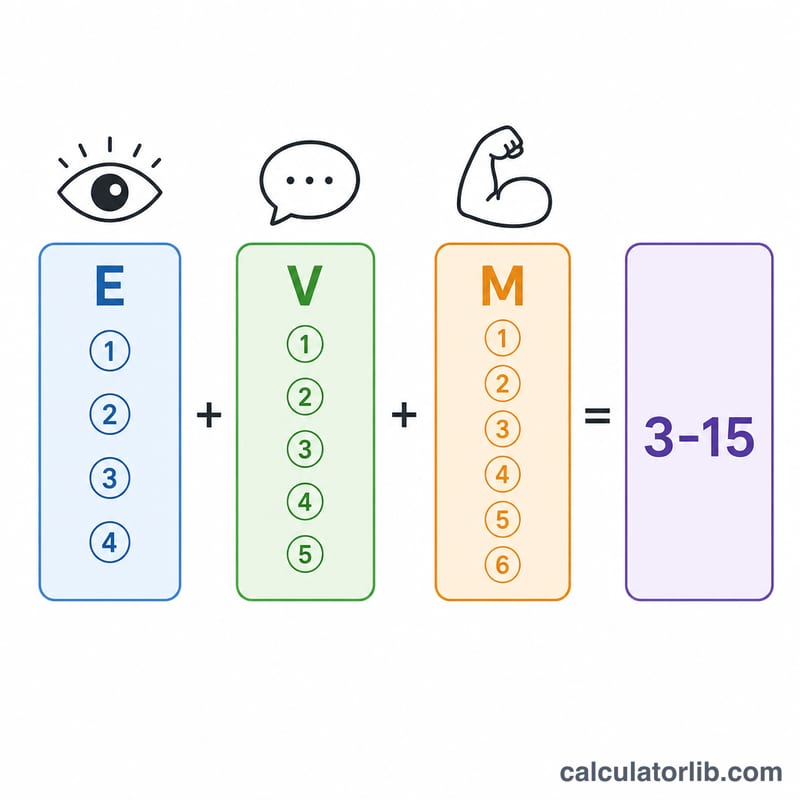
The Glasgow Coma Scale (GCS) is a standardized clinical tool used worldwide to assess a person's level of consciousness after a brain injury or acute illness. First described in 1974, it grades three independent responses — eye opening, verbal response, and motor response — and sums them into a single number between 3 and 15. A higher score reflects greater awareness; a lower score indicates deeper impairment of consciousness.
How to Use This Calculator
Select the best observed response for each of the three categories. Eye opening is scored from 1 to 4, verbal response from 1 to 5, and motor response from 1 to 6. The calculator adds the three values together and returns the total along with a severity band. Always record the score by component (for example E3 V4 M5 = GCS 12) rather than the total alone, since the breakdown carries important clinical detail.
The Formula Explained
The score is simply the sum of three sub-scores:
$$\text{GCS} = \text{Eye (1-4)} + \text{Verbal (1-5)} + \text{Motor (1-6)}$$
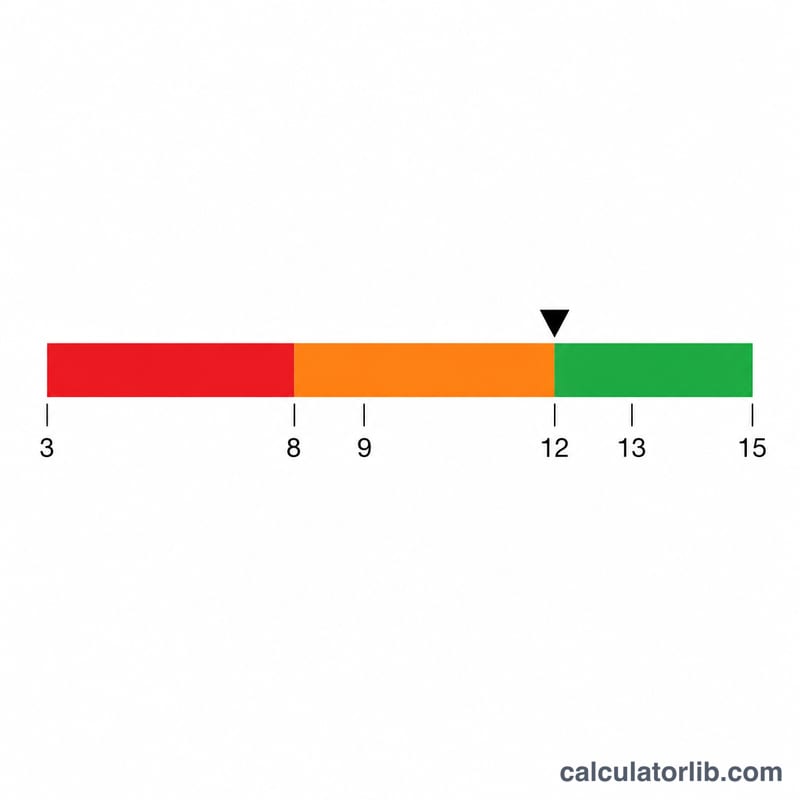
The minimum possible total is 3 (no response in any category — a patient is never scored 0), and the maximum is 15 (fully responsive). Scores are grouped as Mild (13–15), Moderate (9–12), and Severe (3–8).
Worked Example
A patient opens their eyes to speech (E3), is confused when talking (V4), and localizes to a painful stimulus (M5). The total is $$3 + 4 + 5 = \mathbf{12}$$ which falls in the Moderate range.
FAQ
Why is the lowest score 3, not 0? Each category has a minimum of 1 (no response), so the floor is \(1 + 1 + 1 = 3\).
What score indicates a coma? A GCS of 8 or less is commonly used as the threshold for severe injury and often prompts consideration of airway protection.
Is this a diagnosis? No. The GCS is an assessment aid and does not replace evaluation by a qualified clinician.