
What is the Wells Score for DVT?
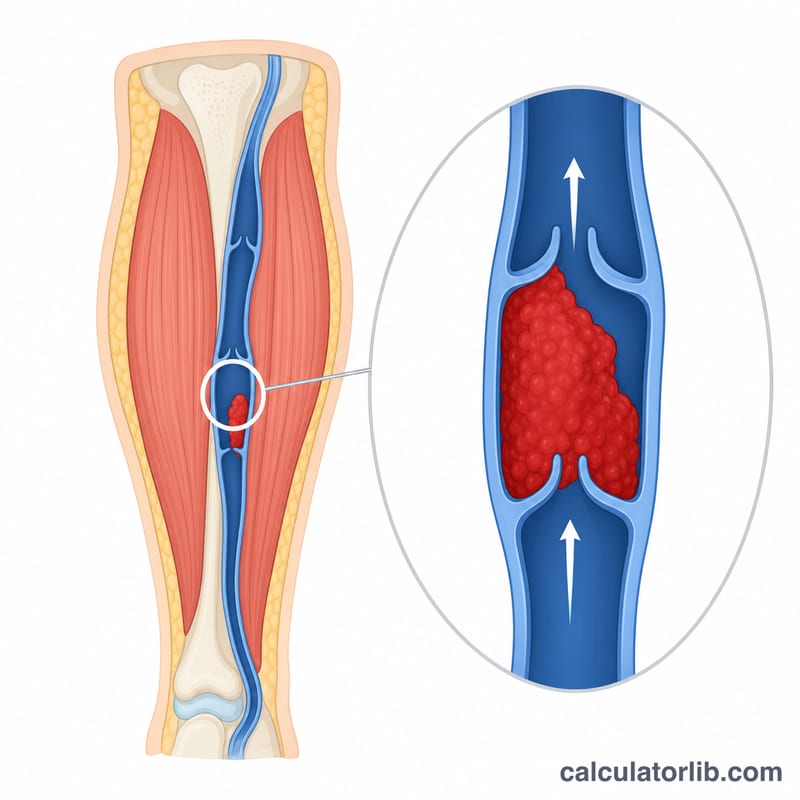
The Wells Score for deep vein thrombosis (DVT) is a validated clinical prediction rule that estimates the pretest probability that a patient with leg symptoms has a DVT. By scoring nine positive clinical features and subtracting points when an alternative diagnosis is equally likely, clinicians can decide whether to proceed directly to compression ultrasound or to first use a D-dimer test. This tool implements the widely used three-tier (low/moderate/high) version of the rule.
How to use this calculator
Tick each clinical criterion that applies to your patient. Each positive feature contributes +1 point, while "alternative diagnosis at least as likely as DVT" subtracts 2 points. The calculator instantly totals the points and maps the result to a risk category and an approximate DVT prevalence.
The formula explained
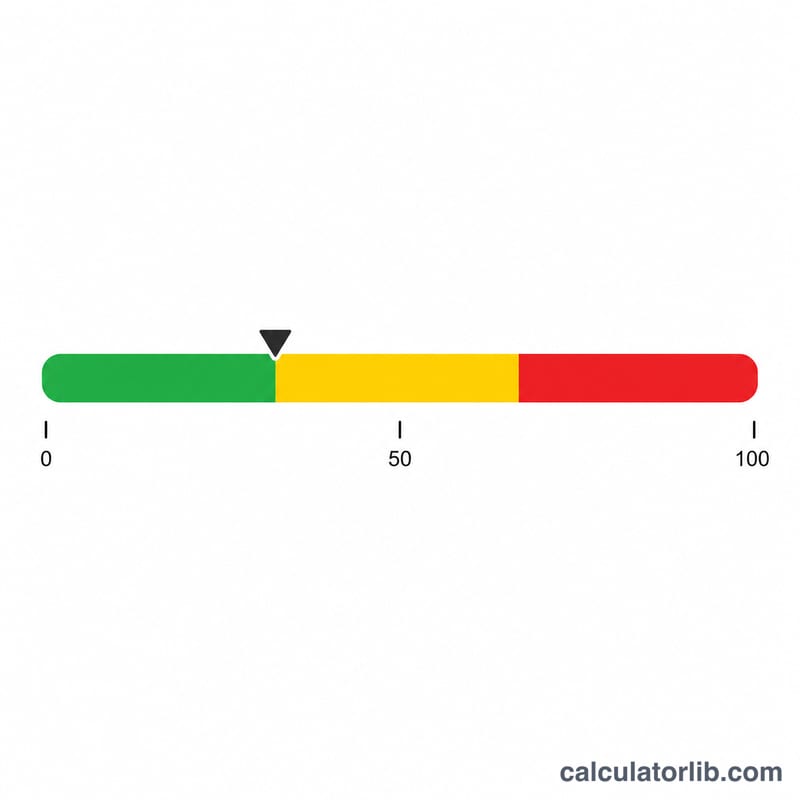
$$\text{Score} = \text{Cancer} + \text{Paralysis} + \text{Bedridden} + \text{Tenderness} + \text{Leg Swollen} + \text{Calf Swelling} + \text{Edema} + \text{Collateral Veins} + \text{Prior DVT} - 2\cdot\text{Alt. Diagnosis}$$ The included items are active cancer, paralysis/immobilization, recent bedridden/surgery, deep-vein tenderness, whole-leg swelling, calf swelling \(\geq 3\) cm, pitting edema, collateral superficial veins, and prior documented DVT — each +1 — minus 2 if an alternative diagnosis is at least as likely. Stratification: a total below 1 is low risk (~5% DVT), 1–2 is moderate (~17%), and 3 or more is high (~53%).
Worked example
A patient has active cancer (+1), localized deep-vein tenderness (+1), and entire-leg swelling (+1), with no alternative diagnosis. $$\text{Total} = 1 + 1 + 1 = 3 \text{ points} \rightarrow \text{High risk}$$ approximately 53% prevalence of DVT. This patient warrants compression ultrasound imaging.
FAQ
Is there a two-tier version? Yes. A dichotomized model classifies "DVT likely" (\(\geq 2\)) versus "DVT unlikely" (\(\leq 1\)); this calculator uses the original three-tier model.
Can the score be negative? Yes — selecting only "alternative diagnosis as likely" gives \(-2\), which still falls in the low-risk category.
Does a low score rule out DVT? Not alone. A low or unlikely score is typically combined with a negative D-dimer to safely exclude DVT. This tool is for education and clinical support, not a substitute for clinical judgment.