
What is the CURB-65 score?
CURB-65 is a clinical prediction tool used to assess the severity of community-acquired pneumonia (CAP) and guide decisions about whether a patient can be managed at home, on a general ward, or needs intensive care. It was derived from the British Thoracic Society research and is widely used internationally. This calculator is a decision-support aid and does not replace clinical judgment.
How to use it
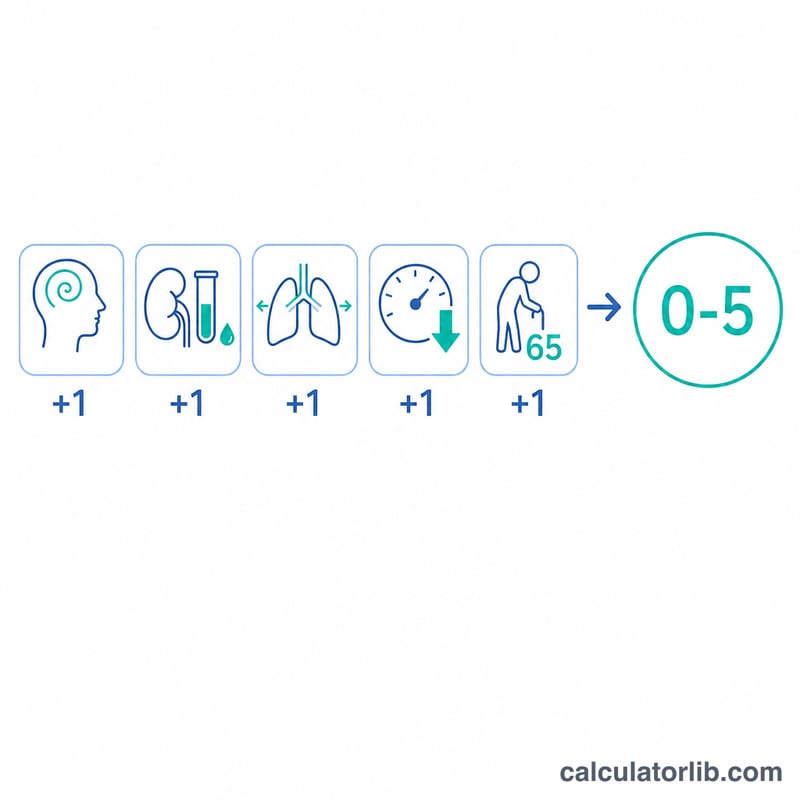
Answer Yes or No to each of the five criteria. Each "Yes" adds one point. The total ranges from 0 to 5. The calculator returns the score, the estimated 30-day mortality, a risk category, and a suggested disposition.
The five criteria explained
C – Confusion of new onset (or Abbreviated Mental Test score ≤ 8). U – blood Urea nitrogen greater than 7 mmol/L (about 19 mg/dL). R – Respiratory rate of 30 breaths per minute or more. B – low Blood pressure (systolic < 90 mmHg or diastolic ≤ 60 mmHg). 65 – Age 65 years or older. The score is simply the sum of points: $$\text{Score} = \text{C} + \text{U} + \text{R} + \text{B} + 65$$
Worked example
An 80-year-old patient (1 point for age) presents with new confusion (1 point) and a respiratory rate of 32 (1 point). Urea is normal and blood pressure is fine. $$\text{Score} = 1 + 0 + 1 + 0 + 1 = 3$$ A score of 3 indicates high risk with roughly 14% 30-day mortality, so hospital admission and assessment for intensive care are recommended.
FAQ
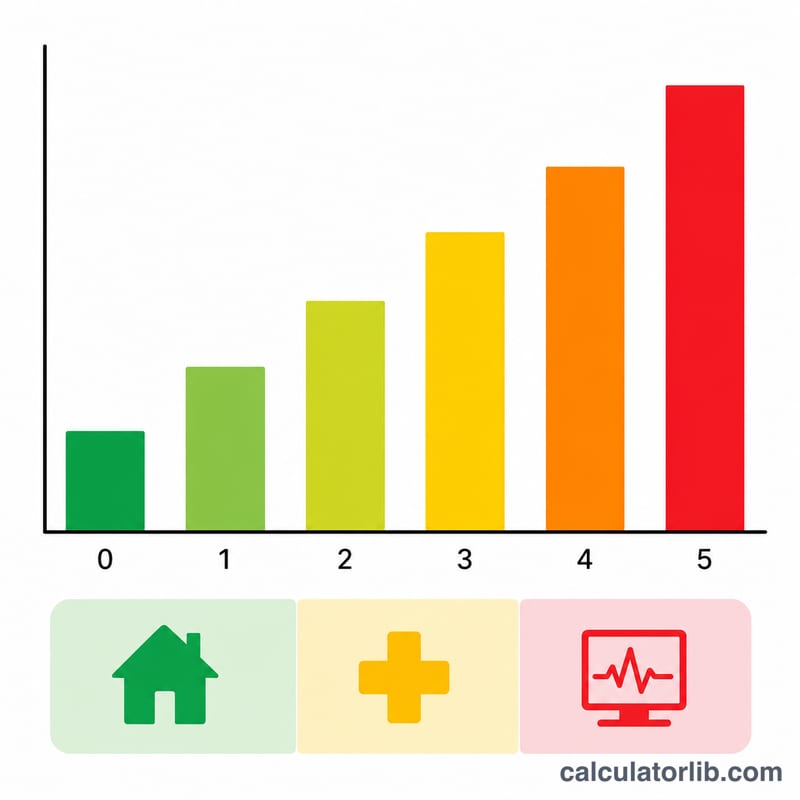
What do the scores mean? 0–1: low risk (~0.6–2.7% mortality), consider outpatient care. 2: intermediate risk (~6.8%), consider a short hospital stay. 3–5: high risk (14–28%), hospitalize and assess for ICU.
Is CURB-65 the same as CRB-65? CRB-65 drops the urea (blood test) criterion, making it usable in primary care without labs; the maximum score is 4.
Does a low score guarantee safety? No. Always combine the score with clinical judgment, social circumstances, oxygen saturation, and comorbidities.