
What is the AUDIT-C?
The AUDIT-C (Alcohol Use Disorders Identification Test – Consumption) is a brief, validated three-question screening tool used worldwide to identify people who may be drinking at hazardous or harmful levels. It is the consumption-focused short form of the full 10-item AUDIT developed by the World Health Organization. This calculator is intended for general educational screening only and does not replace professional medical advice or diagnosis.
How to use this calculator
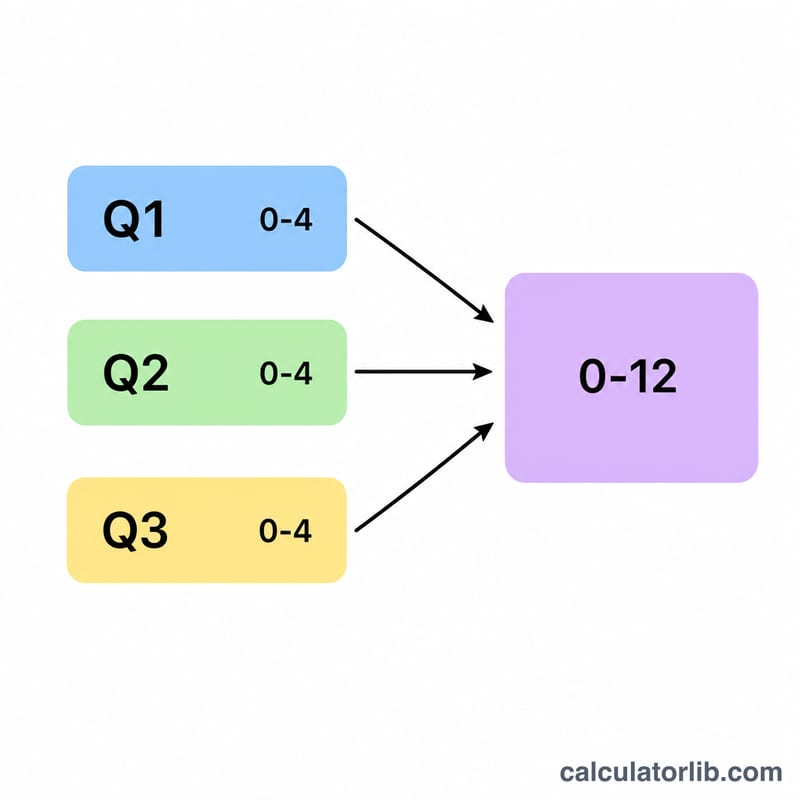
Answer all three questions about how often you drink, how much you typically drink on a drinking day, and how often you have six or more drinks on one occasion. Each answer is worth 0 to 4 points. Select your sex, since the recommended risk threshold differs. The calculator adds the three answers to give a total from 0 to 12 and tells you whether your result is a positive screen.
The formula explained
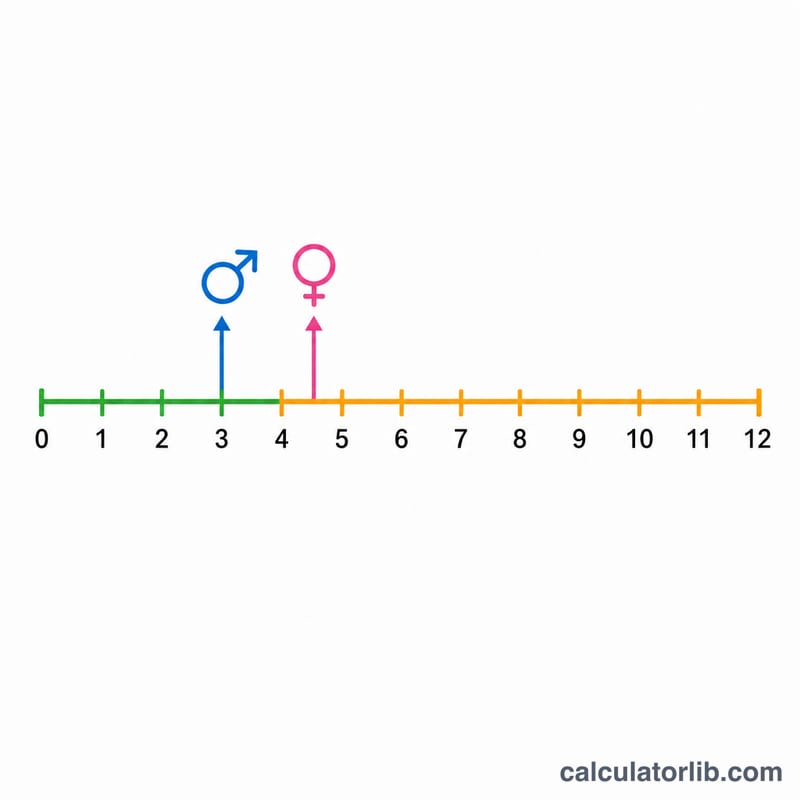
The score is simply the sum of the three items: $$\text{Score} = \text{Q1} + \text{Q2} + \text{Q3}$$ Because each item ranges from 0 to 4, the minimum is 0 and the maximum is 12. A higher score indicates a greater likelihood of hazardous drinking or an active alcohol use disorder. A commonly used cutoff is a score of 4 or more for men and 3 or more for women to flag a positive screen that warrants further assessment.
Worked example
Suppose a man answers "2–3 times a week" (3) to question 1, "3 or 4 drinks" (1) to question 2, and "Monthly" (2) to question 3. His total is $$3 + 1 + 2 = 6$$ Because \(6\) is greater than the male threshold of \(4\), this is a positive screen, suggesting he should discuss his drinking with a clinician.
AUDIT-C Scoring Key for Each Question
The AUDIT-C consists of three questions. Each answer is worth 0 to 4 points, and the three point values are summed to produce a total score from 0 to 12. Use the table below to find the point value of each answer.
| Answer option | Points |
|---|---|
| Q1 — How often do you have a drink containing alcohol? | |
| Never | 0 |
| Monthly or less | 1 |
| 2–4 times a month | 2 |
| 2–3 times a week | 3 |
| 4 or more times a week | 4 |
| Q2 — How many standard drinks on a typical day when you are drinking? | |
| 1 or 2 | 0 |
| 3 or 4 | 1 |
| 5 or 6 | 2 |
| 7 to 9 | 3 |
| 10 or more | 4 |
| Q3 — How often do you have 6 or more drinks on one occasion? | |
| Never | 0 |
| Less than monthly | 1 |
| Monthly | 2 |
| Weekly | 3 |
| Daily or almost daily | 4 |
For example, someone who drinks 2–3 times a week (Q1 = 3), typically has 3–4 drinks (Q2 = 1), and has 6+ drinks less than monthly (Q3 = 1) scores a total of 5.
Interpreting Your AUDIT-C Score
The AUDIT-C total ranges from 0 (no reported alcohol use) to 12 (the highest reported frequency and quantity on every item). A higher score corresponds to a greater likelihood of hazardous or harmful drinking. A screen is considered positive at a score of 4 or more for men and 3 or more for women.
- 0 — No alcohol use reported.
- 1–2 — Low-level drinking; below the screening cutoff for both sexes.
- 3 — Positive screen for women; below cutoff but worth noting for men.
- 4–6 — Positive screen for both sexes, consistent with hazardous drinking patterns.
- 7–12 — High score associated with a substantially greater probability of active alcohol use disorder and of more frequent heavy drinking.
A higher total reflects more frequent drinking, larger amounts per occasion, and more frequent heavy-drinking days. The AUDIT-C is a screening tool, not a diagnosis: a positive result indicates that further assessment may be warranted, while a negative result does not rule out alcohol-related risk. This page provides general information and is not a substitute for professional medical evaluation or advice.
AUDIT-C Risk Cutoffs by Sex
The AUDIT-C was developed and validated from the full 10-item Alcohol Use Disorders Identification Test (AUDIT) as a brief screen for hazardous drinking and active alcohol use disorder. Validation studies (Bush et al., 1998; Bradley et al., 2007) established sex-specific positive thresholds because typical drinking patterns differ between men and women.
| Group | Score range | Standard positive cutoff | Higher-specificity cutoff |
|---|---|---|---|
| Men | 0–12 | ≥ 4 | ≥ 5 |
| Women | 0–12 | ≥ 3 | ≥ 4 |
At the standard cutoffs (≥4 for men, ≥3 for women), the AUDIT-C has high sensitivity for detecting hazardous drinking and alcohol use disorders. Some guidelines and clinical settings adopt the higher cutoffs (≥5 for men, ≥4 for women) to improve specificity — that is, to reduce false-positive screens — at the cost of missing some lower-level hazardous drinkers. The choice of threshold depends on whether the goal is broad case-finding or more targeted identification.
FAQ
Is a positive screen a diagnosis? No. It indicates an elevated risk and that a fuller assessment may be helpful, not that you have an alcohol use disorder.
What counts as a standard drink? Definitions vary by country, but a standard drink is roughly 14 grams of pure alcohol in the US (e.g., a 12 oz beer, 5 oz wine, or 1.5 oz spirits).
Why is the threshold lower for women? On average women reach harmful blood-alcohol levels at lower intake due to body composition, so a lower cutoff improves screening sensitivity.