
What is the Tire Pressure Temperature Calculator?
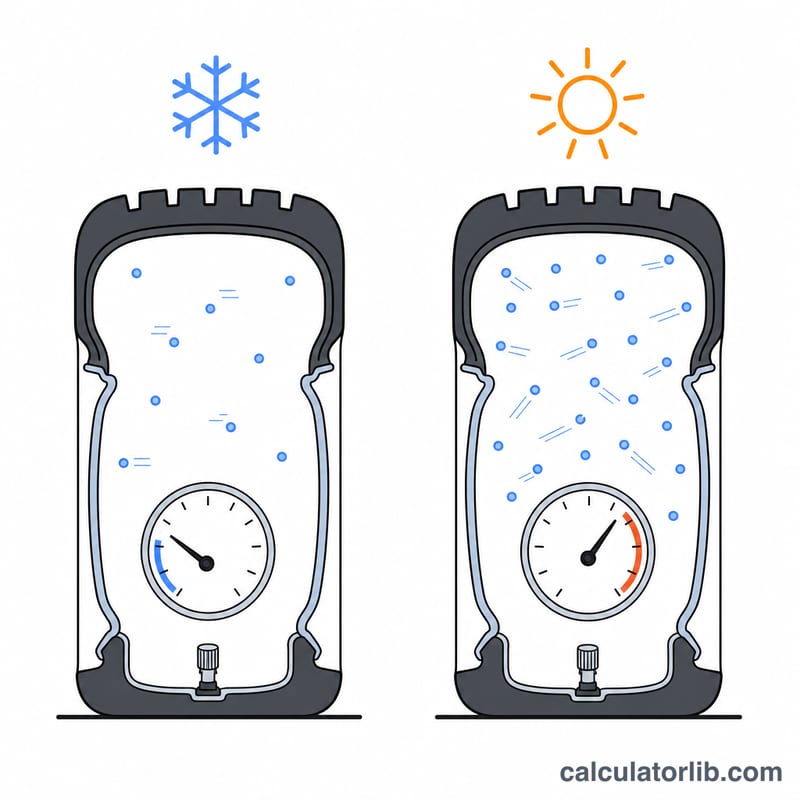
Tire pressure isn't fixed — it rises and falls with the air temperature inside the tire. This calculator estimates how your gauge pressure (in PSI) will change when the temperature changes, using the ideal gas law. It's useful for understanding why your tire pressure warning light comes on during a cold morning, or why pressure climbs after highway driving heats the tires.
How to use it
Enter your current tire pressure as read on a standard gauge, the temperature at which you measured it, and the new temperature you want to predict for. The calculator returns the expected gauge pressure at the new temperature and the total change in PSI.
The formula explained
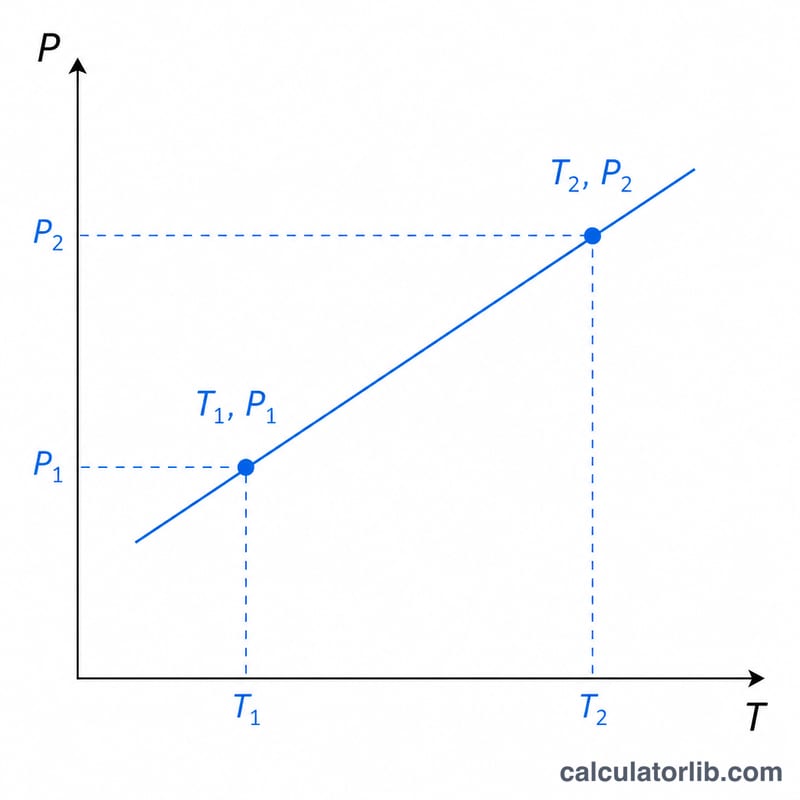
A gauge reads pressure above atmospheric pressure (about 14.7 PSI at sea level). The ideal gas law applies to absolute pressure and absolute temperature (Kelvin). So we add 14.7 to convert gauge to absolute, scale by the ratio of absolute temperatures (°C + 273.15), then subtract 14.7 to convert back to gauge:
$$P_2 = \left(\text{P}_1 + 14.7\right) \cdot \frac{\text{T}_2 + 273.15}{\text{T}_1 + 273.15} - 14.7$$
Worked example
Suppose your tires read 32 PSI at 20 °C and the temperature drops to 0 °C overnight. Absolute pressure is \(32 + 14.7 = 46.7\) PSI. The temperature ratio is $$\frac{0 + 273.15}{20 + 273.15} = \frac{273.15}{293.15} \approx 0.93178.$$ So \(46.7 \times 0.93178 \approx 43.515\), minus 14.7 gives about 28.82 gauge PSI — a drop of roughly 3.2 PSI. A rough rule of thumb is about 1 PSI per 5.5 °C (10 °F).
FAQ
Why does cold weather lower my tire pressure? Cooler air molecules move slower and exert less pressure, so the gauge reading falls even though no air has escaped.
Should I inflate to spec when tires are hot or cold? Manufacturer pressures are "cold" specs — measure before driving or after the car has sat for several hours.
Is this exact? It's a close approximation. Real tires also change volume slightly and atmospheric pressure varies with altitude, so treat the result as a reliable estimate.