
What Is the Pressure Calculator?
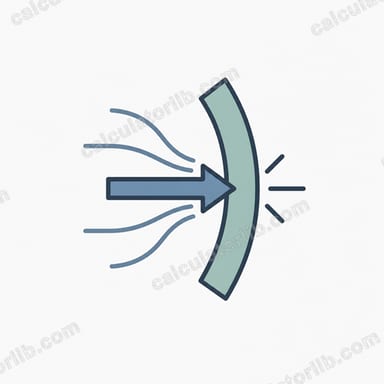
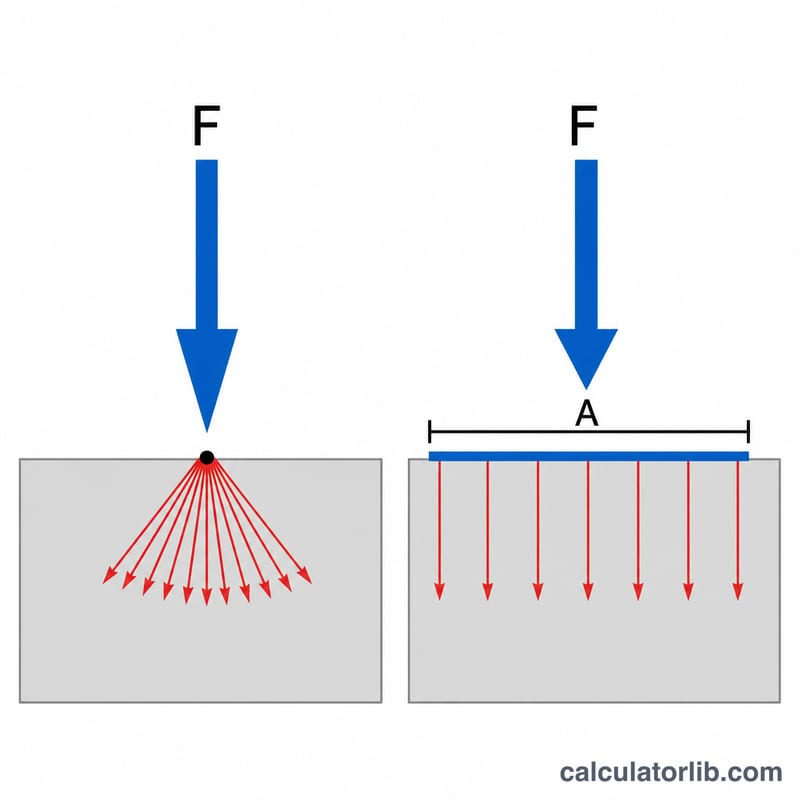
The Pressure Calculator works out the pressure exerted when a force is applied over a surface area. Pressure is one of the most fundamental quantities in physics and engineering, describing how concentrated a force is. The same force spread over a large area produces low pressure, while the same force focused on a tiny area produces very high pressure — which is why a sharp knife cuts so easily.
How to Use It
Enter the force in newtons (N) and the area in square metres (m²). The calculator returns the pressure in pascals (Pa), the SI unit, and automatically converts it to kilopascals, bar, and pounds per square inch (psi) so you can compare against common engineering references.
The Formula Explained
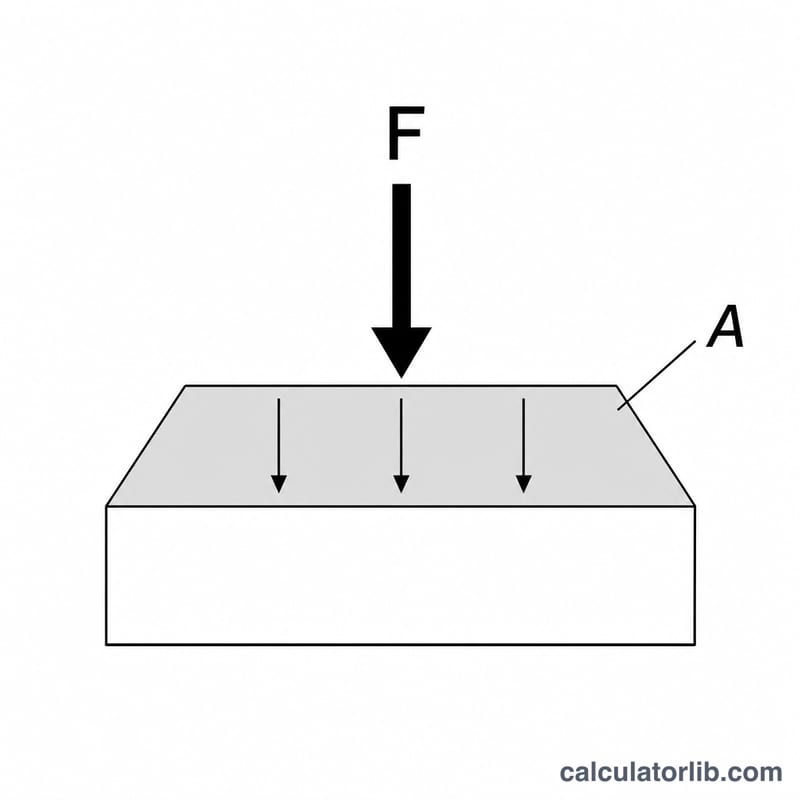
Pressure is defined by the equation:
$$P = \frac{F}{A}$$
where \(P\) is pressure (Pa), \(F\) is the perpendicular force (N), and \(A\) is the area (m²). One pascal equals one newton per square metre. Because pressure scales inversely with area, halving the area doubles the pressure for the same force.
Worked Example
Suppose a 500 N force is applied over an area of 0.25 m². Then $$P = \frac{500}{0.25} = 2000 \text{ Pa}.$$ That is 2 kPa, 0.02 bar, or about 0.29 psi. If the same force were applied over just 0.01 m², the pressure would jump to 50,000 Pa (50 kPa).
FAQ
What units does this use? Inputs are SI units — newtons for force and square metres for area — producing pressure in pascals, with conversions to kPa, bar, and psi.
What if my area is zero? Division by zero is undefined, so a zero area returns a zero result. Always enter a positive area.
How do I convert to atmospheres? One standard atmosphere is 101,325 Pa, so divide your pascal result by 101,325 to get atmospheres.