
What Is Pressure Head?
Pressure head is the height of a fluid column that a given pressure can support. It is a key concept in fluid mechanics and hydraulics, expressing pressure in convenient units of length (meters or feet of fluid) rather than pascals. It appears in Bernoulli's equation, pump sizing, and the analysis of water distribution networks.
How to Use This Calculator
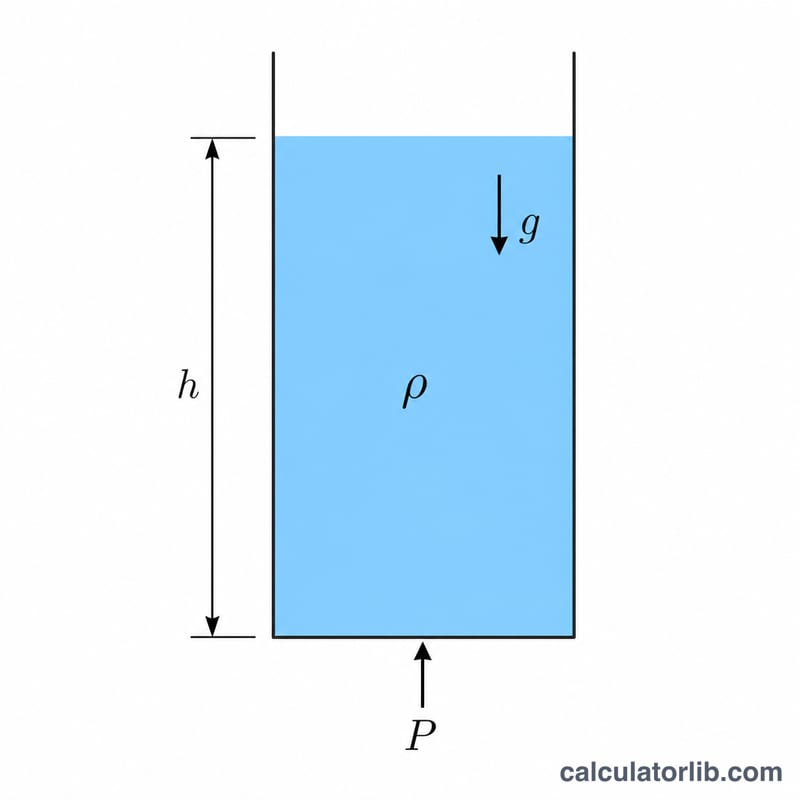
Enter the pressure P in pascals, the fluid density \(\rho\) in kilograms per cubic meter, and the gravitational acceleration g in meters per second squared (about 9.81 m/s² on Earth). The calculator returns the pressure head in meters of that fluid column. For water, \(\rho \approx 1000 \text{ kg/m}^3\); for mercury, \(\rho \approx 13{,}595 \text{ kg/m}^3\).
The Formula Explained
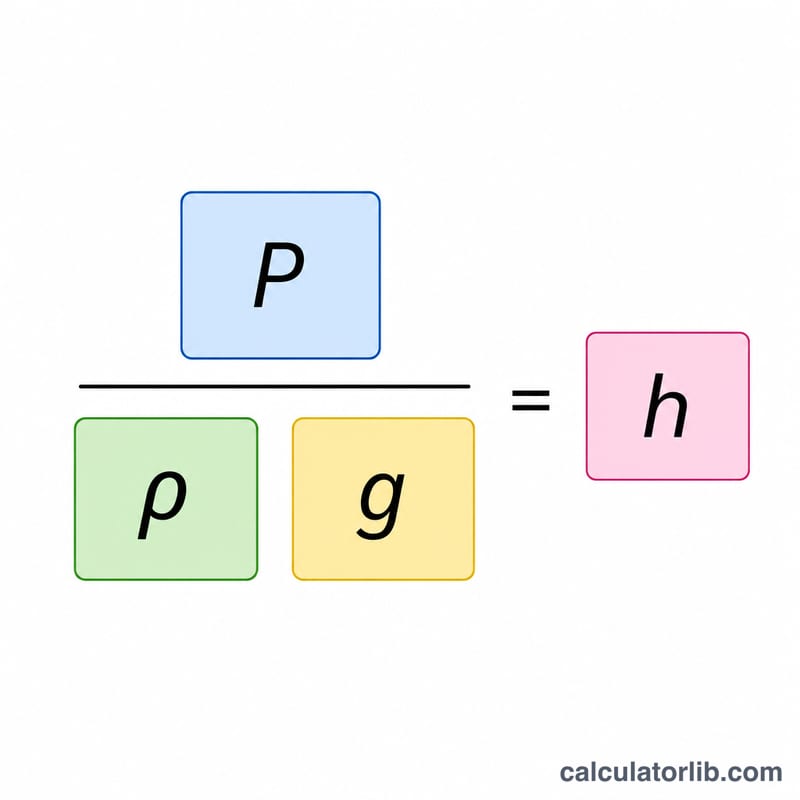
The relationship comes from the hydrostatic pressure equation \(P = \rho g h\). Solving for height gives:
$$h = \frac{P}{\rho \cdot g}$$Here P is gauge or absolute pressure, \(\rho\) is the fluid density, and g is gravitational acceleration. A denser fluid produces a shorter column for the same pressure, which is why mercury barometers are far shorter than equivalent water columns.
Worked Example
Suppose a pressure of 101,325 Pa (one standard atmosphere) acts on water with density 1000 kg/m³ and g = 9.81 m/s². Then:
$$h = \frac{101325}{1000 \times 9.81} = \frac{101325}{9810} \approx 10.329 \text{ m}$$So one atmosphere supports roughly a 10.3-meter column of water — consistent with the limit on suction-lift pumps.
FAQ
Should I use gauge or absolute pressure? Use whichever your problem requires; gauge pressure gives head relative to atmosphere, absolute pressure gives head relative to a perfect vacuum.
What gravity value should I use? Standard Earth gravity is 9.81 m/s²; adjust for other locations or planets if needed.
Can I use other units? The formula is unit-consistent in SI. If you input pressure in Pa, density in kg/m³ and g in m/s², the head comes out in meters.