
What Is Hydraulic Horsepower?
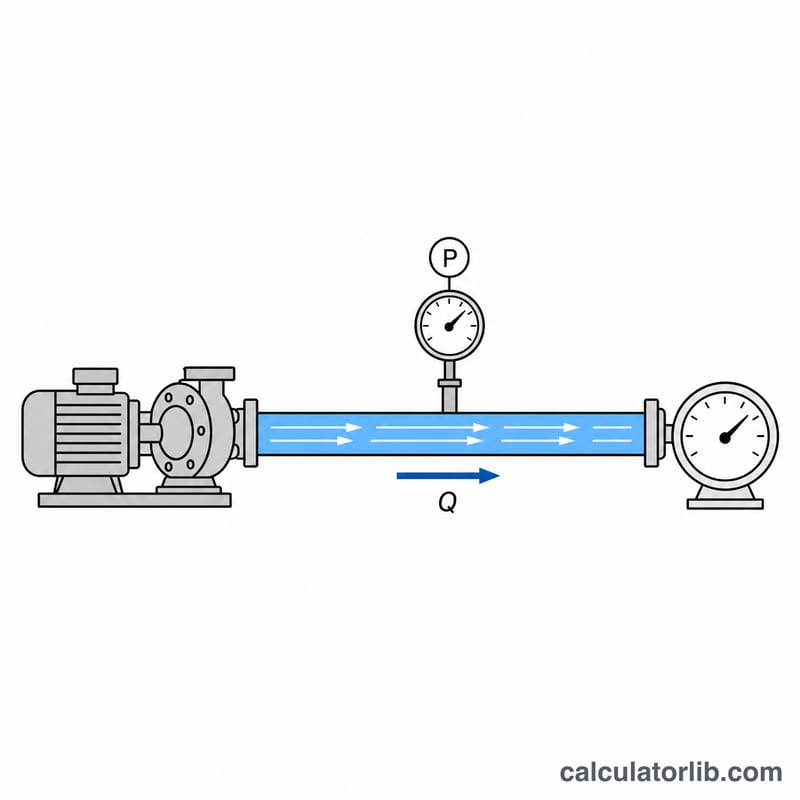
Hydraulic horsepower (HHP) is the mechanical power carried by a flowing pressurized fluid. It tells you how much useful power a pump must deliver to push a given flow rate against a given pressure. Engineers use it to size pumps, motors, and hydraulic systems for machinery, presses, and industrial equipment.
How to Use This Calculator
Enter the flow rate in gallons per minute (GPM) and the system pressure in pounds per square inch (PSI). The calculator instantly returns the hydraulic horsepower, plus the equivalent power in watts. Note these are US customary units; for metric inputs convert to GPM and PSI first.
The Formula Explained
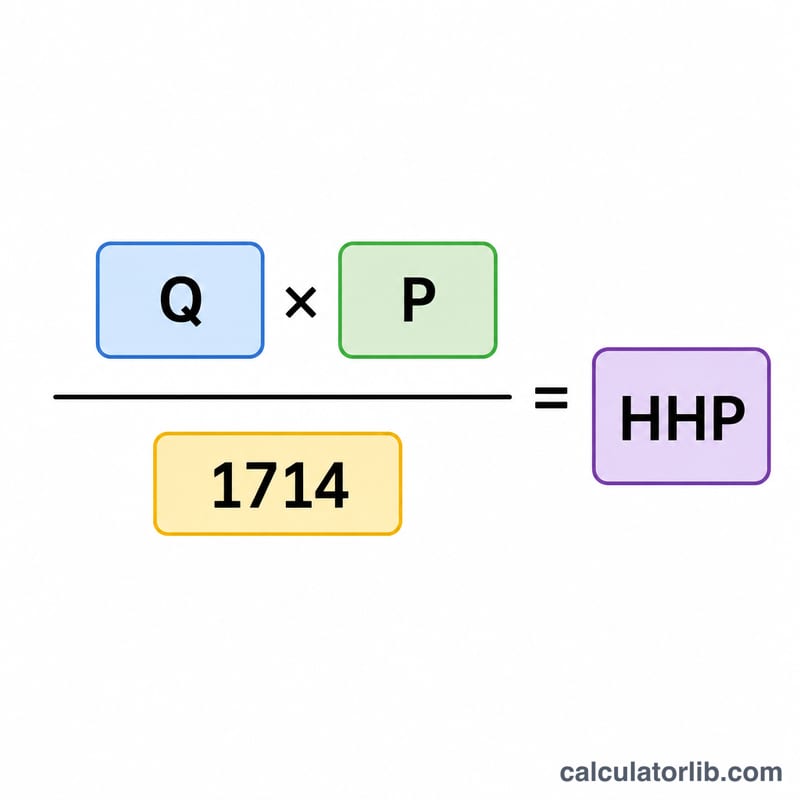
The governing equation is $$\text{HHP} = \frac{\text{Q} \times \text{P}}{1714}$$ where Q is flow in GPM and P is pressure in PSI. The magic number 1714 is a unit-conversion constant: 1 horsepower equals 33,000 ft\(\cdot\)lbf/min, and converting gallons and PSI into those units yields 1714. The result is the ideal (theoretical) power — actual input power is higher because pumps are not 100% efficient. Divide HHP by the pump efficiency (e.g. \(0.85\)) to estimate required brake horsepower.
Worked Example
Suppose a pump moves 10 GPM at 2000 PSI. Then $$\text{HHP} = \frac{10 \times 2000}{1714} = \frac{20000}{1714} \approx 11.67 \text{ HP}$$ In watts that's about \(11.67 \times 745.7 \approx 8700 \text{ W}\).
FAQ
Is this the same as the pump's motor power? No. This is the theoretical fluid power. The electric motor must supply more because of pump and drive inefficiencies.
What if I have liters per minute and bar? Convert first: \(1 \text{ L/min} \approx 0.264 \text{ GPM}\) and \(1 \text{ bar} \approx 14.5 \text{ PSI}\), or use a metric hydraulic power formula.
Why 1714? It is the conversion factor that turns GPM \(\times\) PSI directly into horsepower under US units.