
What is hydraulic conductivity?
Hydraulic conductivity (K) measures how easily water moves through a porous medium such as soil, sand, gravel, or fractured rock. It is a key parameter in groundwater hydrology, geotechnical engineering, and environmental site assessment. A high K (e.g. clean gravel) lets water flow freely; a low K (e.g. clay) impedes flow. This calculator derives K from a constant-head permeameter test using Darcy's law.
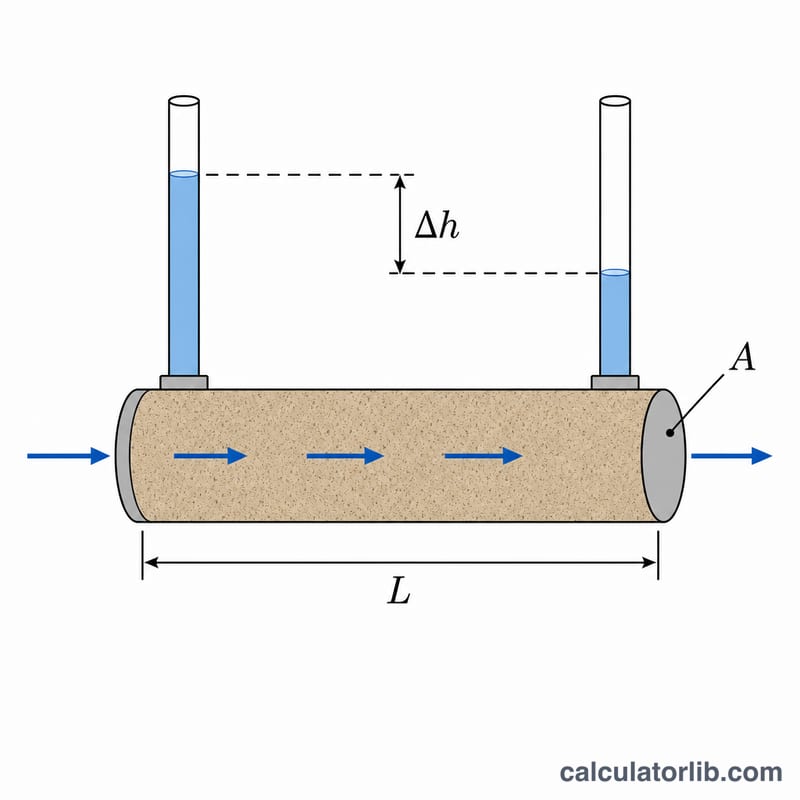
The formula
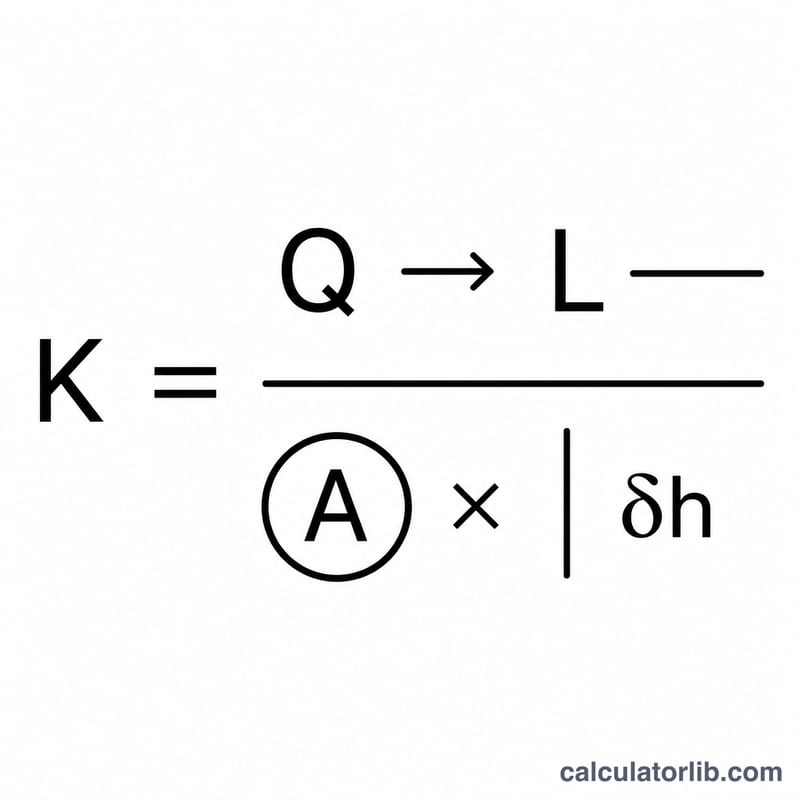
From Darcy's law, the hydraulic conductivity is:
$$K = \frac{Q \cdot L}{A \cdot \Delta h}$$
where \(Q\) is the volumetric flow rate (m³/s), \(L\) is the length of the soil sample along the flow path (m), \(A\) is the cross-sectional area perpendicular to flow (m²), and \(\Delta h\) is the head difference (the hydraulic head loss) across the sample (m). The result K has units of velocity (m/s).
How to use it
Enter the measured flow rate, the sample length, the cross-sectional area of the sample, and the head difference between the inlet and outlet. The calculator returns K in m/s and converts it to m/day for convenience. Make sure all inputs use consistent SI units.
Worked example
Suppose \(Q = 0.0001\) m³/s, \(L = 0.5\) m, \(A = 0.01\) m², and \(\Delta h = 1.0\) m. Then $$K = \frac{0.0001 \times 0.5}{0.01 \times 1.0} = \frac{0.00005}{0.01} = 0.005 \text{ m/s}.$$ Multiplying by 86,400 seconds per day gives 432 m/day — typical of a coarse sand.
FAQ
What units should I use? Use SI units throughout: m³/s for flow, meters for length, area, and head. K is then in m/s.
What is a typical K value? Gravel: \(10^{-2}\)–\(1\) m/s; sand: \(10^{-5}\)–\(10^{-2}\); silt: \(10^{-9}\)–\(10^{-5}\); clay: below \(10^{-9}\) m/s.
Is this the same as permeability? No. Intrinsic permeability depends only on the medium, while hydraulic conductivity also depends on the fluid's density and viscosity (i.e. on water properties).