
What Is the Hydraulic Gradient?
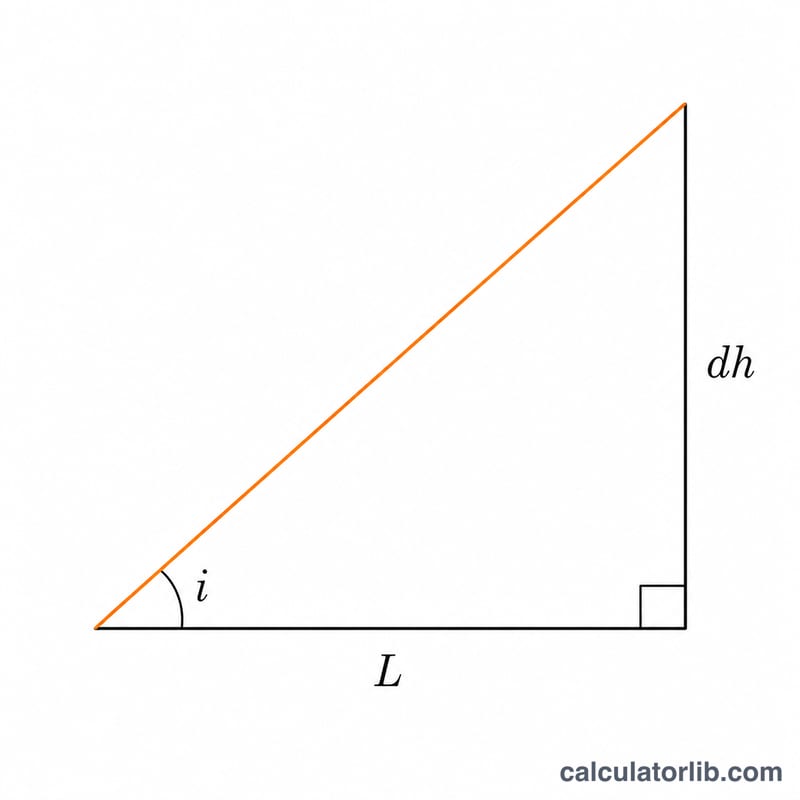
The hydraulic gradient (\(i\)) describes how steeply hydraulic head changes along the path that water travels. It is a core quantity in groundwater hydrology and seepage analysis, defined as the change in hydraulic head (head loss) divided by the distance over which that change occurs. Because it is a ratio of length to length, the hydraulic gradient is dimensionless.
How to Use This Calculator
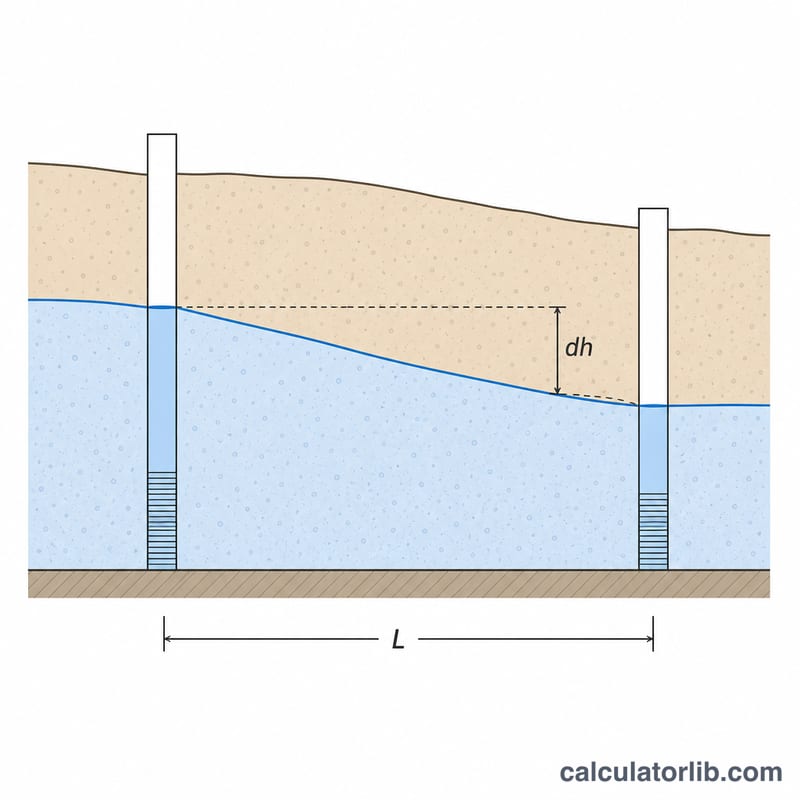
Enter the head loss dh (the difference in hydraulic head between two points, in metres) and the flow path length L (the distance between those points along the flow direction, in metres). The calculator returns the hydraulic gradient as a dimensionless ratio and also as a percentage. Keep both inputs in the same length unit; if you use feet for both, the gradient stays the same since the units cancel.
The Formula Explained
The relationship is $$i = \frac{\text{Head Loss (m)}}{\text{Flow Path Length (m)}}$$ A larger head loss over a short distance produces a steep gradient and faster flow, while the same head loss over a long distance gives a gentle gradient. Combined with Darcy's Law (\(q = K \cdot i\)), the gradient drives the calculation of groundwater discharge through a soil or aquifer of hydraulic conductivity \(K\).
Worked Example
Suppose two monitoring wells are 100 m apart and the water table drops 5 m between them. Then $$i = \frac{5}{100} = 0.05$$ or 5%. This means head decreases by 0.05 m for every metre travelled in the flow direction.
FAQ
Is the hydraulic gradient always less than 1? Not necessarily. In steep or highly disturbed settings the gradient can exceed 1, though in regional aquifers it is usually much smaller.
What units should I use? Any consistent length unit for both dh and L. The result is unitless because the units cancel.
Why does it matter? The gradient determines the direction and rate of groundwater flow and is essential for seepage, contaminant transport, and dewatering calculations.