
What is the Pump Power Calculator?
This calculator estimates the power required to drive a pump that moves a fluid against a given head. It computes both the hydraulic power (the useful energy delivered to the fluid) and the shaft power (the larger input power needed once pump efficiency losses are accounted for). It works for any fluid by letting you set the density, and uses SI units throughout.
How to use it
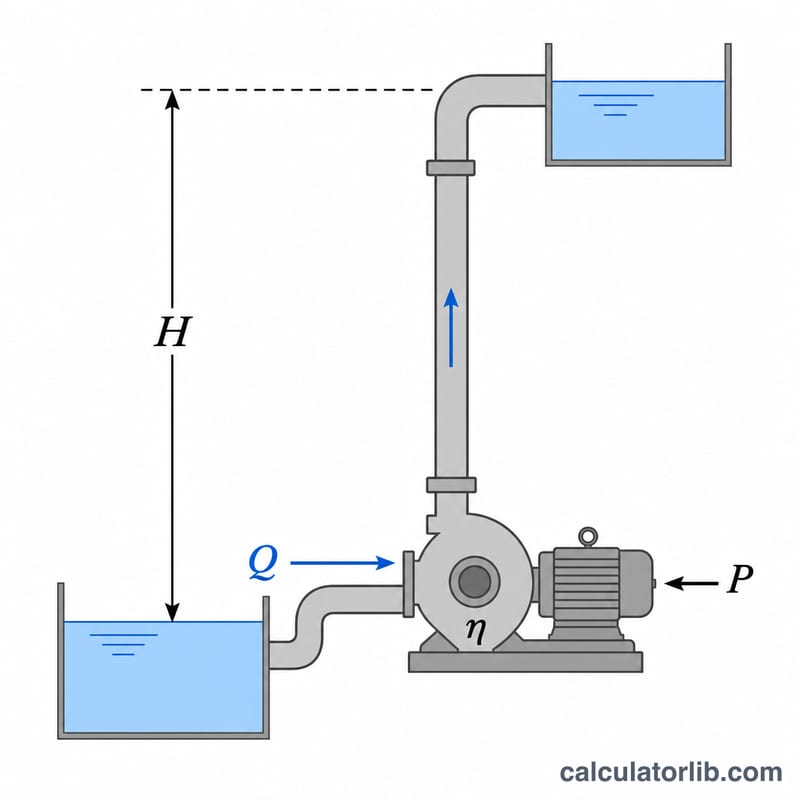
Enter the volumetric flow rate \(Q\) in cubic metres per second, the total head \(H\) in metres, the fluid density \(\rho\) (1000 kg/m³ for water), gravity \(g\) (9.81 m/s²), and the pump's overall efficiency \(\eta\) as a percentage. The tool returns shaft power in kilowatts, watts and horsepower, plus the underlying hydraulic power.
The formula explained
The hydraulic power is \(P_h = \rho \cdot g \cdot Q \cdot H\), where each term contributes the weight flow (\(\rho \cdot g \cdot Q\)) multiplied by the height it is lifted (\(H\)). Dividing by efficiency \(\eta\) gives the shaft power, because a real pump must absorb more power than it delivers:
$$P = \dfrac{\rho \cdot g \cdot Q \cdot H}{\eta}$$
Efficiency is entered as a percent and converted to a fraction internally.
Worked example
For water (\(\rho = 1000\ \text{kg/m}^3\), \(g = 9.81\)), \(Q = 0.05\ \text{m}^3\text{/s}\), \(H = 20\ \text{m}\) and \(\eta = 70\%\): hydraulic power =
$$1000 \times 9.81 \times 0.05 \times 20 = 9810\ \text{W} \approx 9.81\ \text{kW}$$
Shaft power =
$$\dfrac{9810}{0.70} = 14{,}014\ \text{W} \approx 14.01\ \text{kW}$$
or about 18.8 hp.
FAQ
What is "head"? Head is the equivalent height the pump must raise the fluid, including static lift plus friction losses, expressed in metres.
Why is shaft power higher than hydraulic power? Pumps are not 100% efficient — friction, leakage and turbulence consume extra power, so input shaft power always exceeds the useful hydraulic output.
Can I use it for liquids other than water? Yes — just change the density \(\rho\) to match your fluid (e.g. ~850 kg/m³ for oil).